Algeria
 Egypt
 Libya
 Morocco
 Sudan
 Tunisia
 Benin
 Burkina Faso
 Cabo Verde
 Côte d'Ivoire
 Ghana
 Guinea
 Guinea-Bissau
 Liberia
 Mali
 Mauritania
 Niger
 Senegal
 Sierra Leone
 The Gambia
 Togo
 Cameroon
 Central African Republic
 Chad
 DR Congo
 Equatorial Guinea
 Gabon
 Republic of the Congo
 São Tomé and Príncipe
 Burundi
 Comoros
 Djibouti
 Eritrea
 Ethiopia
 Kenya
 Madagascar
 Malawi
 Mauritius
 Mozambique
 Rwanda
 Seychelles
 Somalia
 South Sudan
 Tanzania
 Uganda
 Angola
 Botswana
 Eswatini
 Lesotho
 Namibia
 South Africa
 Zambia
 Zimbabwe
A race for reliable megawatts, not just assets
In Nigeria, the electricity question is not simply about producing more. Above all, it is about generating power predictably, paying plants on time and connecting that energy to a still-fragile grid. It is against this backdrop that a new Gulf-based player is entering Africa’s independent power generation scene, with a simple bet: finance assets already in service rather than relying solely on long-term, high-risk projects.
ePointZero, the energy arm of 2PointZero Group, announced on 31 August 2026 that it would acquire 90% of Azura Power Holdings. The deal is structured with Nigerian company Amaya Capital, which retains a 10% stake. The amount has not been disclosed and the transaction remains subject to the usual regulatory approvals.
This choice is far from incidental for the Nigerian market. The country has strengthened its legal framework with the Electricity Act 2023, while the Federal Ministry of Power and regulator NERC seek to clarify the roles of the federal government and states. Abuja is also pushing to decentralise the sector, signalling the emergence of a more open market, but without removing longstanding bottlenecks.
Azura, an African private power model backed by long-term contracts
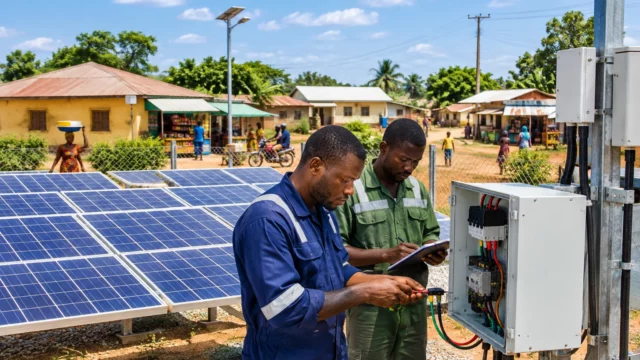
Azura Power is no newcomer. The group operates 752 megawatts in service or undergoing commissioning, spread across Nigeria, Senegal and Mozambique. Its portfolio includes Azura-Edo, a 461 MW gas-fired plant near Benin City; Tobene in Senegal, with 116 MW; and CTRG in Mozambique, with 175 MW. The group also says it has a further development pipeline of more than 1.3 gigawatts.
Azura-Edo is particularly important in Nigeria. The company describes the plant as the country’s first major project-financed IPP, with a long-term power purchase agreement signed with Nigerian Bulk Electricity Trading. It is precisely this kind of structure that reassures investors: cash flows are more predictable, revenues are contractual and market risk is partly cushioned by the guarantee framework.
This rationale explains ePointZero’s interest. The 31 August announcement presents Azura as a pan-African IPP platform with resilient cash flows and an experienced team. In other words, the Emirati group is not just buying turbines; it is buying an operational presence in several markets, with an industrial and regulatory base that has already been tested.
Azura’s history also highlights the decisive role of multilateral lenders and African investors. The Nigerian project has benefited from the support of institutions including the World Bank, IFC, British International Investment, the US DFC and the Dutch FMO. Africa50 was also involved in developing Azura. This mix of public, private and African capital illustrates the financing model the continent is using to get around the weakness of sovereign balance sheets.
What the acquisition changes for Nigeria, and what it says about the continent
The underlying issue remains the same: sub-Saharan Africa still accounts for most of the global electricity-access deficit, with more than 560 million people without power, according to the World Bank in June 2026. Data from the same institution show that the region still bears the greatest share of unmet needs. In this landscape, IPPs have become a key lever, as they can mobilise capital without directly increasing public debt.
Nigeria’s case is emblematic. The country has a large market, strong industrial demand and significant gas potential. But the power sector remains constrained by inadequate transmission, payment delays and institutional fragmentation. Recent reforms aim to address this, with no guarantee of quick results. For households, the stakes are tangible: more reliable power, and therefore less reliance on generators. For businesses, it is the difference between intermittent production and a planned operation.
Under the transaction, Amaya Capital retains 10% of Azura Power. This detail matters. It shows that African capital remains at the heart of the arrangement, even when the controlling shareholder comes from the Gulf. This configuration is becoming increasingly common: money, technology, guarantees and local knowledge flow between African, Middle Eastern and multilateral players, with Nigeria serving as a leading platform in West Africa.
The regional significance is clear. Azura already operates in Senegal and Mozambique, linking the deal to West and Southern Africa, beyond the Nigerian market alone. In the context of Mission 300, led by the World Bank and the African Development Bank to accelerate access to electricity across the continent, the entry of another major investor into a multinational platform is no isolated event. Rather, it signals a new contest for African power assets regarded as bankable, profitable and strategic.
The most practical question remains: will the sale simply change the shareholder, or will it accelerate installed capacity, new connections and greater grid reliability? That is where the deal’s real value for Abuja, Nigerian industries and, more broadly, African power markets still seeking a balance between energy sovereignty, private capital and universal access will be determined.