
 Algeria
 Egypt
 Libya
 Morocco
 Sudan
 Tunisia
 Benin
 Burkina Faso
 Cabo Verde
 Côte d'Ivoire
 Ghana
 Guinea
 Guinea-Bissau
 Liberia
 Mali
 Mauritania
 Niger
 Senegal
 Sierra Leone
 The Gambia
 Togo
 Cameroon
 Central African Republic
 Chad
 DR Congo
 Equatorial Guinea
 Gabon
 Republic of the Congo
 São Tomé and Príncipe
 Burundi
 Comoros
 Djibouti
 Eritrea
 Ethiopia
 Kenya
 Madagascar
 Malawi
 Mauritius
 Mozambique
 Rwanda
 Seychelles
 Somalia
 South Sudan
 Tanzania
 Uganda
 Angola
 Botswana
 Eswatini
 Lesotho
 Namibia
 South Africa
 Zambia
 Zimbabwe
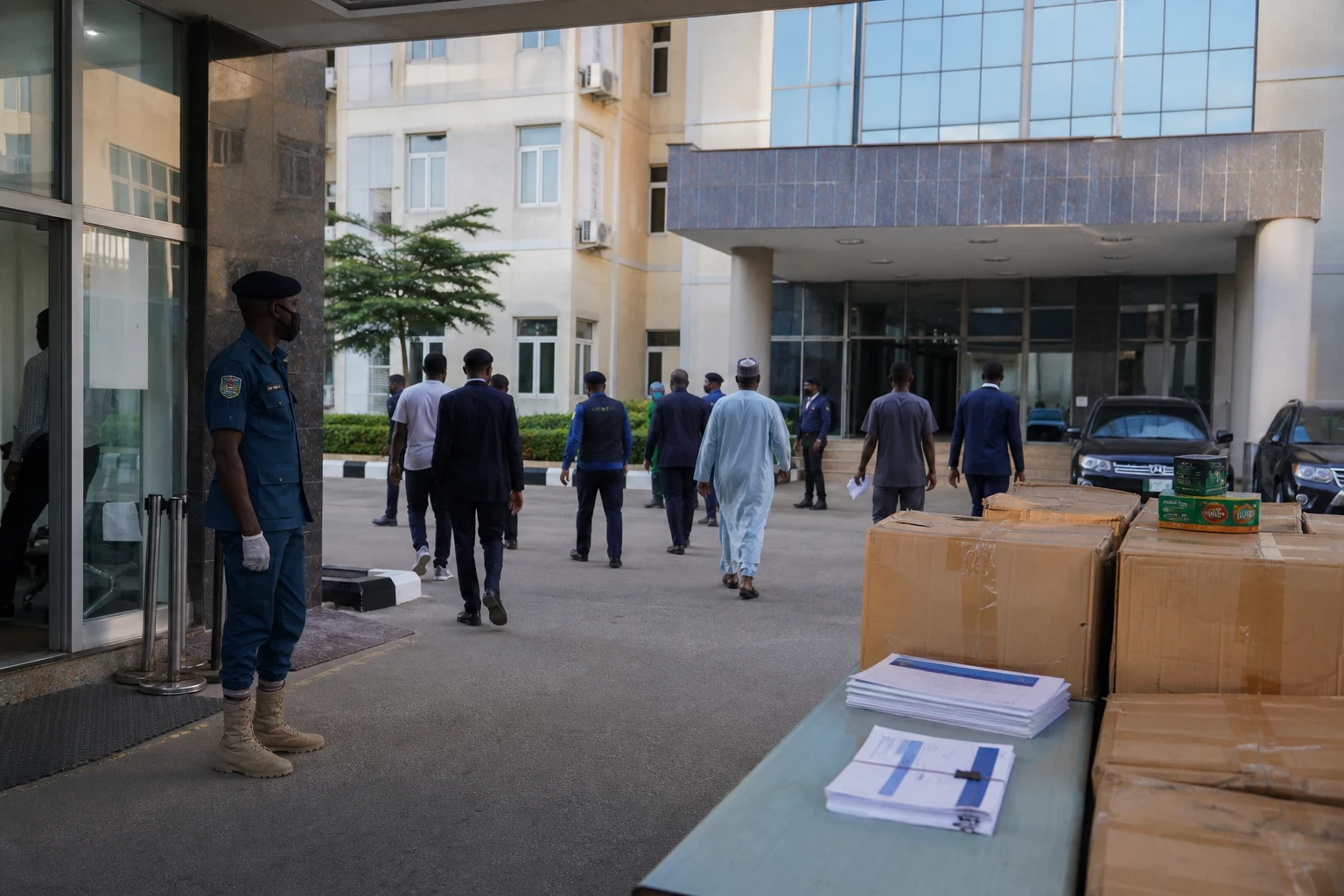
A discreet package, but a significant warning
In Lagos, a carton of soap can serve as a smokescreen. In a country where clandestine routes intersect with a security crisis, the discovery of 47 200 captagon tablets and several million opioid tablets is a reminder of a simple reality: synthetic drug trafficking follows weaknesses in the state, at borders and in local markets. Nigeria, with Abuja as its political capital and Lagos as its economic powerhouse, remains a sought-after transit point for criminal networks seeking to move drugs towards the north of the country and beyond.
The case is also part of a broader regional trend. In West Africa, ECOWAS (the Economic Community of West African States, the regional organisation) and UNODC have documented the rise of synthetic drugs and opioids for several years, particularly tramadol, whose non-medical circulation has become a public health and security problem across the sub-region.
What anti-drug services seized
On 30 August, Nigeria’s National Drug Law Enforcement Agency, the NDLEA, announced the interception of a consignment of captagon and opioids at Murtala Muhammed International Airport in Lagos. According to its statement, the operation began after the arrest, on 22 August, of Akinbile Kazeem Aikins, 49, who had arrived from Accra, Ghana, aboard an Africa World Airlines flight. A search of a carton of local soap, often called “Ghana Soap”, uncovered the 47 200 tablets hidden in the soap bars. The NDLEA also said it had seized more than 3.9 million opioid tablets, with a total market value of more than 6.2 billion naira.
The suspect reportedly told investigators that he was to deliver the consignment in northern Nigeria. This detail matters. It suggests an already structured distribution chain, able to absorb products from abroad and direct them to areas where access to healthcare, police control and administrative presence are more fragile. The NDLEA also recalled that captagon had previously been seized in Nigeria in September 2021 at Apapa port in Lagos, and again in April 2026 in Kwara State, when 10 000 tablets were intercepted on the road to Bode Saadu.
The name captagon is significant. UNODC notes that this synthetic amphetamine remains mostly associated with the Middle East and certain conflict zones, while West Africa is facing above all the rise of tramadol and other pharmaceutical opioids. In other words, Nigeria lies at the intersection of two neighbouring criminal markets: that of wartime stimulants and that of cheap opioids.
Why this seizure is more than a crime story
The issue is at its heart a security one, but also an economic one. In northern Nigeria, armed groups do not finance themselves through kidnappings for ransom alone. They also benefit from parallel economies in which weapons, smuggled goods, diverted fuel and, increasingly, drugs circulate. These drugs can keep fighters in a state of disinhibition or feed resale networks. The NDLEA has previously said that “terrorists and bandits” use drugs to carry out their activities. This assessment echoes UNODC warnings about the links between illicit markets, conflict and the criminal economy in West Africa.
The national context makes this trafficking all the more sensitive. In the north-east, the insurgency led by Boko Haram and Islamic State West Africa Province has continued since 2009. In the north-west and central regions, armed groups known as “bandits” carry out raids, kidnappings for ransom and village attacks. At the end of August, SBM Intelligence estimated that 7 825 people had been kidnapped between July 2025 and June 2026, with 7.78 billion naira paid in ransoms. Reuters and the Associated Press reported these figures, while noting that banditry weighs heavily on rural communities and trust in the authorities.
This link between insecurity and the drug economy matters for two reasons. First, it shows that smuggling is not simply a customs problem. It affects the movement of money, weapons and people. Second, it exposes deep social vulnerability. In cities, products pass through more visible resale channels. In rural areas of the north, they can supply armed groups, local militias or transport networks that benefit from administrative remoteness. The same consignment therefore does not have the same effects in Lagos, Abuja or a northern border community.
A warning for Nigeria, and for the region
Nigeria is not an isolated case. ECOWAS and UNODC have for years documented the rise of cross-border trafficking in West Africa, with routes running through ports, airports and land corridors linking the Gulf of Guinea to the Sahel. This configuration encourages the “diversion” of consignments, false declarations and the use of everyday products, such as soap, to conceal tablets.
The continental significance is clear. Synthetic drugs move quickly, in small volumes and with high margins. They adapt to local crises. Where authority weakens, they become embedded in war economies. Where demand rises, they also feed consumption driven by survival, work or homelessness. For Abuja, the challenge is therefore not just to arrest a courier. It is to cut financial flows, strengthen cooperation with Accra, customs services and regional mechanisms, and address security, public health and border monitoring at the same time.
The next question will be how to sustain enforcement. The NDLEA is carrying out more and more seizures, but SBM Intelligence’s figures on ransoms show that criminal economies retain a strong capacity to adapt. Nigeria, Africa’s most populous country and a central ECOWAS player, is a barometer here. If synthetic drug trafficking gains ground there, the entire sub-region must prepare for routes that are faster, more flexible and harder to dismantle.



