Algeria
 Egypt
 Libya
 Morocco
 Sudan
 Tunisia
 Benin
 Burkina Faso
 Cabo Verde
 Côte d'Ivoire
 Ghana
 Guinea
 Guinea-Bissau
 Liberia
 Mali
 Mauritania
 Niger
 Nigeria
 Senegal
 Sierra Leone
 The Gambia
 Togo
 Cameroon
 Central African Republic
 Chad
 DR Congo
 Equatorial Guinea
 Gabon
 Republic of the Congo
 São Tomé and Príncipe
 Burundi
 Comoros
 Djibouti
 Eritrea
 Ethiopia
 Kenya
 Madagascar
 Malawi
 Mauritius
 Mozambique
 Rwanda
 Seychelles
 Somalia
 South Sudan
 Tanzania
 Uganda
 Angola
 Botswana
 Eswatini
 Namibia
 South Africa
 Zambia
 Zimbabwe
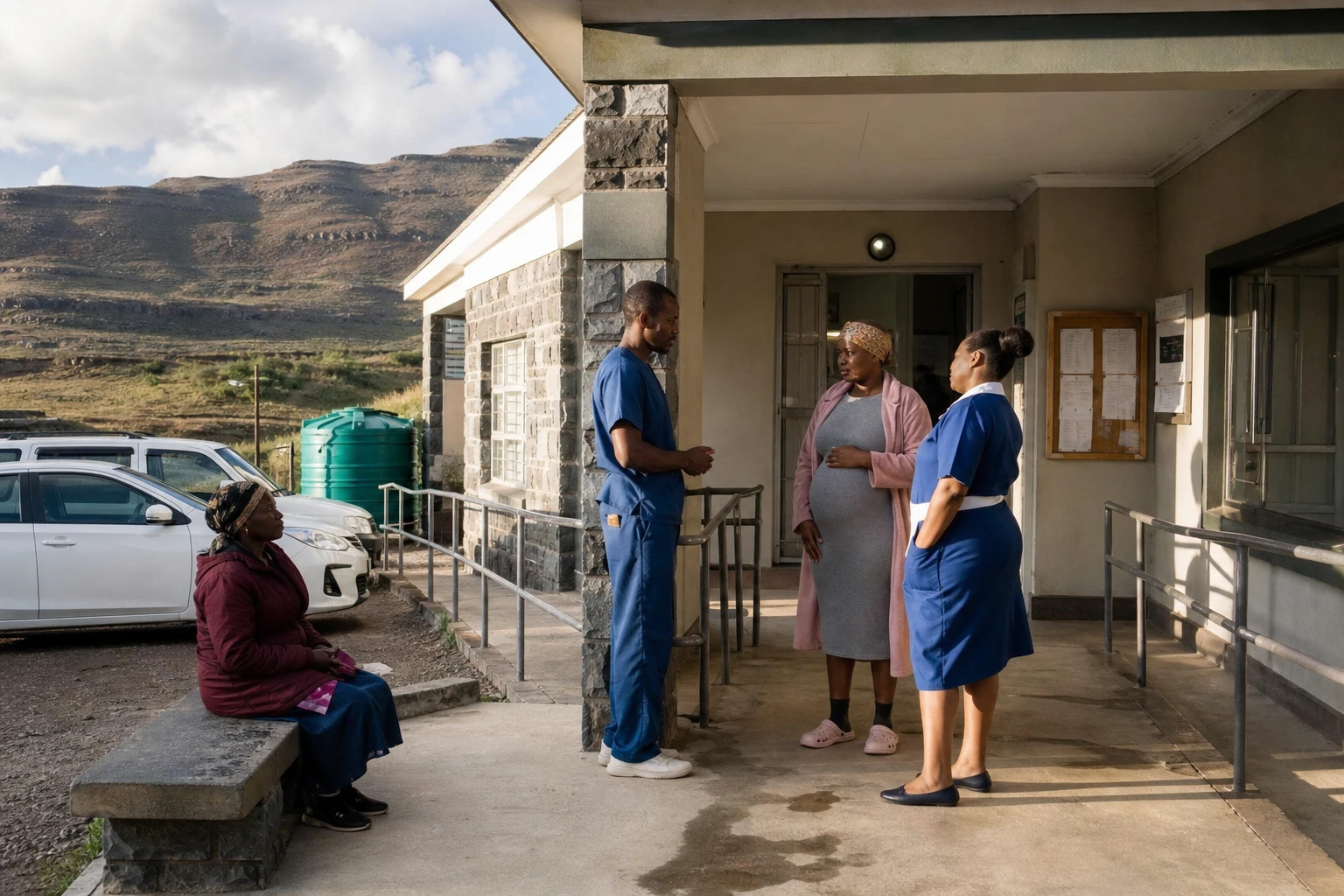
In Lesotho’s mountains, childbirth remains a test of access to care
In Lesotho, childbirth depends on more than pregnancy. It also depends on the road, the distance and the number of healthcare workers available. In a landlocked country in southern Africa, where much of the population lives far from major centres, maternal health remains a very practical concern, especially for rural families who have to make do with understaffed clinics.
The country now has just over 2.3 million inhabitants, according to World Bank data. It belongs to the Southern African Development Community, or SADC, a regional bloc of 16 member states that also works on social and health integration. In this context, the challenge of maternal care is not an isolated one. It affects patients’ mobility, staff availability and the organisation of referrals to hospitals, often as far as neighbouring South Africa.
Men enter a profession long seen as women’s work
Against this backdrop, one development is attracting attention. In Lesotho, men are training and working as midwives, a profession that remains overwhelmingly female worldwide. The World Health Organization notes that men make up less than 1% of all midwives globally. At the same time, Africa continues to face a persistent shortage of specialised health workers, particularly in rural areas.
This male presence is not an abstract symbol. It responds to a practical constraint. Lesotho’s Ministry of Health describes a system in which health centres, community teams and faith-based facilities play a leading role, especially outside cities. In remote villages, a lack of qualified staff lengthens the time it takes to receive care. In obstetrics, every hour counts.
The development is all the more notable because it forms part of a quiet challenge to gender-related social roles. Here, men are not replacing women. They are expanding an understaffed profession while adapting to communities where trust in healthcare also depends on proximity, attentive listening and continuity of care.
The figures show urgency, but also progress
Official and UN agency data paint a nuanced picture. According to UNICEF in Lesotho, the maternal mortality ratio stood at 530 deaths per 100,000 live births in the 2023/24 Demographic and Health Survey. The country has nevertheless made significant progress in care during childbirth: 92% of births are now attended by skilled personnel, and 86% take place in a health facility.
This progress should not obscure the fragility of the system. UNICEF also notes that neonatal mortality remains high, at 26 deaths per 1,000 live births, and that stillbirths remain a concern. In other words, Lesotho has improved access, but the quality and speed of care are still not good enough. A woman’s arrival at a health facility does not, by itself, guarantee a favourable outcome.
In this context, male midwives are playing a useful role. Their presence can help identify complications, reassure patients who have travelled long distances and extend health coverage where there are few posts. The United Nations Population Fund also stresses that effective maternity care requires support throughout pregnancy, during childbirth and after the birth.
What this development means for Basotho communities
For pregnant women in rural areas, the issue is first and foremost practical. One more available healthcare worker means less waiting, more follow-up and sometimes a faster referral to hospital. In a mountainous country where travel remains difficult, this presence can reduce delays in receiving care, a classic factor in maternal mortality.
For men who choose this path, the challenge is as much social as professional. They are entering a profession shaped by longstanding norms, but bring a useful response to staff shortages. This reality speaks to a broader debate in southern Africa: how to recruit, train and retain healthcare workers in the most remote areas without leaving the burden of the health system to rest solely on women and families themselves.
Lesotho also shows that health policy can become more effective when it is rooted in the community. The government cites a broad network of community health workers, health centres and faith-based facilities with a strong presence in rural areas. This network does not solve everything, but it helps bring care closer to pregnant women, where the journey to hospital can still weigh heavily on the outcome of a birth.
A regional lesson for SADC and the continent
The Basotho case reaches beyond the kingdom’s borders. In several SADC countries, maternal health remains closely linked to geographic inequalities, staff shortages and transport difficulties. Lesotho is a reminder that an effective response requires not only larger infrastructure, but also teams that are closer to communities and more evenly distributed between urban and rural areas.
It also highlights a continental trend: Africa bears a heavy share of the global shortage of midwives and qualified healthcare workers. The WHO estimates that shortages remain concentrated in regions where needs are greatest, while UNICEF and the WHO emphasise the decisive role of skilled personnel in reducing maternal and neonatal deaths. The issue, then, is not simply a rare profession. It is about the practical organisation of the right to give birth in safe conditions.
In Lesotho, this development also says something broader about the social changes under way. When a man puts on a midwife’s uniform at a rural health centre, he is not just challenging a gender norm. He is also signalling that communities are looking for practical solutions to a lasting emergency: ensuring safer, closer and more dignified births, from Maseru to the villages of the highlands.