
 Algeria
 Egypt
 Libya
 Morocco
 Sudan
 Tunisia
 Benin
 Burkina Faso
 Cabo Verde
 Côte d'Ivoire
 Ghana
 Guinea
 Guinea-Bissau
 Liberia
 Mali
 Mauritania
 Niger
 Senegal
 Sierra Leone
 The Gambia
 Togo
 Cameroon
 Central African Republic
 Chad
 DR Congo
 Equatorial Guinea
 Gabon
 Republic of the Congo
 São Tomé and Príncipe
 Burundi
 Comoros
 Djibouti
 Eritrea
 Ethiopia
 Kenya
 Madagascar
 Malawi
 Mauritius
 Mozambique
 Rwanda
 Seychelles
 Somalia
 South Sudan
 Tanzania
 Uganda
 Angola
 Botswana
 Eswatini
 Lesotho
 Namibia
 South Africa
 Zambia
 Zimbabwe
Gas as a policy response to rising transport bills
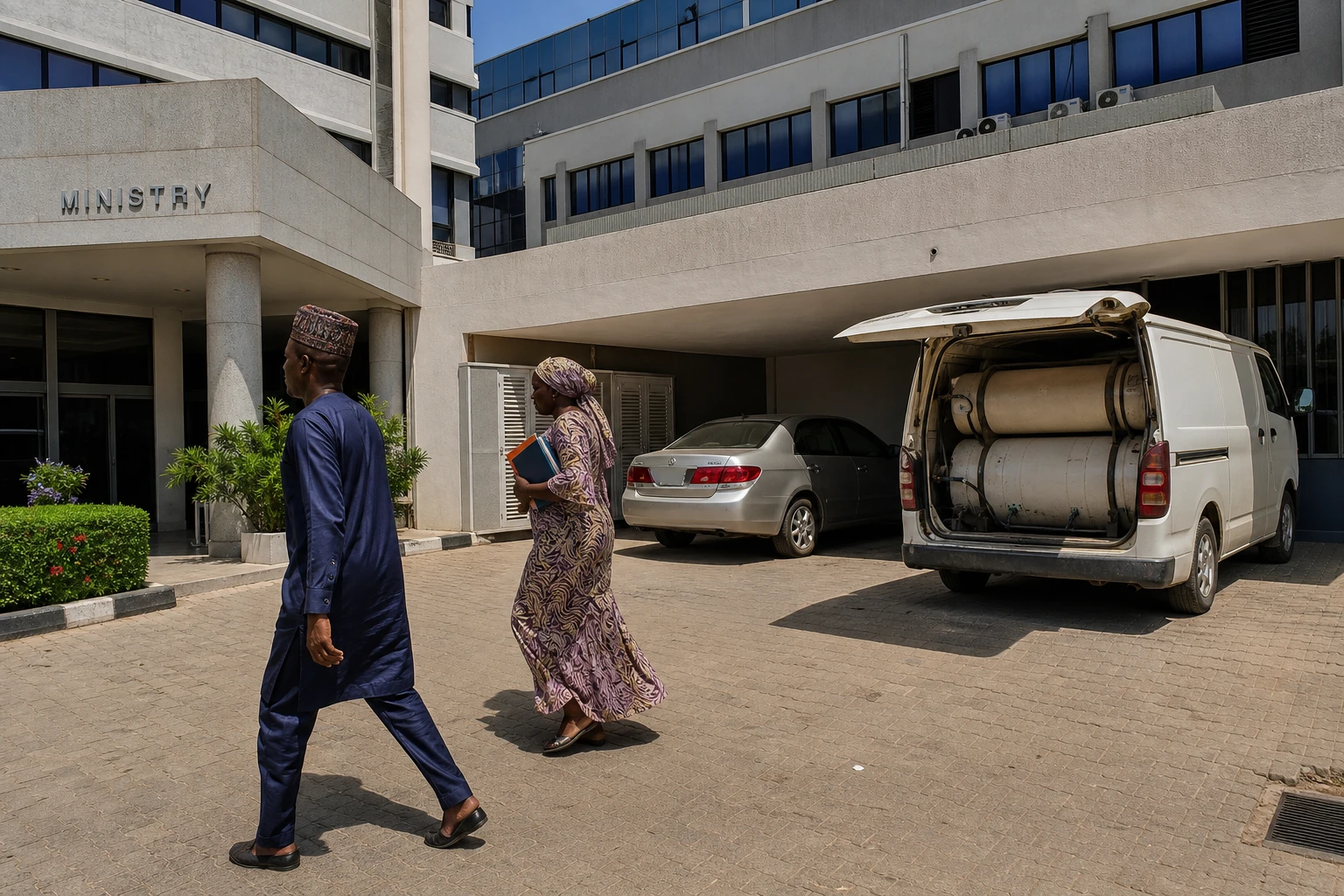
In Nigeria, daily travel remains one of the biggest expenses for urban households and small businesses. When petrol prices rise, the pressure ripples through the entire economic chain: motorcycle taxis, minibuses, deliveries, informal markets and commutes. Against this backdrop, Abuja is increasingly backing compressed natural gas, or CNG, as a transition option to cut costs without reinstating the fuel subsidy.
This direction follows a path set in 2023, when President Bola Tinubu scrapped the petrol subsidy on the day he was sworn in. Since then, the country has seen a sharp rise in pump prices and sustained pressure on the cost of living. Reuters had already reported in 2023 that the end of the subsidy had prompted Nigerian authorities to seek an alternative based on the country’s vast gas reserves.
What the federal government is preparing in Abuja
On 27 August 2026, President Bola Tinubu said a joint federal and state committee would be set up to immediately launch measures aimed at reducing transport fares. He also announced the addition of 500 new CNG dispensing stations, which would bring the planned network under the public programme to 1,000. The executive presents this rollout as a practical way to translate CNG’s lower operating costs into cheaper journeys.
The federal government had already begun developing the sector in 2026. In May, the presidency announced the commissioning of four CNG projects backed by the Midstream and Downstream Gas Infrastructure Fund, including stations and conversion centres in Lagos, Abuja and Owerri. This sequence shows that the priority is no longer simply to announce an alternative, but to establish visible infrastructure along major transport corridors.
The programme is run by the Presidential Initiative on Compressed Natural Gas and Electric Vehicles, a federal initiative launched in 2023 and recently expanded to include electric vehicles. Its official portal reports more than 120,000 vehicles converted, over 93,000 conversion kits acquired and several hundred certified centres. The same source also claims that more than $2.5 billion in investment has been mobilised across the value chain.
Why Nigeria’s bet is not just a technical one
On paper, CNG has a clear advantage: it reduces fuel costs per kilometre. President Tinubu has said that a CNG vehicle spends 60 to 80 per cent less than a petrol vehicle. The argument resonates immediately with transport operators, delivery companies and commuters facing the combined effects of fuel prices, inflation, and increases in tolls, insurance and maintenance costs.
But conversion remains costly for many users. Several analyses cited in the Nigerian press put the cost of adapting a vehicle at between 900,000 and 1.6 million naira, still a high figure for many independent drivers. The availability of gas is another issue. The AP reported in 2024 that the network of stations and conversion centres remained limited, and that a lack of infrastructure was holding back CNG adoption in the country.
In other words, the real issue is not just the choice of fuel. It is whether the state can bring three things together at once: refuelling stations, affordable conversion kits and a reliable supply chain. Without that, CNG risks remaining mainly an urban solution, useful along a few routes in Abuja, Lagos and other hubs, but less accessible in outlying states and areas where services are scarce.
What this means for households, states and public debate
For households, the promise is simple: pay less to travel. For transport operators, the stakes are broader: protect margins, maintain vehicle runs and avoid passing each new fuel price increase on to passengers as another shock. For the states, the equation is both fiscal and political. On 27 August 2026, several governors backed the principle of a national affordable transport programme based on CNG, on the premise that lower operating costs would translate into lower fares.
The federal government is also seeking to avoid a political return to the former subsidy. Ending this public expenditure eased pressure on state finances, but also shifted discontent towards families’ everyday lives. Reuters reported that Tinubu said he had saved more than 1,000 billion naira in just over two months after the subsidy was scrapped. This fiscal argument remains central in Abuja, but it is not enough to calm anger over the high cost of living.
In this context, CNG serves as a political shock absorber. It allows the government to respond to rising costs without reopening the subsidy taps. It also enables the president to defend a reform presented as more sustainable, based on domestic gas resources and private investment. But if stations are slow to arrive, kits remain expensive or gas prices rise in turn, the social argument will quickly lose its force.
A development to watch in Nigeria and beyond
Nigeria’s CNG expansion goes beyond the energy sector. It concerns how a major African oil-producing country is trying to organise its transition using its own resources, without waiting for an imported solution. It also points to a wider issue in West Africa: when transport depends on volatile fuels and fragile supply networks, access to affordable energy becomes a matter of social stability as well as industrial policy.
For ECOWAS, where the movement of people and goods remains vital, Nigeria’s experience will be closely watched. If Abuja succeeds in genuinely reducing transport costs along major routes, the model could inspire other regional capitals also seeking to cushion the impact of energy price shocks. But if the network remains too concentrated and conversion stays beyond the reach of small operators, the programme will remain an ambitious announcement, without lasting social change.
The next step will therefore be less about speeches than a test of capacity. Nigeria has the gas, a vast domestic market and a public administration able to launch visible projects from Abuja. The question is whether these 500 new stations will become a network that is genuinely useful to ordinary users, or just another symbol of the transition under way.



