Algeria
 Egypt
 Libya
 Morocco
 Sudan
 Tunisia
 Benin
 Burkina Faso
 Cabo Verde
 Côte d'Ivoire
 Ghana
 Guinea
 Guinea-Bissau
 Liberia
 Mali
 Mauritania
 Niger
 Nigeria
 Senegal
 Sierra Leone
 The Gambia
 Togo
 Cameroon
 Central African Republic
 Chad
 DR Congo
 Equatorial Guinea
 Gabon
 Republic of the Congo
 São Tomé and Príncipe
 Burundi
 Comoros
 Djibouti
 Eritrea
 Ethiopia
 Kenya
 Madagascar
 Malawi
 Mauritius
 Mozambique
 Rwanda
 Seychelles
 Somalia
 South Sudan
 Uganda
 Angola
 Botswana
 Eswatini
 Lesotho
 Namibia
 South Africa
 Zambia
 Zimbabwe
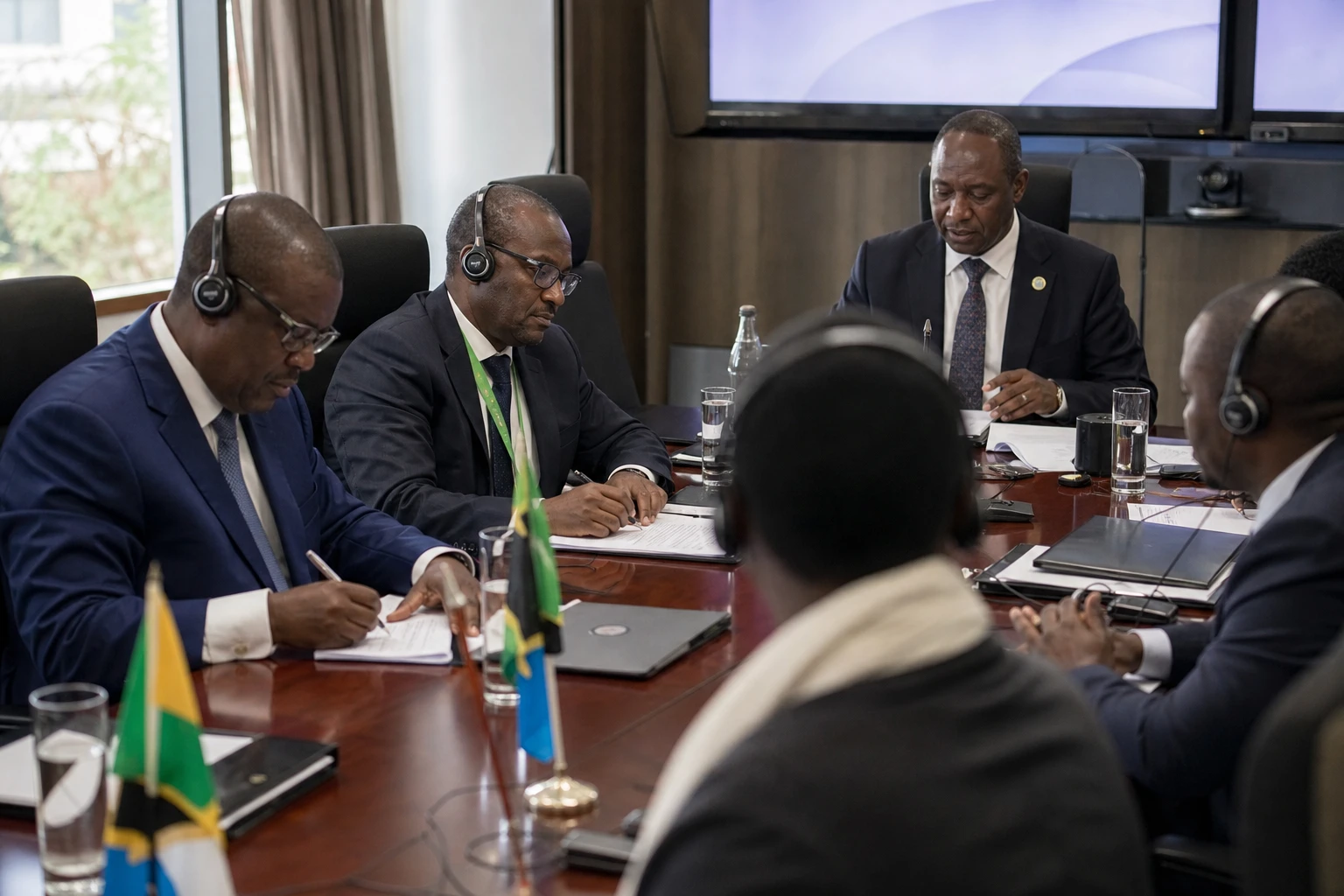
Key post changes hands in Dodoma with no apparent break
In Tanzania, the vice-presidency is more than a symbolic role. It matters to the balance of the executive, the continuity of the state and the political image of a government seeking to project stability. In Dodoma, the country’s political capital, parliament unanimously approved the appointment of Deogratius John Ndejembi as the new vice-president, following Emmanuel Nchimbi’s departure. The vote brought together 324 MPs, with no votes against and no invalid ballots.
The change comes as Tanzania remains at the heart of the East African Community, a bloc where institutional stability carries weight for trade, major projects and the flow of public decisions. The country’s parliament is based in Dodoma, and the vice-presidency plays a role as a political link between the presidency and the administration. The government’s official website notes that the office of vice-president took its current form with the constitutional reforms associated with the introduction of multiparty politics in 1992.
The process was swift. The ruling Chama Cha Mapinduzi (CCM) first selected Deogratius Ndejembi to succeed Emmanuel Nchimbi, then parliament confirmed the choice on 28 August 2026. The government said the procedure followed the constitutional framework for cases in which a vice-president was not directly elected alongside the president and must therefore receive MPs’ approval.
The immediate context explains the rapid move. Emmanuel Nchimbi had announced his resignation and withdrawal from public life, initially set to take effect on 4 September 2026. But, according to the Attorney General, his loss of CCM membership had already disqualified him from remaining in office. The CCM subsequently expelled him from its ranks and approved Ndejembi’s promotion.
Who is Deogratius Ndejembi, and what his profile says about Tanzanian power
Deogratius John Ndejembi is a 43-year-old politician, born on 12 July 1983. Originally from the Dodoma region, he is the CCM MP for Chamwino. His profile published by Tanzania’s parliament confirms his parliamentary mandate and membership of the dominant party.
His career is not that of a technocrat emerging from a major central government department. Before entering public service, he worked in the private sector, particularly in sales and marketing. Parliamentary biographies and official accounts link him to several companies and communications sectors. He then joined the administration in 2016 and was elected as an MP in 2020.
His rise through the state apparatus has been varied and rapid. He held local government posts before joining the government in 2021 as a deputy minister, then served in several portfolios, including labour, youth, employment and people with disabilities, followed by lands, housing and human settlements development. In 2025, he was appointed energy minister. Parliament and official accounts also confirm that he served in local government administration before joining the central government.
His academic background combines international study and public-sector management. Official profiles list a degree in international relations from the University of Lincoln in the UK, obtained between 2006 and 2009, as well as a higher diploma from Tanzania’s Institute of Administrative Management. This hybrid profile partly explains why the CCM presents him as a leader able to work across several areas of the state.
The appointment also says something about the way power is exercised in Dar es Salaam and Dodoma. The CCM favours officials who have already served at several levels of the state and can engage with ministries, MPs and constituency voters. In a system where the party remains the main route into public office, the vice-presidency is both an institutional position and a political signal.
A signal for the executive, regional balances and the next political steps
The most tangible impact of the change concerns continuity in government. Ndejembi reaches the top of the executive after serving in energy, social affairs, labour and local administration. For the presidency, this kind of profile offers reassurance about the flow of information between ministries, local authorities and the political centre. For citizens, the stakes are more practical: the vice-presidency supports the implementation of public priorities, from infrastructure projects to social policies.
The unanimous parliamentary vote does not erase a more complex political reality. The succession followed a resignation, a departure from the party and a legal clarification on the vacancy. This mix of law, party discipline and parliamentary procedure shows how Tanzania manages internal transitions without public upheaval. Nationally, it reinforces the image of a centralised system in which the CCM retains control over the selection of key figures.
Regionally, Tanzania remains under close observation within the East African Community, where institutional stability facilitates major shared priorities: transport, energy, trade and economic integration. The fact that an energy minister has become vice-president is not insignificant in a country committed to major energy and logistics projects. It suggests political continuity around a development agenda, but also a narrowing of the circle of officials expected to lead on that agenda.
The next steps will unfold in Dodoma, through the ordinary rhythm of Tanzania’s institutions: the swearing-in, a reshaping of parliamentary balances, and then the handling of economic and social issues. Chamwino constituency will have to fill the seat left vacant when its MP became vice-president. In a tightly regulated system, institutional details matter as much as symbolism. And the message is clear: Tanzania’s government wants to show it can make a swift replacement without leaving a vacuum at the top of the state.