Algeria
 Egypt
 Libya
 Morocco
 Sudan
 Tunisia
 Benin
 Burkina Faso
 Cabo Verde
 Côte d'Ivoire
 Ghana
 Guinea
 Guinea-Bissau
 Liberia
 Mali
 Mauritania
 Niger
 Nigeria
 Senegal
 Sierra Leone
 The Gambia
 Togo
 Cameroon
 Central African Republic
 Chad
 DR Congo
 Equatorial Guinea
 Gabon
 Republic of the Congo
 São Tomé and Príncipe
 Burundi
 Comoros
 Djibouti
 Eritrea
 Ethiopia
 Madagascar
 Malawi
 Mauritius
 Mozambique
 Rwanda
 Seychelles
 Somalia
 South Sudan
 Tanzania
 Uganda
 Angola
 Botswana
 Eswatini
 Lesotho
 Namibia
 South Africa
 Zambia
 Zimbabwe
In a landscape dominated by everyday dramas, a bunker shifts the focus
In Nairobi, fiction has no shortage of subject matter. Political tensions, economic pressures and the city’s overwhelming place in national life already provide plenty to draw on. Yet one Kenyan series has taken an unexpected detour: trapping eight characters in a bunker to talk about the country, its divisions and its capacity to build community. This approach says something broader than its plot: in Kenya, television is beginning to allow itself to explore other genres, with stories that no longer simply reproduce reality, but shift it in order to examine it more closely.
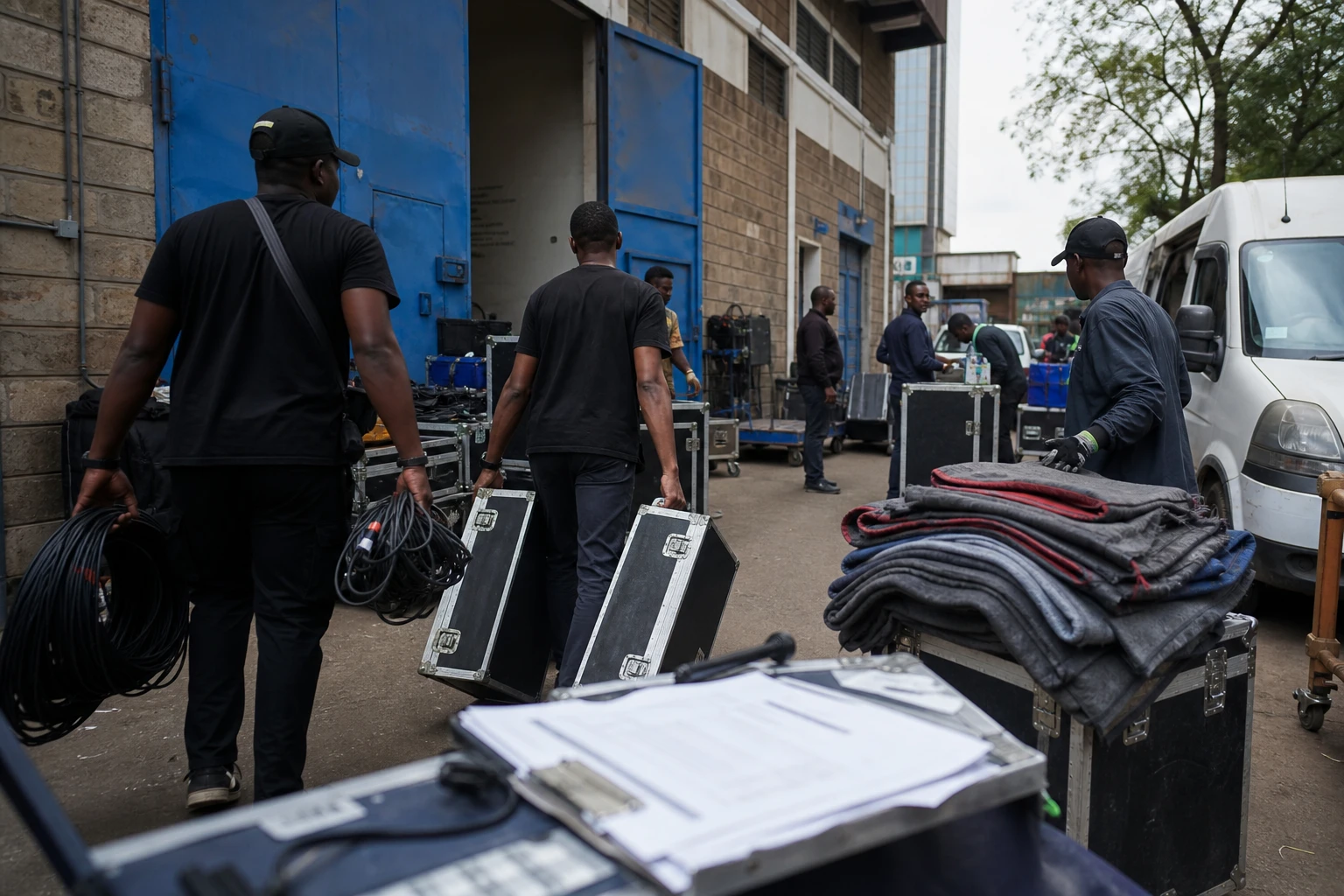
The setting matters. Kenya has an audiovisual industry structured by the Kenya Film Commission, which advises the government, promotes local films and helps make the country a filming destination. At the same time, regulations governing the distribution of films and series were clarified in 2024, signalling the emergence of a more organised market around platforms, cinema and works distributed online. In this context, a science-fiction production is not merely an artistic exception. It also tests the place Kenya wants to give its stories in an increasingly competitive regional cultural economy, both in East Africa and on pan-African platforms.
A science-fiction series about Kenya today
Subterranea is billed as the first Kenyan science-fiction series backed by Showmax. According to the platform’s official description, it has eight episodes and follows eight participants in a psychological experiment who are placed in an underground bunker. The plot plays on a double sense of disorientation: the characters initially believe they are witnessing the collapse of the world outside, before realising they are at the centre of an experimental set-up. The series premiered on 26 September 2024.
Director and producer Likarion Wainaina has described the project as a break with convention. He links the fiction to a Kenyan audiovisual culture long dominated, in his view, by family dramas and family comedies. His aim is not to produce escapist science fiction, but a work built around situations familiar to Kenyan audiences. The team describes it as a story centred on characters grounded in concrete social realities, so viewers can recognise tensions that are very much present in society. Here, science fiction is a framework, not an escape.
The themes explored in the series are sensitive: cult abuses, abortion, depression and addiction. These subjects often remain largely invisible on screen in East Africa, where television productions still favour more conventional formats. By setting them in an enclosed space, the series forces its protagonists to confront one another, as well as what they keep hidden. This storytelling choice says much about a society in which psychological and moral realities are very much present, without always finding a place in public life. The bunker becomes a mirror of the city, and then of the entire country.
A mirror of social tensions, between urban pressure and fragile solidarity
The series’ setting resonates with Kenya in 2024. That year, Nairobi was also the scene of large-scale social mobilisation around the Finance Bill, driven largely by young Kenyans from Generation Z. The protests put anger over taxes, the high cost of living and the distance between rulers and the ruled at the heart of public debate. They also underscored the political role of the capital, where institutions, media, the administration and symbols of power are concentrated. In this climate, a fiction about confinement, fear and cooperation between strangers takes on particular significance.
The series also echoes a slower transformation: urbanisation and the reshaping of social ties. Kenya, like many countries in East Africa, is seeing its cities grow and some local support networks weaken. Likarion Wainaina links the idea of the bunker to this question: what remains of community when pressure mounts, and when differences of age, origin, religion or life experience come together in a confined space? The plot offers a simple hypothesis: survival depends on mutual support. This is not a slogan. It is a social test staged episode by episode.
This message touches a sensitive point in Kenya’s cultural landscape. On the one hand, local creativity is becoming more ambitious. On the other, funding, risk-taking and genre diversity remain real obstacles. Wainaina has noted that the project had to contend with budgetary constraints, which also highlights the fragility of a sector still searching for production models. At the same time, the presence of established actors and talents from theatre, cinema and other Kenyan series shows that an ecosystem already exists. The series has not appeared out of nowhere: it is part of an industry beginning to think of itself as an industry, rather than merely a succession of isolated projects.
Beyond Kenya, a milestone for African fiction
The stakes extend beyond Nairobi. Across the continent, African science fiction is advancing in fits and starts, often through cinema and sometimes via platforms, but still rarely in the form of a high-profile series aimed at a broad local audience. The Kenyan case is interesting because it shows a transition: an industry no longer content to export social dramas or romantic comedies, but willing to explore psychology, the future, technology and collective tensions on its own terms. This matters for East Africa, but also for the pan-African space, where platforms are reshaping viewing habits.
The continent-wide significance also lies in a change of perspective. A work of fiction such as Subterranea shows that African stories can address confinement, fear, mental health, religion and social violence without being trapped by clichés. It also demonstrates that a country such as Kenya, with Nairobi as its cultural and economic centre of gravity, can be a laboratory for underexplored genres. The question to watch, then, is not only whether the series succeeds. It is what comes next: what other genre, what other imaginary, what other kind of character will Kenyan creators dare to put centre stage?