Algeria
 Egypt
 Libya
 Morocco
 Sudan
 Tunisia
 Benin
 Burkina Faso
 Cabo Verde
 Côte d'Ivoire
 Ghana
 Guinea
 Guinea-Bissau
 Liberia
 Mali
 Mauritania
 Niger
 Senegal
 Sierra Leone
 The Gambia
 Togo
 Cameroon
 Central African Republic
 Chad
 DR Congo
 Equatorial Guinea
 Gabon
 Republic of the Congo
 São Tomé and Príncipe
 Burundi
 Comoros
 Djibouti
 Eritrea
 Ethiopia
 Kenya
 Madagascar
 Malawi
 Mauritius
 Mozambique
 Rwanda
 Seychelles
 Somalia
 South Sudan
 Tanzania
 Uganda
 Angola
 Botswana
 Eswatini
 Lesotho
 Namibia
 South Africa
 Zambia
 Zimbabwe
A strong training system is not enough when the economy struggles to absorb young people
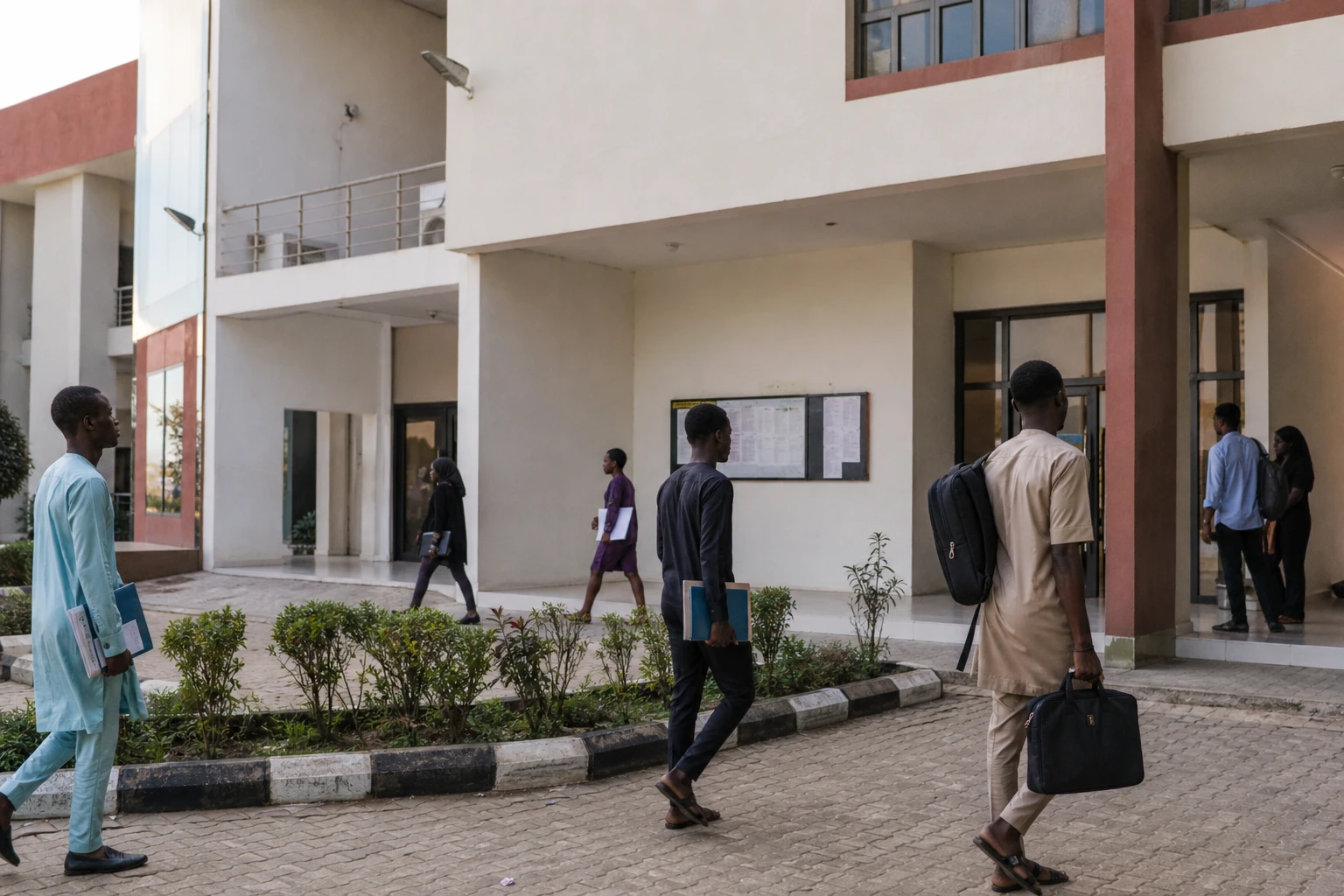
In Nigeria, the real issue is not simply training more people. It is where young Nigerians will work once they have their qualifications. In a country where the informal economy remains the main entry point into the labour market, the question of skills runs up against a simple reality: without formal jobs, upgrading training raises expectations faster than it creates positions. The imbalance lies between an education policy that is being modernised and a productive sector that remains too narrow.
This tension is particularly acute in Abuja, where the federal government has been pushing since 2025 for a broader overhaul of technical and vocational education and training, commonly referred to by the acronym TVET. The project involves the National Board for Technical Education, the NBTE, a key body regulating technical and vocational programmes. It also forms part of the framework of the Federal Ministry of Education and TETFund, the public fund that finances some interventions in higher and technical education.
NBTE reform aims to bring programmes closer to the labour market
The issue took on a new dimension in August 2026. According to the Nigerian press, the Ministry of Education launched a restructuring of the NBTE, backed by an assessment conducted by KPMG and funded by TETFund. The plan provides for the rollout of 31 national occupational standards, intended to bring courses closer to the practical needs of businesses and professions. A report by The Guardian Nigeria also refers to a 1 billion naira intervention to modernise programmes.
The NBTE had already undertaken significant regulatory changes in 2025. Its official website says the National Innovation Diploma programme was discontinued, 46 institutions were upgraded to award national diplomas, and 136 licences were withdrawn from institutions whose accreditation had not been renewed. These decisions show that the reform is not limited to course content. It also concerns the system’s governance, a point often decisive in countries where technical training pathways have long suffered from a lack of clarity and oversight.
The federal government now presents TVET as a driver of employment and entrepreneurship. The official national education reform portal refers to a technical training programme launched on 30 May 2025, in partnership with NELFUND and TETFund, with more than 1,700 accredited centres and over 30 occupations covered. This institutional expansion shows a determination to align training more closely with market needs. But it does not, on its own, guarantee the availability of lasting jobs for graduates.
Informality lies at the heart of Nigeria’s problem
The figures from the National Bureau of Statistics are unequivocal. In its labour force survey for the second quarter of 2024, Nigeria recorded an informal employment rate of 93.0%. The same document notes that the increase has been marginal but continuous, after 92.7% in the first quarter of 2024. In other words, almost all Nigerian workers are employed outside the protections and stability associated with formal employment.
The phenomenon also affects graduates. NBS data show that informality affects almost all workers with no formal education, but also a large proportion of trained workers. In analyses cited by the Nigerian Economic Summit Group, the country needs to create millions of formal jobs to keep pace with the annual influx of new entrants into the labour market. The NESG says Nigeria faces a need for structural transformation, not merely a skills problem. In short, training is necessary, but it cannot by itself make up for a shortfall in the creation of productive jobs.
This reality affects social groups in different ways. In cities, graduates move between short-term contracts, micro-enterprises and self-employment. In regions where industry and formal services are weaker, informality often becomes the norm rather than a choice. For women, young people and low-skilled workers, the absence of social safety nets further increases vulnerability. Nigeria therefore does not merely lack technicians. It lacks an ecosystem capable of absorbing these skills into more stable value chains.
What this means for Nigeria and West Africa
The issue extends beyond Abuja. Within ECOWAS, the Economic Community of West African States, Nigeria carries weight because of its population, domestic market and role as a regional magnet for capital, goods and labour. If its technical training reform succeeds, it could become a model for other countries facing the same gap between qualifications and jobs. If it fails, it will serve as a reminder of an obvious truth that is too often underestimated: education reforms deliver results only when underpinned by a coherent industrial, energy and trade strategy.
The issue also reflects a concern across the continent. For several years, the African Union and regional institutions have advocated better links between training, skills mobility and industrialisation. Nigeria, with Abuja as its decision-making centre, is now testing this equation on a large scale. What happens next will depend on the federal government’s ability to bring together three levers: the quality of standards, regulatory discipline and the expansion of a private sector capable of creating decent jobs. Without this, NBTE reforms will remain an important administrative advance, but an incomplete remedy for an economy in which the informal sector continues to absorb most workers.