
 Algeria
 Egypt
 Libya
 Morocco
 Sudan
 Tunisia
 Benin
 Burkina Faso
 Cabo Verde
 Côte d'Ivoire
 Ghana
 Guinea
 Guinea-Bissau
 Liberia
 Mali
 Mauritania
 Niger
 Senegal
 Sierra Leone
 The Gambia
 Togo
 Cameroon
 Central African Republic
 Chad
 DR Congo
 Equatorial Guinea
 Gabon
 Republic of the Congo
 São Tomé and Príncipe
 Burundi
 Comoros
 Djibouti
 Eritrea
 Ethiopia
 Kenya
 Madagascar
 Malawi
 Mauritius
 Mozambique
 Rwanda
 Seychelles
 Somalia
 South Sudan
 Tanzania
 Uganda
 Angola
 Botswana
 Eswatini
 Lesotho
 Namibia
 South Africa
 Zambia
 Zimbabwe
A religious gathering that goes beyond symbolism
In Abuja, Nigeria’s capital, Muslim and Christian leaders chose to put forward a joint text rather than pile up declarations of intent. The gesture matters because it comes in a country where religion remains a powerful social marker, but can also become a dividing line when politics, security or access to resources are involved. In this context, a declaration signed together speaks as much to the faithful as to public officials.
The initiative builds on an established tradition in Nigeria: interfaith dialogue, local mediation and the search for shared mechanisms to prevent tensions. The country already has frameworks such as the Nigeria Inter-Religious Council, which brings Muslim and Christian leaders together for consultation. At West African level, this kind of effort aligns with ECOWAS priorities; in recent years, the regional bloc has also stressed social cohesion, violence prevention and the fight against extremism.
What the Abuja Declaration contains
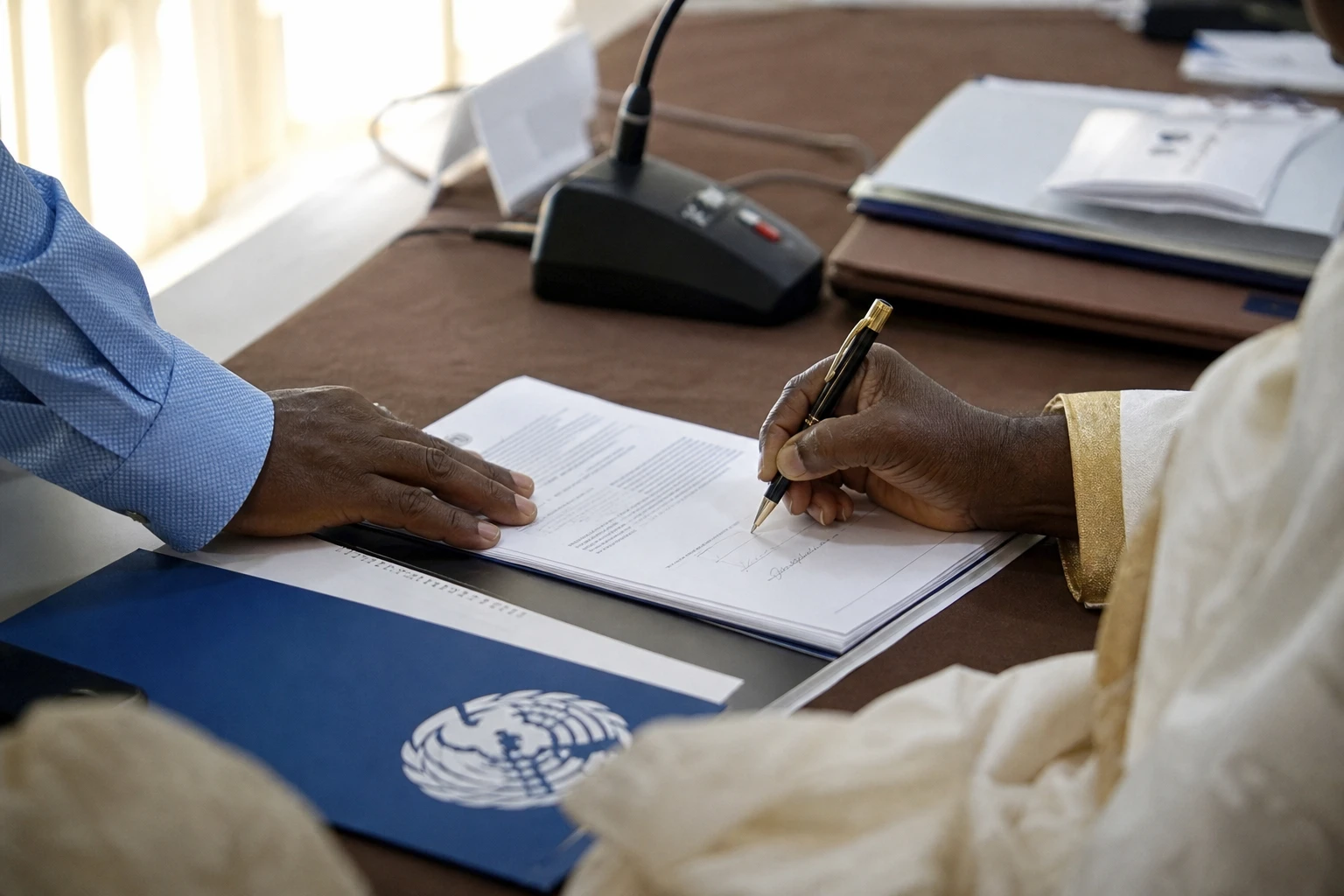
The international conference entitled “Diversity and Social Peace: A Partnership for a Promising Future” was held in Abuja under the patronage of Nigerian President Bola Ahmed Tinubu. According to information made public, it brought together Muslim and Christian religious leaders, ministers, parliamentarians and civil society representatives. At its conclusion, participants adopted the “Abuja Declaration” by consensus.
The text is more than a formula for unity. It provides for a joint action plan bringing together public institutions, religious leaders and civic organisations. It also seeks to expand scientific, training and media programmes linked to the “Charter of Makkah”, with a view to strengthening coexistence, social peace and stability. In the approach outlined by the organisers, follow-up should not rely on goodwill alone. A regional coordination body is to support the implementation of the commitments made in Abuja.
Another point stands out: the determination to turn interfaith engagement into a practical tool for conflict prevention. References to protecting national unity, religious and ethnic diversity, and mediation show that the issue goes beyond communication. The aim is to build bridges between institutions at a time when religious discourse spreads quickly, including on social media, and can serve either to calm tensions or to escalate them.
Why Abuja, and why now?
The choice of Abuja is not neutral. The federal capital is home to the state apparatus, major faiths, diplomatic missions and many of the country’s mediation efforts. It is also a place where political signals are read far beyond Nigeria. When religious leaders adopt a joint text there, they are addressing the federal government, but also regional states closely watching initiatives that could reduce social polarisation.
The West African context adds to its significance. ECOWAS is seeking to contain security fragmentation, political tensions and the effects of violent extremism. It has recently stepped up dialogue frameworks with religious and community actors, particularly on social cohesion and the prevention of radicalisation. The Abuja initiative therefore comes at a time when religion is seen less as a sphere apart than as a potential lever for stability.
In Nigeria, the stakes are tangible. In a country facing security tensions in several areas, the authorities are seeking credible local partners. Religious leaders often have an audience that the state cannot always reach as effectively, particularly in outlying neighbourhoods, rural areas and displaced communities. Their ability to speak to followers of different religions can help dispel rumours, contain hate speech and support grassroots mediation.
The limits of a text and the test of implementation
An essential question remains: what is a joint declaration worth if it produces no measurable results? This is where caution is needed. Interfaith texts often carry considerable moral weight, but their effectiveness depends on institutional discipline, continuity of funding, the quality of follow-up and local communities’ support. Without these, the agreement remains a political signal: useful, but fragile.
The information made public puts particular emphasis on follow-up. The creation or activation of a regional coordination body bringing together religious and civic leaders shows that the promoters want to move from words to structure. This matters because neighbourhood disputes, land-related tensions, community rivalries and opportunistic manipulation cannot be resolved with a family photograph. They require trained mediators, channels for raising early warnings and lasting relationships of trust.
For the Nigerian authorities, the benefits are twofold. On the one hand, they are presenting a method of dialogue in a regional climate where public authority is often challenged. On the other, they are drawing on religious figures able to carry a message of calm through a highly segmented social environment. For communities, the issue is different: it is less about diplomatic protocol than about ensuring coexistence in everyday life, in schools, markets, neighbourhoods and places of worship.
Regional significance beyond Nigeria
The Abuja Declaration’s significance therefore extends beyond the national level. It tests a West African approach to managing tensions: bringing together the state, faith communities, civil society and, where possible, regional bodies. This approach echoes ECOWAS priorities on social stability and violence prevention, as well as the African Union’s continental frameworks for peace and security.
The next test will be turning the text into visible action. Observers will follow the establishment of the proposed coordination body, the bilateral or institutional agreements signed on the sidelines of the meeting, and the ability of religious leaders to influence public debate in the months ahead. If these commitments outlast the initial announcements, Abuja could become a point of reference for other West African capitals seeking practical mechanisms for social peace.



