Algeria
 Egypt
 Libya
 Morocco
 Sudan
 Tunisia
 Benin
 Burkina Faso
 Cabo Verde
 Côte d'Ivoire
 Ghana
 Guinea
 Guinea-Bissau
 Liberia
 Mali
 Mauritania
 Niger
 Nigeria
 Senegal
 Sierra Leone
 The Gambia
 Togo
 Cameroon
 Central African Republic
 Chad
 DR Congo
 Equatorial Guinea
 Gabon
 Republic of the Congo
 São Tomé and Príncipe
 Burundi
 Comoros
 Djibouti
 Eritrea
 Kenya
 Madagascar
 Malawi
 Mauritius
 Mozambique
 Rwanda
 Seychelles
 Somalia
 South Sudan
 Tanzania
 Uganda
 Angola
 Botswana
 Eswatini
 Lesotho
 Namibia
 South Africa
 Zambia
 Zimbabwe

As land gradually replaces livestock
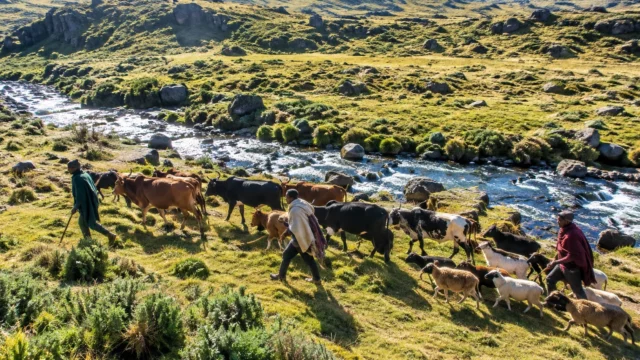
In south-eastern Ethiopia, climate change is visible not only in the absence of rain. It can also be seen in people’s choices about how to live. In the Somali region, families who once relied on pastoralism are now settling around irrigated plots, fodder and vegetable crops. This shift is no whim. It is a survival strategy in the face of repeated droughts that have weakened herds, incomes and the mobility of pastoral communities.
The stakes go beyond agriculture alone. In Ethiopia, pastoralism remains central to the arid lowlands, especially in the Somali and Afar regions. But successive poor rainy seasons have eroded the very foundations of this model. Regional authorities, alongside partners such as the World Food Programme and the FAO, are now promoting agro-pastoralism, solar-powered irrigation, fodder production and water management. The aim is clear: to keep families in place by diversifying their livelihoods.
A local response to a regional crisis
The Somali region is a vast, arid border area at the heart of the Horn of Africa. It depends heavily on livestock, but is also exposed to climate shocks affecting the pastoral corridor linking Ethiopia, Kenya and Somalia. The problem is not confined to one area: UN agencies have described the period from 2020 to 2023 as an exceptional drought, marked by five consecutive poor rainy seasons in the Horn of Africa. In 2024, the WFP was still warning that recurrent droughts remained one of the main drivers of livelihood disruption in the Somali region.
In Gode, in the Somali region, a new solar-powered irrigation station was inaugurated this year with support from the Ethiopian government, the WFP, the German embassy and the public development bank KfW. It is intended to boost food production throughout the year and help drought-exposed communities withstand climate shocks. This type of investment signals a change in approach: rather than relying solely on emergency assistance, efforts are being made to secure water, crops and incomes.
Families reshape their economies
On the ground, this transition is taking very practical forms. Former livestock herders are growing onions, vegetables and fodder. The principle is simple: some of the land produces food for the market, while the rest feeds animals kept in enclosures. According to local actors cited in resilience programmes in the region, this reduces reliance on unpredictable pastures and improves the quality of milk. It also changes households’ daily lives, bringing schools, healthcare and water closer to where they live.
The figures give a sense of the scale of this shift. The Somali regional bureau says that nearly 70% of the rural population remains primarily pastoralist, while a smaller share already practises agro-pastoralism. In other words, the move towards cultivation is not starting from scratch. It builds on an existing hybrid economy, which the climate crisis is accelerating. This is also reflected in resilience projects across the Ethiopian lowlands, which aim to protect pastoralist and agro-pastoralist households through irrigation, natural resource management and early warning systems.
But adaptation comes at a cost. Moving from nomadism to farming requires seeds, pumps, fencing, inputs and access to markets. Without support, the poorest families may be left behind. That is why the strongest projects do more than distribute equipment. They organise access to water, training, fodder production, veterinary services and warning systems. In the Somali region, environmental authorities also stress that climate resilience must be built at the level of communities, local institutions and ecosystems.
A useful solution, but not a universal one
The shift from herding to farming should not be presented as a one-size-fits-all model. Pastoralism specialists cited by humanitarian programmes have warned against poorly designed projects that disrupt local systems without understanding how they work. In dry areas, pastoralism is not backward. It is often a rational adaptation to an unstable environment. The real issue, then, is not to replace herders, but to give them several options when grass disappears, water points dry up and markets deteriorate.
This is where the debate takes on national significance. Ethiopia is seeking to reconcile food security, the protection of livelihoods and climate adaptation. In the lowlands, that means more technical investment closer to the ground: solar-powered irrigation, water storage, fodder crops, microinsurance for livestock and support for regional administrations. The shift is also of interest to the African Union, based in Addis Ababa, because it touches on a continental question: how to protect mobile populations without locking them into a single economic activity.
For the Horn of Africa, the question remains open. Successive droughts have already exposed the vulnerability of pastoral economies when seasons go awry. The next rains, the next sowings and the next public investments will show whether agro-pastoralism becomes a lasting transition or merely a temporary response. In Ethiopia, the Somali region is now testing a broader lesson: in arid areas, climate adaptation is measured not only in tonnes harvested, but also in families’ ability to live with dignity, remain mobile when necessary and settle when possible.