Algeria
 Egypt
 Libya
 Morocco
 Sudan
 Tunisia
 Benin
 Burkina Faso
 Cabo Verde
 Côte d'Ivoire
 Ghana
 Guinea
 Guinea-Bissau
 Liberia
 Mali
 Mauritania
 Niger
 Nigeria
 Senegal
 Sierra Leone
 The Gambia
 Togo
 Central African Republic
 Chad
 DR Congo
 Equatorial Guinea
 Gabon
 Republic of the Congo
 São Tomé and Príncipe
 Burundi
 Comoros
 Djibouti
 Eritrea
 Ethiopia
 Kenya
 Madagascar
 Malawi
 Mauritius
 Mozambique
 Rwanda
 Seychelles
 Somalia
 South Sudan
 Tanzania
 Uganda
 Angola
 Botswana
 Eswatini
 Lesotho
 Namibia
 South Africa
 Zambia
 Zimbabwe
African women’s football has stepped up, but Cameroon must still catch up
On paper, the latest major continental tournament told a simple story: more teams, tighter matches and higher stakes. In reality, it also brought home a less comfortable truth for Cameroonian football: when standards rise, the absence of a national side is immediately noticeable. Cameroon did not take part in the finals of the CAF TotalEnergies Women’s Africa Cup of Nations, held in Morocco in July 2025 after the CAF decided to postpone it.
The tournament confirmed two powerful trends in Africa. First, Morocco has established itself as a hub for organising women’s football on the continent. Second, the women’s competition has become a genuine test of the depth of football associations. CAF retained a 16-team format, as announced in its official calendar, opening the door to more nations.
The regional context: CEMAC watches a more structured continent
For Cameroon, a Central African country and CEMAC member, the stakes go beyond the sporting result. The region is also looking at whether its football associations can build women’s teams that are consistent, well supported and competitive. Across Africa, CAF is pushing for clearer professionalisation, with better-defined calendars, increased prize money and greater visibility. The prize for the winner of WAFCON 2024 was doubled to $1 million, while the overall prize fund rose by 45%.
In this context, Morocco is both a showcase and a logistical benchmark. The kingdom hosted the last three editions cited by CAF and has confirmed its growing strength in women’s football under Jorge Vilda. The organisation, stadiums and calendar gave the competition a stability that many African tournaments had not always enjoyed.
The facts: a larger, more open and less predictable tournament
The main sporting lesson is clear. WAFCON 2024, played in Morocco in 2025, was won by Nigeria, who beat Morocco 3-2 in the final in Rabat to claim a 10th continental title. CAF confirmed the result and noted that Nigeria remained the tournament’s record champions, ahead of South Africa and Equatorial Guinea.
The expanded 16-team format also produced a more open competition. CAF noted that the tournament generated more surprises, more goals and more closely contested matches. The official tally was 90 goals in 32 games, an average of 2.81 goals per match. That marked an improvement on the previous edition.
At the same time, the competition revealed new strengths. Malawi, making its debut at the highest continental level, caused a sensation. Tanzania also challenged the established order. And several teams showed that the gap between the best and the rest of the continent is narrowing. CAF published several articles on these developments, a sign of broader progress in standards.
The Cameroon case: an absence that says a great deal
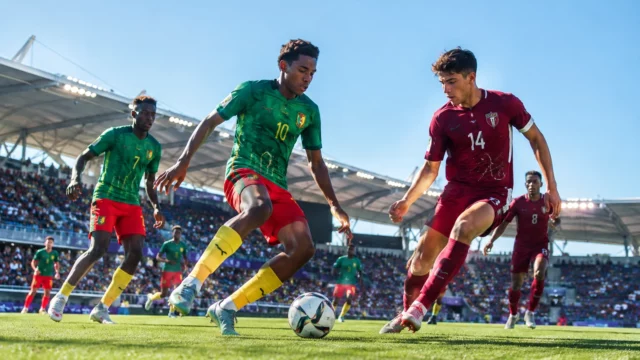
Cameroon, meanwhile, were not in the final line-up. That is a major fact. The women’s national team were eliminated by Kenya in qualifying in 2023, on penalties, after a 1-1 aggregate score. CAF explicitly stated that the Indomitable Lionesses would not take part in the tournament in Morocco.
This absence carries more weight than a missed tournament. It reveals a lack of continuity. Cameroon remains an important force in African women’s football, but its historic standing is no longer enough. As of now, FIFA still ranks Cameroon’s women’s team 71st in the world, with a highest-ever position of 41st. Status matters, but guarantees nothing without a programme, a regular run of matches and technical stability.
The episode also confirmed another reality: continental places are now won through preparation as much as performance on the pitch. The teams making progress combine local structures, player scouting, stable technical leadership and a clear calendar. Cameroon, by contrast, has too often alternated between attempts to relaunch and periods of waiting. In a 16-team tournament, that inconsistency comes at a high cost.
More than a score: competition, funding and the calendar
African women’s football is entering a phase in which gaps are narrowing, but resources remain highly unequal. CAF has increased WAFCON’s prize money and placed the competition within a more ambitious development strategy. Yet obstacles persist: costly travel, visas, low stadium attendance outside the host country and an international calendar that is sometimes poorly aligned. CAF itself has acknowledged that it still needs to find a viable place for the competition in the global calendar.
Cameroon is directly affected by this organisational challenge. As women’s competitions become more crowded, national teams without a regular league or a lasting project quickly fall behind. That affects the players, local clubs and technical staff, and more broadly the country’s ability to develop its own national team. In the short term, missing the finals deprives Cameroonian fans of exposure to the tournament. In the medium term, it reduces players’ visibility and the pressure that can help drive investment.
What this means for Central Africa and the road to 2027
The next horizon is not only continental, but global too. CAF has begun work on African qualifying for the 2027 Women’s World Cup, with a system in which teams qualifying through WAFCON and the play-offs progress towards the global places. FIFA has confirmed that Cameroon is among the nations taking part in this African process. The challenge is clear: Cameroon must return to the heart of the competition, not merely remain on the sidelines.
For Central Africa, the signal is significant. The region needs women’s teams that are visible, consistent and able to compete without waiting for the calendar to offer a helping hand. For Cameroon, the lesson is direct: historic prestige cannot replace planning or regular competition. And on a continent where women’s football is advancing rapidly, staying among the leaders now requires continuous investment.