
 Algeria
 Egypt
 Libya
 Morocco
 Sudan
 Tunisia
 Benin
 Burkina Faso
 Cabo Verde
 Côte d'Ivoire
 Ghana
 Guinea
 Guinea-Bissau
 Liberia
 Mali
 Mauritania
 Niger
 Nigeria
 Senegal
 Sierra Leone
 The Gambia
 Togo
 Central African Republic
 Chad
 DR Congo
 Equatorial Guinea
 Gabon
 Republic of the Congo
 São Tomé and Príncipe
 Burundi
 Comoros
 Djibouti
 Eritrea
 Ethiopia
 Kenya
 Madagascar
 Malawi
 Mauritius
 Mozambique
 Rwanda
 Seychelles
 Somalia
 South Sudan
 Tanzania
 Uganda
 Angola
 Botswana
 Eswatini
 Lesotho
 Namibia
 South Africa
 Zambia
 Zimbabwe
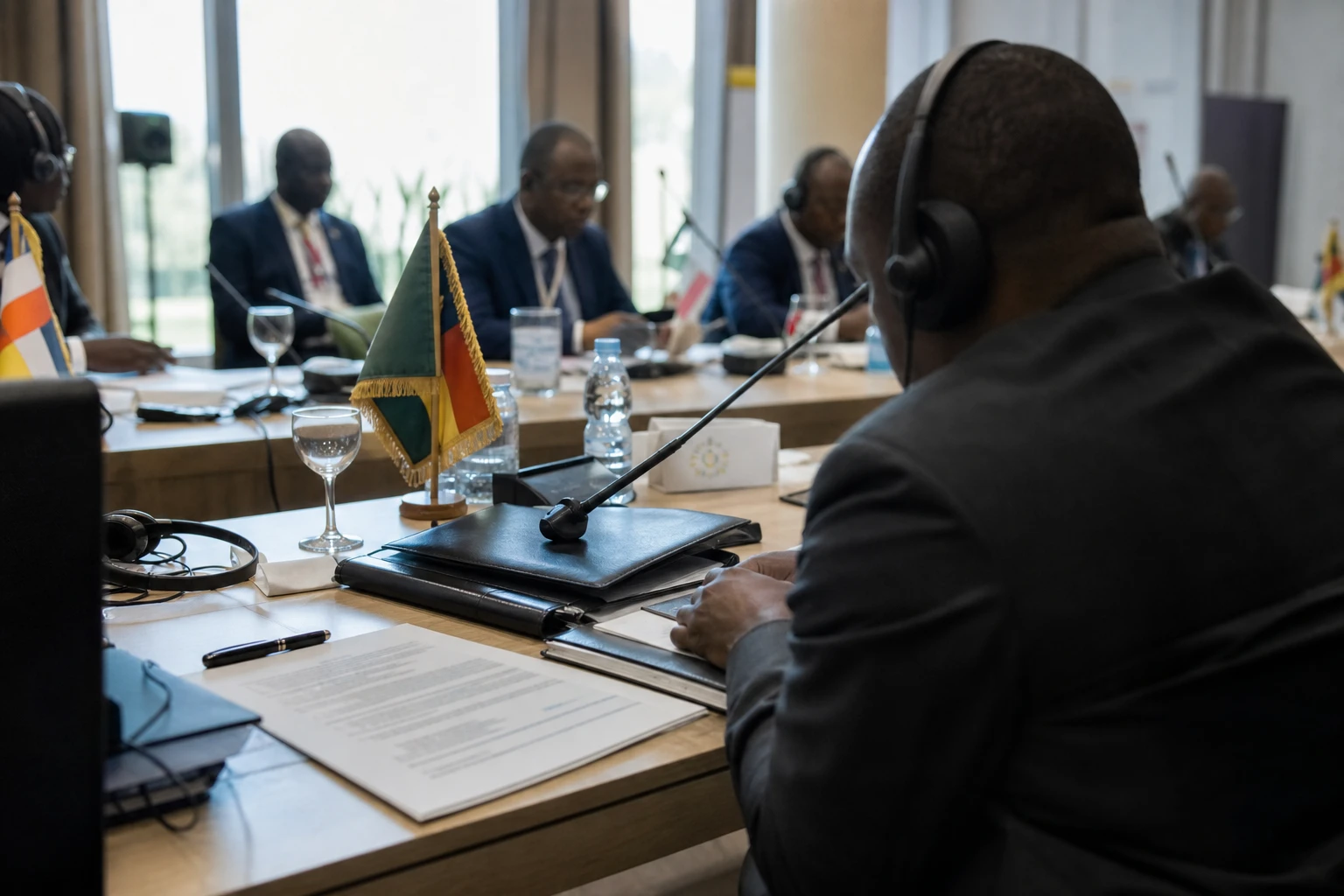
In Yaoundé, justice advances case by case
In Cameroon, hearings linked to post-election violence are not proceeding as a single block. They are being broken up, adjourned and reconfigured, while families wait for answers and defendants often remain in pre-trial detention for months. In Yaoundé, these delays reflect both the military court’s workload and the depth of the crisis that erupted after the 12 October 2025 presidential election.
The issue extends beyond the courtroom. It concerns the balance between public order, the right to protest and a reasonable length of proceedings. It also touches on the role of military justice in a country where sensitive political cases often end up before exceptional courts, a major concern for human rights advocates.
A sequence of events rooted in the October 2025 vote
On 12 October 2025, Cameroonians voted to elect the president of the republic. The Constitutional Council declared Paul Biya the winner on 27 October, with 53.66% of votes cast, according to the Cameroonian public press. The authorities then denounced calls for insurrection, while protests and arrests followed in several cities.
In this climate, people arrested in Yaoundé and other localities were brought before the capital’s military court. In January 2026, the citizens’ defence collective cited 142 defendants brought before the court in connection with the post-election case, facing charges ranging from spreading false news to unlawful assembly, rebellion and failure to carry a national identity card.
Over the following months, hearings were split up. Some cases were adjourned for further questioning, others for deliberation, and others for the prosecution’s submissions and closing arguments. One case cited by several local media outlets was adjourned until 13 August 2026 for further questioning, while another hearing was awaiting the public prosecutor’s submissions and closing arguments on 10 September 2026.
What the 13 August hearings reveal
The 13 August hearing, reported by local media, focused mainly on the circumstances of the detainees’ arrests, whether they had in fact been present at the protests, and the continued examination of the cases. According to the defence, the defendants were eventually heard, despite the language barrier faced by some. Lawyers see this as a modest procedural advance, but not yet a sign of any real acceleration.
This sense of delay is not new. The lawyers’ collective had already called for the cases to be distributed among several judges to prevent them from becoming bogged down. Hearings are being held at an irregular pace, with groups separated and successive adjournments. In practice, this means weeks, sometimes months, of additional waiting for detainees before their cases are even heard on their merits.
Human rights organisations have described a wave of mass arrests after the vote, prolonged detention and limited access to lawyers for some defendants. Human Rights Watch reported in November 2025 that several people arrested in Yaoundé were being held at the State Secretariat for Defence, a facility already documented for the use of torture. Amnesty International, for its part, has recalled that protesters remained in detention for years after other waves of arrests linked to political protests in Cameroon.
A judicial issue, but also a political and social one
For the authorities, these events are part of the response to unrest following the presidential election. For families, they have become a long wait marked by travel costs, irregular visits and uncertainty over the outcome of proceedings. For lawyers, the issues are the proportionality of the charges, the quality of the evidence and respect for the right to a hearing within a reasonable time.
Military justice is at the centre of several tensions here. It is handling cases involving civilians and linked to political dissent, prompting long-standing criticism in Cameroon and beyond. Human rights advocates believe this type of court exposes defendants to greater risks of opaque proceedings and prolonged detention. The authorities, for their part, defend the judicial handling of acts they describe as serious threats to public order.
The contrast is stark between the political capital, where hearings are held under judicial supervision, and conditions on the ground, where several hundred people have been arrested according to figures cited by the defence, with detentions also reported in Douala, Bafoussam, Dschang, Bertoua and Maroua. This geographical spread shows that the crisis has extended beyond Yaoundé and affected much of Cameroon.
What to watch in the coming weeks
The next announced stage in several cases is crucial: submissions by the public prosecutor, closing arguments and then rulings by the military court. If adjournments continue, the case will remain a marker of Cameroon’s difficulty in bringing electoral episodes to a close through clear and swift justice. If rulings are delivered, they will be closely watched both for their substance and for how the court handles civilian defendants in a political case.
Across Central Africa, the Cameroonian case resonates beyond Yaoundé. It raises questions about how a CEMAC state—the Economic and Monetary Community of Central Africa—manages electoral dissent without leaving hundreds of people trapped in drawn-out proceedings. It also underlines a continental truth: institutional stability is measured in part by the ability to deliver swift, consistent and credible justice after an election.



