Algeria
 Egypt
 Libya
 Morocco
 Tunisia
 Benin
 Burkina Faso
 Cabo Verde
 Côte d'Ivoire
 Ghana
 Guinea
 Guinea-Bissau
 Liberia
 Mali
 Mauritania
 Niger
 Nigeria
 Senegal
 Sierra Leone
 The Gambia
 Togo
 Cameroon
 Central African Republic
 Chad
 DR Congo
 Equatorial Guinea
 Gabon
 Republic of the Congo
 São Tomé and Príncipe
 Burundi
 Comoros
 Djibouti
 Eritrea
 Ethiopia
 Kenya
 Madagascar
 Malawi
 Mauritius
 Mozambique
 Rwanda
 Seychelles
 Somalia
 South Sudan
 Tanzania
 Uganda
 Angola
 Botswana
 Eswatini
 Lesotho
 Namibia
 South Africa
 Zambia
 Zimbabwe
At Meroë, Sudan’s heritage holds firm, but cracks are appearing
In northern Sudan, the pyramids of Meroë are more than an archaeological postcard. They are a historical landmark, a source of national pride and a major tourism asset for communities that have already paid the price of war. Today, the danger does not come from a single dramatic act of force. It comes from a quieter accumulation: the absence of guards, the suspension of conservation missions, encroaching sand and instability that cuts the sites off from the rest of the country.
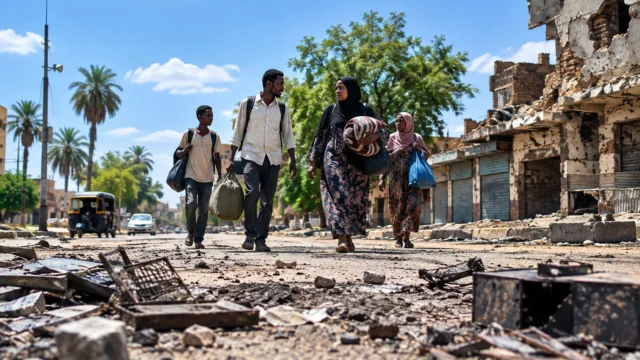
Sudan has been experiencing an armed conflict between forces on the ground since April 2023, with profound effects on the capital, Khartoum, and on the northern regions, where several ancient sites are located. In this context, heritage is not a secondary issue. It affects memory, the local economy, research and the country’s international image. In January 2024, UNESCO also reminded parties that the site on the Island of Meroe must be protected from any military use.
A major site of the Kingdom of Kush, between the Nile and Atbara
The archaeological sites on the Island of Meroe have been on the UNESCO World Heritage List since 2011. They include the royal city of Meroe, the pyramid necropolises and two major associated centres, Naqa and Musawwarat es-Sufra. Together, they bear witness to the scale of the Kingdom of Kush, an ancient African power that flourished from the eighth century BC to the fourth century AD.
The site lies about 200 kilometres north of Khartoum, in a semi-desert area between the Nile and the Atbara. This landscape, both arid and steeped in a long history, explains the expression “Island of Meroe”: the area was once surrounded by an ancient river course. There are more than 200 pyramids, according to the AP, built between 800 BC and 350 AD as royal tombs. Their profile is narrower and more angular than that of the Egyptian pyramids, giving them an instantly recognisable visual identity.
UNESCO also notes that the site preserves traces of artistic exchanges between the Pharaonic world, Greece and Rome. In other words, Meroe tells not only the story of ancient Sudan, but also of the movement of African and Mediterranean influences through a Nile region long connected to major networks of power.
War has halted conservation, and sand has taken the place of teams
The assessment on the ground is straightforward and worrying: preservation efforts have almost ground to a halt. The AP reports that the war has stopped protection work, while guards and inspectors describe sand accumulating on the pyramids and inside the temples, with visible signs that the stone is beginning to deteriorate. One of the guards, Mustafa Ahmed, says the blocks are weakening and stones are beginning to fall.
The problem is not solely linked to the conflict. Experts cited by the AP also point to climate change, which is worsening erosion and desertification, as well as the dispersal of the workforce caused by the war. Foreign missions are also finding it difficult to return to the area in safe conditions. The result is tangible: without a continuous presence, the sites lose their day-to-day upkeep, and in a complex as fragile as Meroe, administrative neglect can quickly become a material risk.
UNESCO’s statements point in the same direction. In 2024, the organisation expressed deep concern over the armed conflict, noted that the crisis was complicating management of the property and recommended renewed technical and financial support. The World Heritage Committee even envisaged that the site could eventually be added to the List of World Heritage in Danger if the situation did not improve.
A cultural, economic and political issue
At Meroe, the stakes extend far beyond the stones. When visits stop, an entire local economy slows down: guards, guides, small businesses, local transport, and tourism and hospitality services. In a country where the war is already disrupting formal economic networks, heritage also loses some of its capacity to support informal livelihoods, which are often essential in rural areas of northern Sudan.
The case of Meroe also illustrates a broader reality in Sudan: war is simultaneously weakening institutions, museums, archives and sites in the field. In 2024, UNESCO warned that cultural and historical sites were increasingly at risk, with damage to more than a hundred cultural sites and at least 22 museums looted or destroyed since the conflict began, according to figures reported by the AP. Such an assessment is a reminder that heritage is not protected by its age. It depends on a very tangible human, logistical and administrative chain.
There is also a symbolic dimension. For Sudanese people, Meroe is visible proof that the country’s history did not begin with the war or recent crises. It evokes an ancient state, queens, kings, architectural expertise and Sudan’s central place in African history. In a context of national fragmentation, this kind of site is a reminder of a shared heritage beyond the front lines.
What Meroe says about Africa in times of crisis
The Sudanese case speaks to the entire continent. It shows that protecting heritage is not only a matter of culture, but also of security, land-use planning and institutional continuity. When war takes hold, archaeologists leave, guards are left on their own and sites deteriorate. That is exactly what is happening today at Meroe, as well as at Naqa and Musawwarat es-Sufra.
What happens next will depend on the ability of the Sudanese authorities, local teams and international partners to return to the sites as soon as conditions allow. UNESCO was already expecting an updated report on the state of conservation by 1 February 2025. But beyond that deadline, the real question remains the same: how can a major African heritage be preserved when the state is fighting for its day-to-day survival? At Meroe, the answer now lies in the long term, between emergency protection and patient reconstruction.