Algeria
 Egypt
 Libya
 Morocco
 Sudan
 Tunisia
 Benin
 Burkina Faso
 Cabo Verde
 Côte d'Ivoire
 Ghana
 Guinea
 Guinea-Bissau
 Liberia
 Mali
 Mauritania
 Niger
 Nigeria
 Senegal
 Sierra Leone
 The Gambia
 Togo
 Cameroon
 Central African Republic
 Chad
 DR Congo
 Equatorial Guinea
 Gabon
 Republic of the Congo
 São Tomé and Príncipe
 Burundi
 Comoros
 Djibouti
 Eritrea
 Ethiopia
 Kenya
 Madagascar
 Malawi
 Mauritius
 Mozambique
 Seychelles
 Somalia
 South Sudan
 Tanzania
 Uganda
 Angola
 Botswana
 Eswatini
 Lesotho
 Namibia
 South Africa
 Zambia
 Zimbabwe
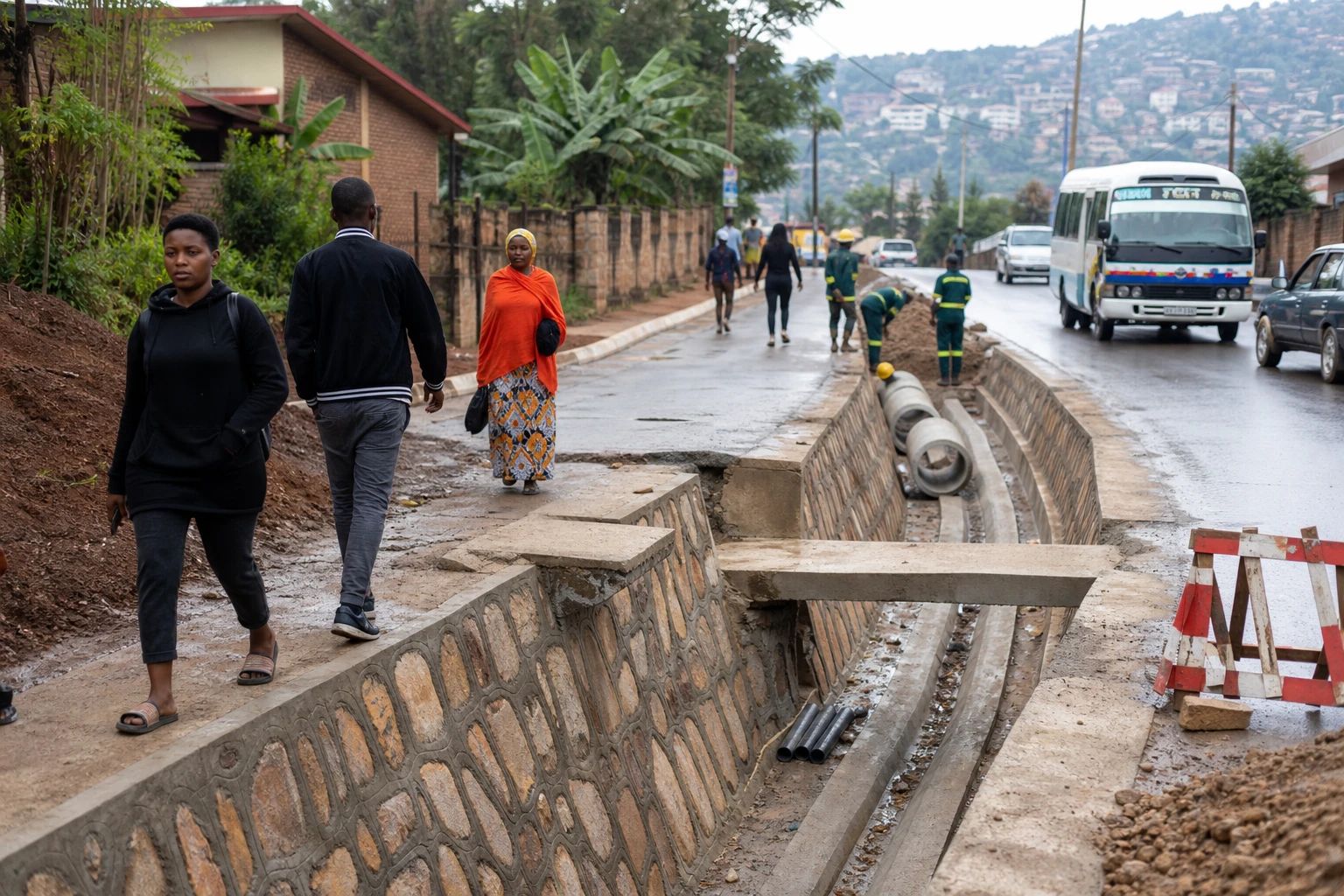
Climate costs are already weighing on households in north-western Rwanda
In the Volcanoes region, the rainy season is no longer measured only in millimetres. Its impact can also be seen in weakened roads, fields swept away, homes under threat and incomes that quickly disappear when water overflows. In Rwanda, the issue is therefore not abstract: climate adaptation has become a matter of economic, social and territorial security.
The issue also extends beyond the northern and western districts. Kigali has made climate resilience a national priority, with a series of projects to restore landscapes, manage watersheds and reduce disaster risks. In a country where agriculture, cultivated hillsides and road infrastructure are highly exposed to intense rainfall, every protective structure can make the difference between a saved harvest and a total loss.
European funding to protect eight Rwandan districts
On 5 August 2026, the Rwandan government and the European Investment Bank signed a €65 million financing agreement, equivalent to about $74.9 million, for the Volcanoes Community Resilience Project. The project is expected to directly benefit about 2.3 million people in eight districts: Burera, Gakenke, Musanze, Nyabihu, Rubavu, Rutsiro, Ngororero and Muhanga.
The European Investment Bank presents the programme as a means of strengthening climate resilience in the country’s north-west. Its aims are practical: build flood-protection infrastructure, restore watersheds, rehabilitate degraded landscapes, and strengthen ecosystems and biodiversity. The Rwandan authorities, for their part, see the initiative as part of a broader risk-management framework led by environmental, water, meteorological and territorial development institutions.
The area was not chosen at random. Project documents note that north-western Rwanda is highly vulnerable to flooding and erosion. World Bank studies estimate annual losses of about $10.1 million in the Volcanoes region alone, while soil erosion is said to cause $76 million in losses nationwide. The same data record 539 deaths, more than 18,400 homes damaged and 7,740 hectares of crops destroyed in the eight districts concerned between 2013 and mid-2023, figures that illustrate the project’s significance.
Why this funding matters beyond the figures
In Kigali, the European funding complements a strategy that is already well under way. In June 2023, the European Union and several partners, including the EIB, announced an additional €300 million to support climate resilience in Rwanda and attract more private investment. The country is also working with other donors on programmes to restore ecosystems, manage wetlands and reduce risks linked to extreme rainfall.
The VCRP is part of this approach to so-called “blended” climate finance, in which grants, loans and technical assistance are combined to make major works possible. The programme’s overall budget, covering 2024-2028, exceeds $300 million and brings together several partners, including the World Bank, the EIB, the Nordic Development Fund and the Green Climate Fund. Rwanda faces a twofold challenge: reducing recurring material losses and preventing climate disasters from placing a lasting burden on public finances.
On the ground, the expected impact differs from one group to another. For rural families, the aim is to protect plots, homes and access routes to markets. For municipalities and districts, the challenge is to maintain structures that require ongoing attention, not just concrete. For the state, the programme should also ease pressure on emergency budgets, already stretched by landslides, floods and road damage. And for tourism around the volcanoes, landscape stability matters as much as protecting neighbouring villages.
What Kigali is seeking to consolidate in the Great Lakes region
The issue also extends beyond national borders. In the East African Community, member states face the same equation: more irregular rainfall, rapid urbanisation, pressure on soils and a growing number of vulnerable infrastructure projects. Rwanda, often cited for the coherence of its environmental planning, is seeking to turn this challenge into a demonstration of good practice: restore landscapes, protect watersheds and involve local communities from the outset of project design.
The pan-African significance is clear. On a continent where climate adaptation receives less funding than mitigation, this kind of project shows that an effective response depends not only on grand speeches, but also on fieldwork, early-warning systems and precise management of at-risk areas. In the coming months, attention will focus on whether the works are actually delivered, the pace of disbursement and the districts’ ability to maintain the structures over time. That is where the credibility of this new stage in Rwanda’s resilience efforts will be decided in practice.