
 Algeria
 Egypt
 Libya
 Morocco
 Sudan
 Tunisia
 Benin
 Burkina Faso
 Cabo Verde
 Côte d'Ivoire
 Ghana
 Guinea
 Guinea-Bissau
 Liberia
 Mali
 Mauritania
 Niger
 Nigeria
 Senegal
 Sierra Leone
 The Gambia
 Togo
 Central African Republic
 Chad
 DR Congo
 Equatorial Guinea
 Gabon
 Republic of the Congo
 São Tomé and Príncipe
 Burundi
 Comoros
 Djibouti
 Eritrea
 Ethiopia
 Kenya
 Madagascar
 Malawi
 Mauritius
 Mozambique
 Rwanda
 Seychelles
 Somalia
 South Sudan
 Tanzania
 Uganda
 Angola
 Botswana
 Eswatini
 Lesotho
 Namibia
 South Africa
 Zambia
 Zimbabwe
A useful border, but exposed to everyday friction
Between Bangui and Yaoundé, the border is more than a line on a map. It is a route for movement, trade and security linking the south-west of the Central African Republic to north-east Cameroon, with the Bangui–Bouar–Béloko corridor at the heart of regional exchanges. In this area, even the smallest altercation can quickly take on political significance because it touches on sovereignty, customs revenue and trust between security forces.
Cameroon and the Central African Republic belong to CEMAC, the Economic and Monetary Community of Central Africa, which aims, among other things, to ensure the free movement of goods and people. But the reality on the ground is more complicated: porous borders, armed groups, various forms of trafficking and informal checks weigh on border communities as well as transport operators. On the Cameroonian side, the French authorities advise against all but essential travel within a 30-kilometre strip along the border with the Central African Republic, a sign that the environment remains fragile.
Against this backdrop, the two capitals had already declared their intention to strengthen cross-border co-operation on 18 June 2026 in Motcheboum. The bilateral meeting, held in Cameroon’s East Region, brought together the defence ministers of both countries and focused specifically on securing their shared border. In other words, the incident in early August did not occur in a diplomatic vacuum: it tested, almost immediately, a co-operation that is still taking shape.
What happened in Gasol, and why the affair was quickly defused
On Saturday 1 August, two Cameroonian gendarmes were intercepted in the village of Gasol, on the Central African side, a few kilometres from the border. According to the account relayed by Bangui, their presence in the locality was considered an unauthorised incursion into national territory. Residents challenged their passage and accused them of extortion, before the intervention of the Central African Armed Forces deployed in the area. The two men were disarmed and taken to the Béloko police station, the Central African border post on the route to Garoua-Boulaï. These details are attributed to the Central African authorities and to the account given locally.
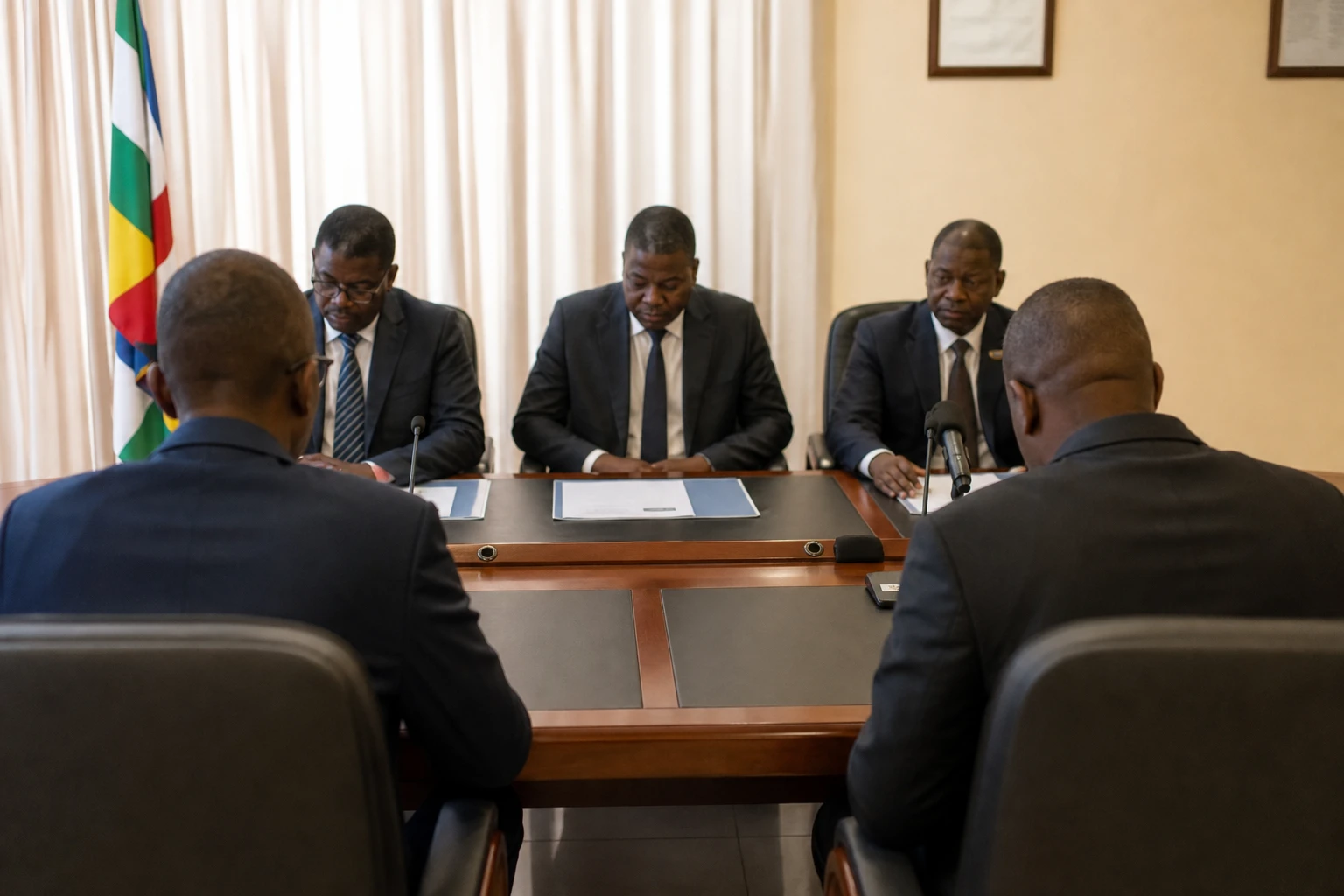
What followed happened quickly. Senior officials from both countries then met, and the tone changed. The weapons seized were returned to the Cameroonian gendarmerie, while a monitoring committee was set up to prevent tensions from escalating. Both states reaffirmed their commitment to respecting each other’s sovereignty. On such a sensitive border, the political handling of the incident mattered as much as the incident itself.
This approach is significant. In an area where the movement of people is often intertwined with that of goods, informal taxes and sometimes criminal networks, a clash between uniformed officers can quickly be interpreted as a provocation. Dialogue therefore served as a tool for stabilisation. It also prevented a local event from turning into a broader bilateral dispute, at a time when both countries are seeking to secure trade corridors and sensitive posts.
A longstanding border dispute, amid territorial control and transit trade
The affair recalls a recurring grievance on the Central African side: for years, some residents and local stakeholders have said that part of the border area is subject to an illegal occupation attributed to Cameroon. Yaoundé rejects the accusation. This longstanding disagreement is about more than a symbolic quarrel. It concerns the demarcation of boundaries, the state’s administrative presence, the security of border villages and control of the flows passing through Béloko and Garoua-Boulaï, a key crossing for the Central African economy.
For Bangui, the western border is strategic. The corridor leading to Cameroon serves as the country’s main artery for supplies and the collection of public revenue. The Central African Ministry of Finance also points out that the CAR is landlocked and that intra-community trade is among CEMAC’s objectives. When this corridor comes under strain, it is not only uniformed personnel who eye one another warily: traders, drivers, customs officers, small-scale transport operators and households also suffer delays, extra costs and insecurity.
Cameroon, for its part, also has an interest in preserving calm. The East Region is a transit area, but also one under constant surveillance. Security services there are stepping up operations against crime, smuggling and trafficking. In such an environment, the border with the Central African Republic requires close co-ordination between the gendarmerie, customs, local authorities and central administrations. Any misstep can complicate the co-operation needed to secure roads, posts and villages.
What the episode says about the sub-region
At regional level, the affair shows how cross-border security has become a practical test for CEMAC, as well as for the partners present in the Central African Republic. The European Union, through its civilian mission EUAM RCA, notes that the Bangui–Bouar–Béloko corridor is essential for trade flows, territorial continuity and co-ordinated border management. This confirms that the issue goes beyond the conduct of a single patrol. It concerns the governance of an entire transit area.
For Central Africa, the message is clear: bilateral agreements only matter if they reach the ground, where residents see uniforms before they see communiqués. The Gasol episode is a reminder of an often-forgotten truth: in border areas, sovereignty is not merely proclaimed; it is practised. And it is measured by the ability of neighbouring states to deal swiftly with a local incident without disrupting the broader balance of their co-operation.



