Algeria
 Egypt
 Libya
 Morocco
 Sudan
 Tunisia
 Benin
 Burkina Faso
 Cabo Verde
 Côte d'Ivoire
 Ghana
 Guinea
 Guinea-Bissau
 Liberia
 Mali
 Mauritania
 Niger
 Nigeria
 Senegal
 Sierra Leone
 The Gambia
 Togo
 Central African Republic
 Chad
 DR Congo
 Equatorial Guinea
 Gabon
 Republic of the Congo
 São Tomé and Príncipe
 Burundi
 Comoros
 Djibouti
 Eritrea
 Ethiopia
 Kenya
 Madagascar
 Malawi
 Mauritius
 Mozambique
 Rwanda
 Seychelles
 Somalia
 South Sudan
 Tanzania
 Uganda
 Angola
 Botswana
 Eswatini
 Lesotho
 Namibia
 South Africa
 Zambia
 Zimbabwe
An absence that goes beyond mere rumour
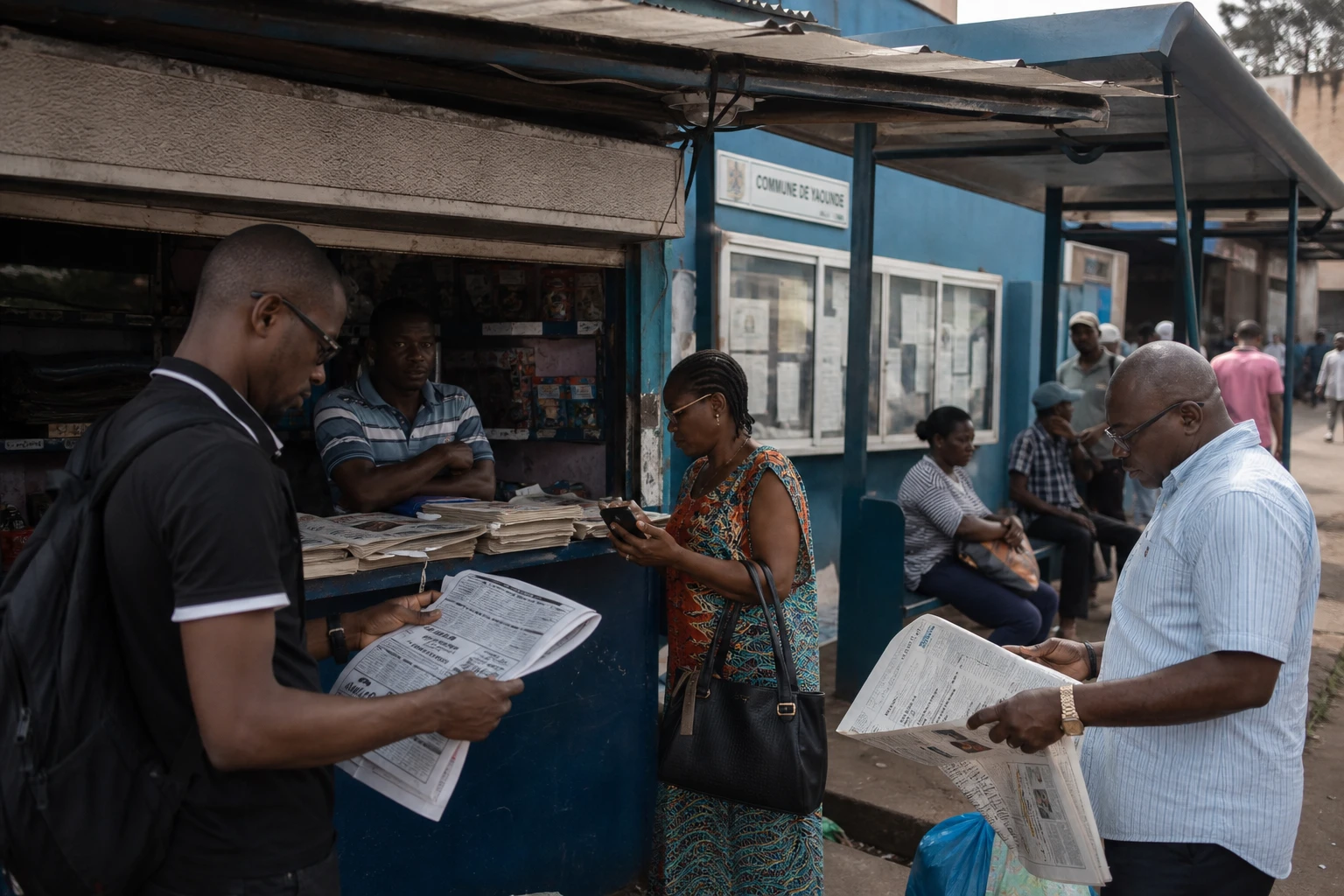
In Yaoundé, a question has become part of everyday conversation, well beyond political circles: who is really setting the pace of the state when the head of the executive disappears from public view for weeks? In Cameroon, this is more than idle curiosity. It touches on institutional continuity, the flow of official information and trust in a system long organised around one man.
The debate intensified after Paul Biya left on 7 June 2026 for what had been presented as a “short private stay in Europe”. The 93-year-old Cameroonian president has not appeared in public since. In the media and on the streets of the capital, the lack of recent images and direct statements has given way to speculation, although no official announcement has confirmed a power vacuum.
A country accustomed to concentrated power
Cameroon is a pivotal state in Central Africa. It belongs to CEMAC, the Economic and Monetary Community of Central Africa, which brings together six countries and is headquartered in Bangui. Political stability in Cameroon carries considerable weight in the sub-region, as the country is among the most structured economies and administrations in the community. Any hesitation at the top in Yaoundé therefore reverberates well beyond national borders.
This episode also comes amid institutional change. In April 2026, parliament adopted a constitutional reform reinstating the post of vice-president, which the government presented as a response to the question of continuity of the state in the event of a vacancy. The opposition, by contrast, sees it as a further mechanism for tightening control. The Constitutional Council subsequently amended its organic laws to reflect the new framework.
In other words, the country was already discussing the post-Biya era before his absence lengthened. In a system where decisions are largely made by the presidency, the issue is not merely medical or symbolic. It is, first and foremost, institutional.
Decrees to show that the state is still functioning
In response to questions, the Cameroonian authorities have stepped up efforts to show that the head of state remains in charge. On 7 June, the public broadcaster announced his departure as a private trip. On 19 June, the government rejected rumours that he had been hospitalised in Geneva, saying that Paul Biya was indeed in Switzerland but was not in a medical facility.
At the end of July, another development reinforced this narrative of continuity: a financing agreement with the Islamic Development Bank, announced at about 28 billion CFA francs. Then, on 3 August, several appointments in the military hierarchy were published, including the promotion of five colonels to the rank of brigadier-general and the appointment of Major-General Ebaka Hypolite as major-general of the armed forces, according to the official press. These decisions were interpreted as a message that the state apparatus was under control.
This strategy of demonstration has its limits, however. A decree signed remotely proves administrative capacity. It cannot replace political presence or the image of a clearly identifiable decision-making centre. That is where tensions arise. The government can insist that the machine is running. Part of the public, meanwhile, is asking who is actually operating it day to day.
What the absence means for the state and Cameroonians
In markets, government offices, newsrooms and activist networks, the same pattern has taken hold: silence fuels concern. The issue is not only the health of a public figure. It concerns the ability of institutions to absorb the unexpected without creating a grey area. In Cameroon, where the president still holds a large share of political initiative, that grey area quickly becomes a national issue.
For the government, the central argument remains continuity. For the opposition and several observers, the problem lies elsewhere: the president’s prolonged absence, combined with the reform creating the post of vice-president and the lack of public debate on succession, gives the impression of a system preparing for transition without openly acknowledging it. The result is diffuse tension between official caution and public impatience.
This tension weighs differently on different groups. For Yaoundé’s elites, it means alliance calculations, signals to the security forces and discreet repositioning. For residents, it is evident in the lack of clear information, the rumours circulating in corridors and the sense that an entire country is moving forward without a clear map. Cameroon is not paralysed. But it is operating with reduced political visibility, fuelling distrust.
A Cameroonian episode with regional repercussions
At the regional level, the episode goes beyond the debate in Cameroon alone. In Central Africa, the stability of capitals matters as much as the texts of laws. In a CEMAC already focused on governance, public finances and institutional reforms, any uncertainty in Cameroon sends a signal. It is a reminder that in Central Africa, the strength of a state is measured not only by its economic announcements but also by its ability to make the succession of power clear.
The Cameroonian precedent is being watched all the more closely because the country continues to face persistent security challenges, particularly in the anglophone regions and from the threat of Boko Haram in the Far North. In this context, every ambiguity at the top affects perceptions of state authority. That is also why the question of the post-Biya era is no longer taboo. It has become a political issue in its own right, with an implicit deadline: whether the new institutional rules will be enough to avert a power-vacuum crisis when the absence is no longer merely temporary.