Algeria
 Egypt
 Libya
 Morocco
 Sudan
 Tunisia
 Benin
 Burkina Faso
 Cabo Verde
 Côte d'Ivoire
 Ghana
 Guinea
 Guinea-Bissau
 Liberia
 Mali
 Mauritania
 Niger
 Senegal
 Sierra Leone
 The Gambia
 Togo
 Cameroon
 Central African Republic
 Chad
 DR Congo
 Equatorial Guinea
 Gabon
 Republic of the Congo
 São Tomé and Príncipe
 Burundi
 Comoros
 Djibouti
 Eritrea
 Ethiopia
 Kenya
 Madagascar
 Malawi
 Mauritius
 Mozambique
 Rwanda
 Seychelles
 Somalia
 South Sudan
 Tanzania
 Uganda
 Angola
 Botswana
 Eswatini
 Lesotho
 Namibia
 South Africa
 Zambia
 Zimbabwe
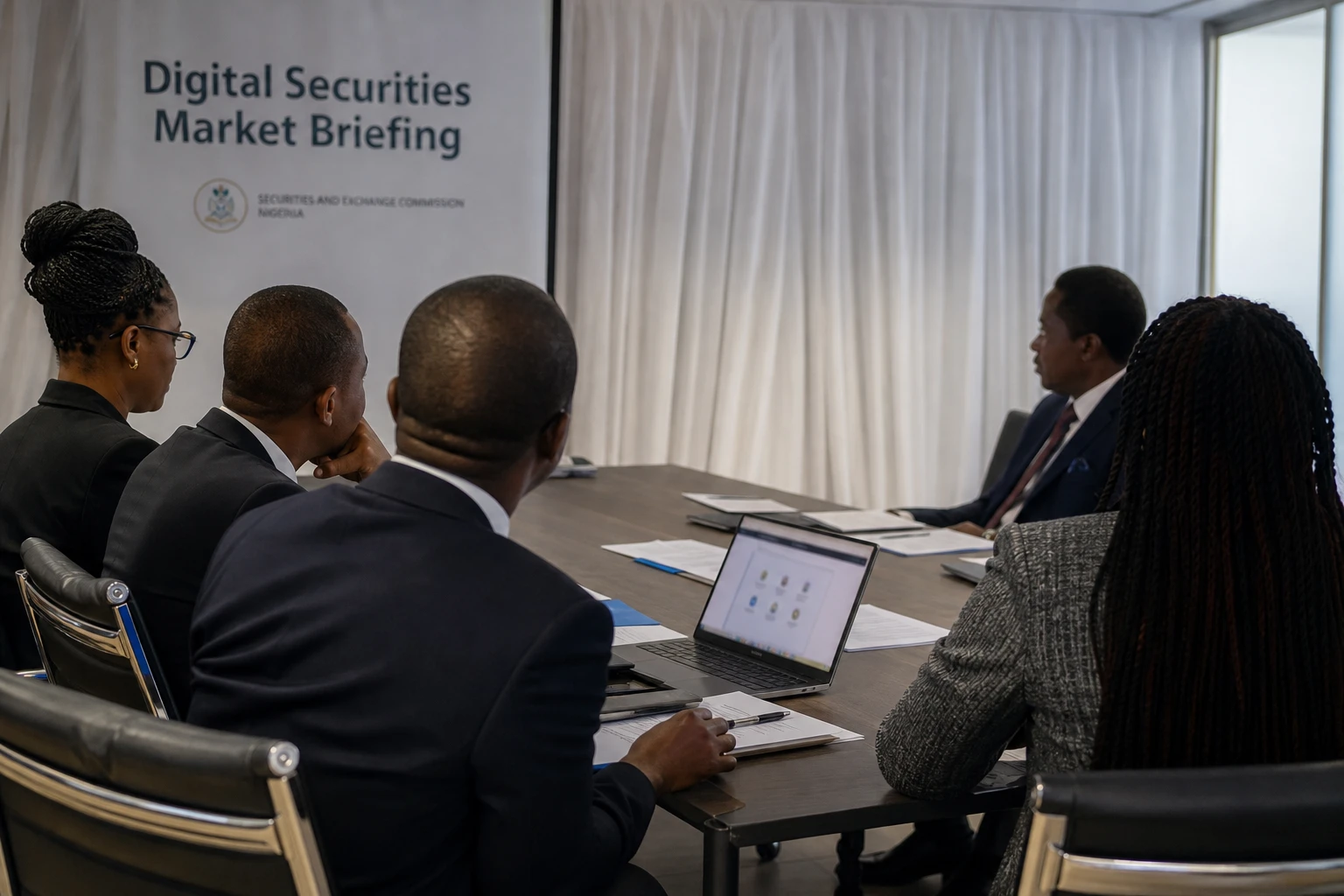
A broader market, with smaller entry points
In Abuja, the question is no longer just how to finance businesses. It is now who can enter the market, at what cost and how quickly. In an economy where small firms account for most formal and informal activity, access to capital often remains slower than Nigerian entrepreneurs’ ambitions. The shift to tokenised securities — shares or bonds represented by digital tokens on a blockchain — is designed precisely to narrow that gap.
Nigeria has already laid the regulatory groundwork for this shift. The Securities and Exchange Commission, the capital markets regulator, says it oversees digital assets when they qualify as securities. The new Investments and Securities Act, adopted in 2025, explicitly mentions virtual assets, digital assets, tokens and products based on distributed ledger technologies. It also confirms the Commission’s role as the Nigerian market’s principal authority.
Against this backdrop, the NASD OTC Securities Exchange, based in Lagos and regulated by the SEC, is preparing to launch a public offering of digital securities, announced for early September. NASD is the over-the-counter market for companies not listed on the Lagos Stock Exchange. Its role is to provide liquidity and transparency for businesses that do not use the main market.
What tokenisation changes for Nigerian businesses
The principle is simple. Instead of a conventional register, ownership is recorded in the form of tokens, with issuance, trading, clearing and settlement taking place on a single infrastructure. In Nigeria, the operator relies on technology provided by Blockstation, which already has an agreement with NASD to provide a blockchain platform for tokenising, listing, trading, clearing and settling assets in a regulated environment. Market orders continue to go through licensed brokers. Oversight remains with the SEC.
The practical benefits lie in two effects. First, fractional ownership lowers the entry threshold for savers. Second, ownership transfers can become near-instantaneous, whereas traditional processes take longer. This promise matters for small and medium-sized enterprises. The market offers them a faster and potentially cheaper source of funding than conventional bank loans, which are often difficult to secure for firms with limited documentation or those too small for banks.
The underlying problem is well known. Nigeria has about 41.5 million micro, small and medium-sized enterprises, according to the latest major statistical census available from the National Bureau of Statistics. Another widely cited estimate in public debate puts the figure at 40 million, of which only 4% are said to have access to formal bank credit, according to a study cited in 2025. Even allowing for caution over these figures, the diagnosis remains sound: Nigeria’s economy is powered by a vast but underfunded network of businesses.
The consequences are tangible. For large companies and institutional investors, tokenisation opens an additional fundraising channel. For smaller firms, it could reduce dependence on expensive loans, often secured against assets that many do not have. For urban savers, particularly a large and connected younger generation, it could make the market more accessible. Nigeria has for several years repeated that more than 60% of its population is under 30. This is not merely a demographic fact. It is also a spur to create financial products that are simple, mobile and low-cost.
The regulatory timetable also matters. Since June 2026, the SEC has announced that Nigeria’s equity and commodities markets have moved to a T+1 settlement cycle — settlement on the business day after a transaction — following the implementation of T+2 in late November 2025. Tokenisation is part of this broader push to shorten settlement times and modernise market infrastructure. It does not replace existing rules; it drives them towards greater speed and traceability.
Abuja, Lagos and the ripple effect across Africa
The issue extends beyond Nigeria. Across Africa, several financial centres are seeking to modernise securities issuance and settlement. On 8 May 2026, the Central Bank of West African States held an international conference in Dakar on crypto-assets and digital innovations, highlighting the implications for monetary and financial stability in WAEMU, the West African Economic and Monetary Union. A common framework has yet to be harmonised across the sub-region.
Further east, the Nairobi Securities Exchange has also made progress on tokenisation and instant settlement through an exploratory memorandum of understanding with Tether, according to public announcements available this summer. Across the continent, this confirms that African markets do not want to remain spectators as digital financial infrastructure is designed elsewhere. Each is seeking, at its own pace, solutions to cut intermediation costs and attract new investors.
In this landscape, NASD has a useful role. The platform is already recognised as Nigeria’s over-the-counter market for unlisted securities and is a member of the African Securities Exchanges Association. Its own website says its market capitalisation reached 2.12 trillion naira in 2026, after strong growth the previous year. This expansion lends weight to the digital experiment. It also shows that demand for alternative financing instruments comes not only from technology start-ups, but from a wider market of companies seeking liquidity.
One central challenge remains: trust. The SEC has repeatedly warned against unregistered platforms and unauthorised investment offers. Tokenised shares will succeed only if investors understand what they are buying, brokers follow the rules and digital securities are held securely. For a market still at an early stage in this segment, technology can speed up access to capital. It cannot, on its own, replace regulatory discipline.
The message from Lagos is clear. Nigeria wants to test a new way of financing its businesses, under supervision. If the experiment succeeds, it could inspire other West African financial centres and strengthen the idea that an African financial market can also be built through local innovation, rather than simply importing foreign models. That is where the story’s continental significance lies.