Algeria
 Egypt
 Libya
 Morocco
 Sudan
 Tunisia
 Benin
 Burkina Faso
 Cabo Verde
 Côte d'Ivoire
 Ghana
 Guinea
 Guinea-Bissau
 Liberia
 Mali
 Mauritania
 Niger
 Nigeria
 Senegal
 Sierra Leone
 The Gambia
 Togo
 Cameroon
 Central African Republic
 Chad
 DR Congo
 Equatorial Guinea
 Gabon
 São Tomé and Príncipe
 Burundi
 Comoros
 Djibouti
 Eritrea
 Ethiopia
 Kenya
 Madagascar
 Malawi
 Mauritius
 Mozambique
 Rwanda
 Seychelles
 Somalia
 South Sudan
 Tanzania
 Uganda
 Angola
 Botswana
 Eswatini
 Lesotho
 Namibia
 South Africa
 Zambia
 Zimbabwe
Gas changes the economic equation
In a country where hydrocarbons account for a large share of public revenue, a new industrial start-up can shift far more than barrels or gas cargoes. In the short term, it can support growth, reduce the import bill for construction projects and give the budget some breathing space. That is precisely the case for the Republic of the Congo, where economic activity remains highly sensitive to changes in oil and gas production. In February 2026, phase II of the Congo LNG project began exporting liquefied natural gas from Pointe-Noire, bringing total capacity to 3 million tonnes a year, or about 4.5 billion cubic metres of gas annually.
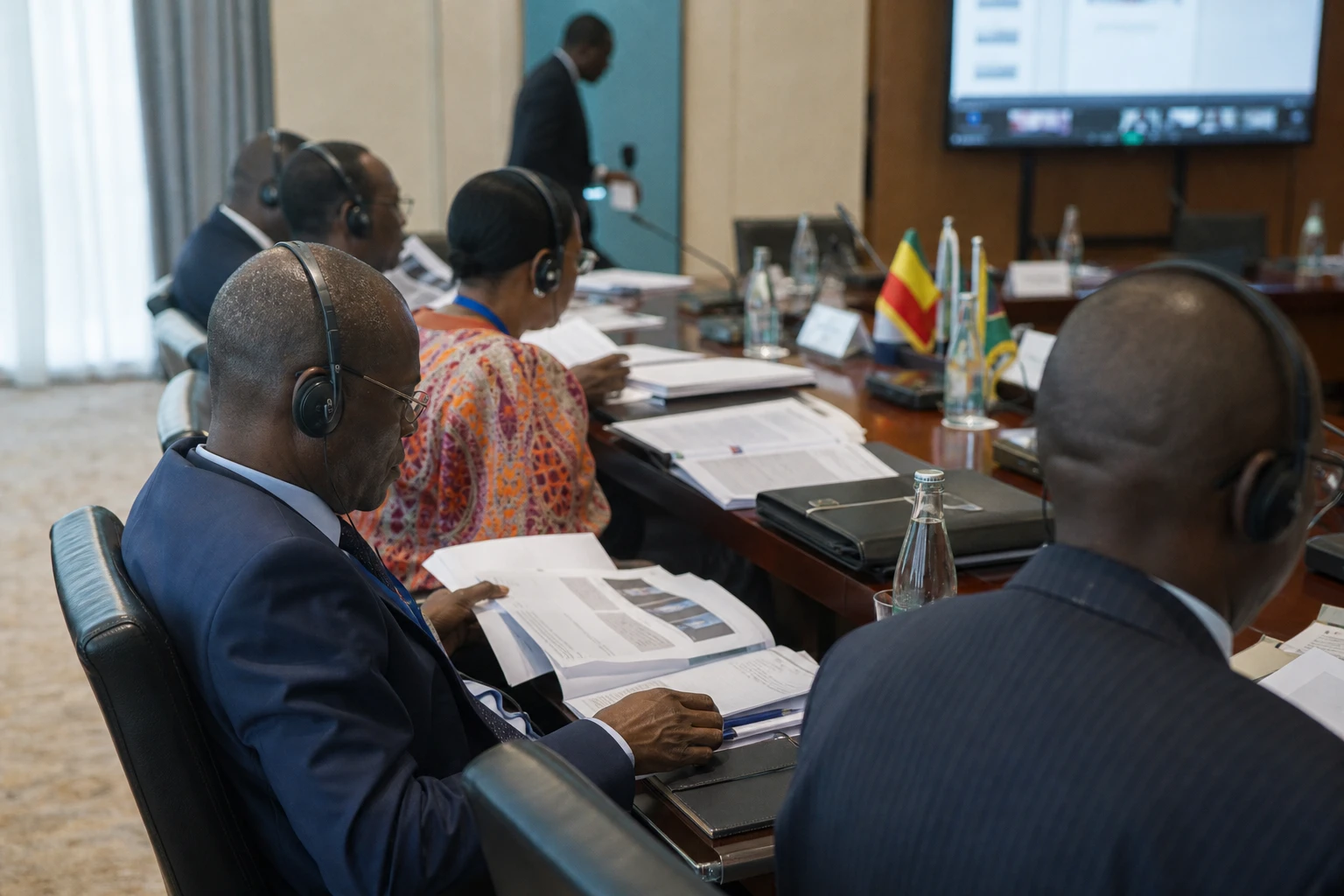
For Brazzaville, the challenge is clear: to turn a resource still largely concentrated underground into budgetary room for manoeuvre and real activity in the domestic economy. The issue also matters for CEMAC, the Economic and Monetary Community of Central Africa. On 22 January 2026, the Congo hosted an extraordinary summit of the sub-region’s heads of state in Brazzaville, focused on economic and monetary stability. In other words, the country is moving forward within a regional framework where fiscal discipline, bank liquidity and reliance on commodities remain central to the debate.
What the growth outlook predicts
Against this backdrop, Fitch Solutions expects real GDP growth in the Congo to accelerate to 5.2% in 2026, from 2.5% in 2025. The projection is based primarily on rising hydrocarbon exports, with national production expected to increase by 27.2%, driven in particular by a surge in gas output. The central assumption is linked to Congo LNG phase II, operated by Eni under the offshore Marine XII permit. The Italian company has confirmed that the phase brings liquefaction capacity to 3 million tonnes a year, up from 0.6 million in phase I.
This is no mere technical detail. The Congo is becoming a more prominent player on the global gas supply map, with knock-on effects for exports, foreign currency and state revenues. The Congolese economy already recorded a moderate recovery in 2025, but the International Monetary Fund warned in its assessment published in 2026 that the recovery remained vulnerable to external shocks, debt and sectoral concentration. The same document notes that high oil revenues can provide a useful window to strengthen reforms and diversify the economy.
The Congolese authorities appear to be banking on this opportunity. On 14 July 2026, the finance ministry presented a draft supplementary budget for 2026, raising revenue to 2,778 billion 16 million CFA francs and expenditure to 2,561 billion 69 million CFA francs, from lower amounts in the initial budget law. The ministry also said the assumed price for Congolese crude had been raised to $67 a barrel, from $60.3, and that public spending had been revised upwards.
Higher revenues, but difficult trade-offs
The expected rise in production will not make constraints disappear. It may, in fact, make them more apparent. On the one hand, more hydrocarbons mean higher budget revenues, greater capacity to fund current transfers and public procurement, and a little more flexibility to support households. On the other, dependence on oil remains unchanged. If international prices fall or production stalls, the windfall can quickly evaporate. The Congo has already learned this from previous cycles.
Social pressures matter just as much. In June 2026, the Bank of Central African States, or BEAC, said inflation in CEMAC had fallen to 1.4% at the end of March 2026, below the community threshold of 3%. But the same institution also showed that the Republic of the Congo was still contributing to inflationary pressures across the sub-region, with persistent price pressures in an environment where food and logistics costs remain sensitive. At national level, the National Institute of Statistics reported average annual inflation of 1.2% in April 2026. The picture, then, is less one of a generalised surge in prices than of an economy still exposed to shocks affecting transport, supply and incomes.
In this context, the impact of Congo LNG phase II will not be uniform. In Brazzaville, the government can hope for greater budgetary room for manoeuvre and more credibility with its partners. In production areas and around the port of Pointe-Noire, industrial activity could support some services, transport and subcontracting. For households, however, the benefits will depend above all on the state’s ability to stabilise prices, make payments on time and prevent additional revenue from being squandered on costly imports or unproductive spending.
A signal for Central Africa
The implications extend beyond the Republic of the Congo. In Central Africa, the question is no longer simply whether to produce hydrocarbons, but what that windfall will fund. CEMAC, facing liquidity pressures, debates over public financing and expectations of a recovery, is seeking to stabilise its macroeconomic framework without constraining growth. Discussions in Brazzaville in January 2026 underscored this priority. If the Congo’s gas exports do indeed ramp up, they could support not only the national economy but also external accounts and the country’s position in regional dialogue on fiscal sustainability.
The real test, however, will come after the initial fanfare. The implementation of the revised 2026 budget, the evolution of export volumes, the stability of domestic prices and the way the central bank supports credit without reigniting inflationary pressures will all need to be monitored. Fitch Solutions’ scenario also assumes a relatively favourable international environment, with energy prices firm enough to boost revenue. In a country whose economy remains closely tied to offshore oil and gas, growth can accelerate quickly. It can also normalise just as quickly if the windfall is not turned into a broader productive base.