Algeria
 Egypt
 Libya
 Morocco
 Sudan
 Tunisia
 Benin
 Burkina Faso
 Cabo Verde
 Côte d'Ivoire
 Ghana
 Guinea
 Guinea-Bissau
 Liberia
 Mali
 Mauritania
 Niger
 Nigeria
 Senegal
 Sierra Leone
 The Gambia
 Togo
 Cameroon
 Central African Republic
 Chad
 DR Congo
 Equatorial Guinea
 Gabon
 Republic of the Congo
 São Tomé and Príncipe
 Burundi
 Comoros
 Djibouti
 Eritrea
 Ethiopia
 Kenya
 Madagascar
 Malawi
 Mauritius
 Mozambique
 Rwanda
 Seychelles
 Somalia
 South Sudan
 Tanzania
 Uganda
 Angola
 Botswana
 Eswatini
 Lesotho
 South Africa
 Zambia
 Zimbabwe
Where the network stops at the edge of the tracks
In Namibia, the digital challenge is not just about connection speeds in major cities. It also plays out in remote villages, where a tower can transform access to schools, clinics and public services. In this southern African country, the debate over network coverage has therefore taken on a very practical dimension: who can help infrastructure get built, and how can lengthy procedures be prevented from further delaying the arrival of a signal?
The issue is particularly sensitive because Namibia remains a vast, sparsely populated country, with sharp disparities between urban centres and rural areas. Windhoek concentrates most services, formal jobs and facilities. Elsewhere, the equation is different: distances are greater, deployment costs rise quickly, and every local agreement matters. It is precisely in this context that traditional authorities are becoming more important, not as a substitute for the state, but as local intermediaries able to open a dialogue.
This approach also forms part of a regional trend. SADC has explicitly made digital transformation and connectivity priorities, calling on member states to pay particular attention to rural and remote areas. At continental level, the African Union is pursuing the same goal through its Digital Transformation Strategy 2020-2030: to make connectivity a lever for integration, rather than a privilege reserved for capital cities.
Figures show the scale of the shortfall
Official data confirm that the digital divide persists. In its reference documents, Namibia’s communications regulator, CRAN, said the country’s 4G coverage reached 88% in 2024, up from 79% in 2021. But this national average masks significant regional disparities. The same source reported that 360,261 people remained without 4G coverage, while 339 schools and 50 health centres lacked adequate connectivity in early 2024. Namibia’s Ministry of Information and Communication Technology, for its part, cited an estimate of 88.4% 4G coverage in recent budget and planning documents.
Meanwhile, ITU data remain useful for placing the problem in a broader context. The UN agency says universal connectivity remains a distant prospect in least developed and landlocked countries, where a significant share of the population remains offline. Namibia is not in the same category as those states, but it shares several structural constraints: vast distances, low population density and limited investment returns in some areas.
Deployment therefore depends on more than technology. It also depends on access to land, local acceptance and the speed of approvals. This is where traditional authorities become useful players. They can explain a project, allay suspicions and help identify suitable sites. They can also remind communities that a telecommunications tower is not just for calls. It supports government services, telemedicine, education and the economic activity of small traders and transport operators.
The challenge for the country is now to move from theoretical coverage to actual use. Installing an antenna is not enough if the service is too expensive, electricity is unavailable or people lack suitable devices. The issue is therefore not only technical. It is social, economic and territorial.
The role of traditional leaders in deployment
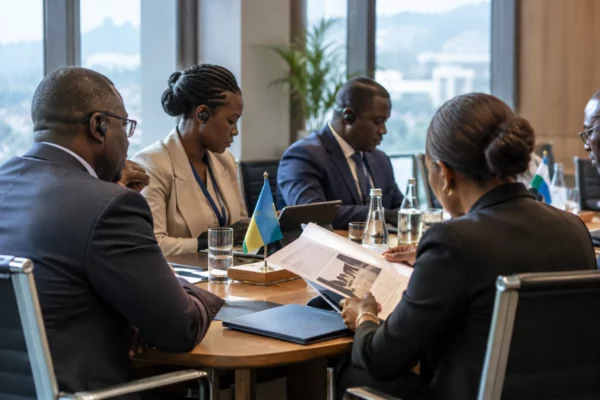
A meeting held in Windhoek at the Traditional Authorities Trust focused on precisely this issue: how to simplify the installation of towers in communities. Participants included Information and Communication Technology Minister Emma Theofelus, as well as representatives of the Communications Regulatory Authority of Namibia, MTC, Telecom Namibia and PowerCom. The idea is simple. If government agencies and operators work with holders of local authority, they can reduce delays, clarify expectations and limit obstacles.
This choice says something about Namibia’s approach. Rather than impose a purely centralised model, the government is seeking to work with structures that already organise community life. In a country where customary authority retains real influence in several regions, this cooperation can make projects easier to understand. It can also prevent mistrust from turning into outright opposition.
Local resistance is not unique to Namibia. In several African countries, antenna projects prompt concerns about radio waves, often fuelled by misinformation about the health effects of non-ionising radiation. Such debates have accompanied the transition to 4G and then to 5G. The most effective response is generally the same: clear information, early consultation and visible commitments to benefits for the community.
For operators, the issue is financial. Every month of delay adds to costs and postpones returns on investment. For rural households, the stakes are immediate: access to communications, online services, health alerts and certain markets. For the state, the challenge is to deliver on a promise in its development plans: to expand access to telecommunications by 2030, particularly in underserved areas.
A test for Windhoek’s digital strategy
This comes as Namibia has already introduced several measures to close coverage gaps. CRAN recently announced new investments through the Universal Service Fund, a universal service mechanism that finances infrastructure in areas with low commercial returns. The regulator has also launched or supported towers in rural localities such as Epinga and Ehomba, in Kunene, showing that efforts to catch up are progressing through targeted sites rather than grand symbolic gestures.
The country is therefore seeking a balance. On the one hand, it wants to speed things up without adding to procedural burdens. On the other, it must respect communities, their land and their customary practices. This is where the involvement of traditional authorities can make a difference: not by bypassing the rules, but by making them easier to apply. In a context where connectivity determines access to public services, this cooperation is becoming a development tool as much as an administrative one.
The implications extend beyond Namibia’s borders. Across SADC, states are seeking to make connectivity a driver of economic integration. A more reliable digital route between regions, capitals and border posts supports trade, the flow of information and cross-border services. The issue is also central to the African Union: without strong networks across the continent, the promise of a continental digital market remains unfulfilled.
Namibia is therefore making progress on familiar but decisive ground. The question is no longer whether the country needs to connect. It is how to connect its outlying areas too, without leaving rural communities behind the showcase of the capital cities.