Algeria
 Egypt
 Libya
 Morocco
 Sudan
 Tunisia
 Benin
 Burkina Faso
 Cabo Verde
 Côte d'Ivoire
 Ghana
 Guinea
 Guinea-Bissau
 Liberia
 Mali
 Mauritania
 Niger
 Nigeria
 Senegal
 Sierra Leone
 The Gambia
 Togo
 Cameroon
 Central African Republic
 Chad
 DR Congo
 Equatorial Guinea
 Republic of the Congo
 São Tomé and Príncipe
 Burundi
 Comoros
 Djibouti
 Eritrea
 Ethiopia
 Kenya
 Madagascar
 Malawi
 Mauritius
 Mozambique
 Rwanda
 Seychelles
 Somalia
 South Sudan
 Tanzania
 Uganda
 Angola
 Botswana
 Eswatini
 Lesotho
 Namibia
 South Africa
 Zambia
 Zimbabwe
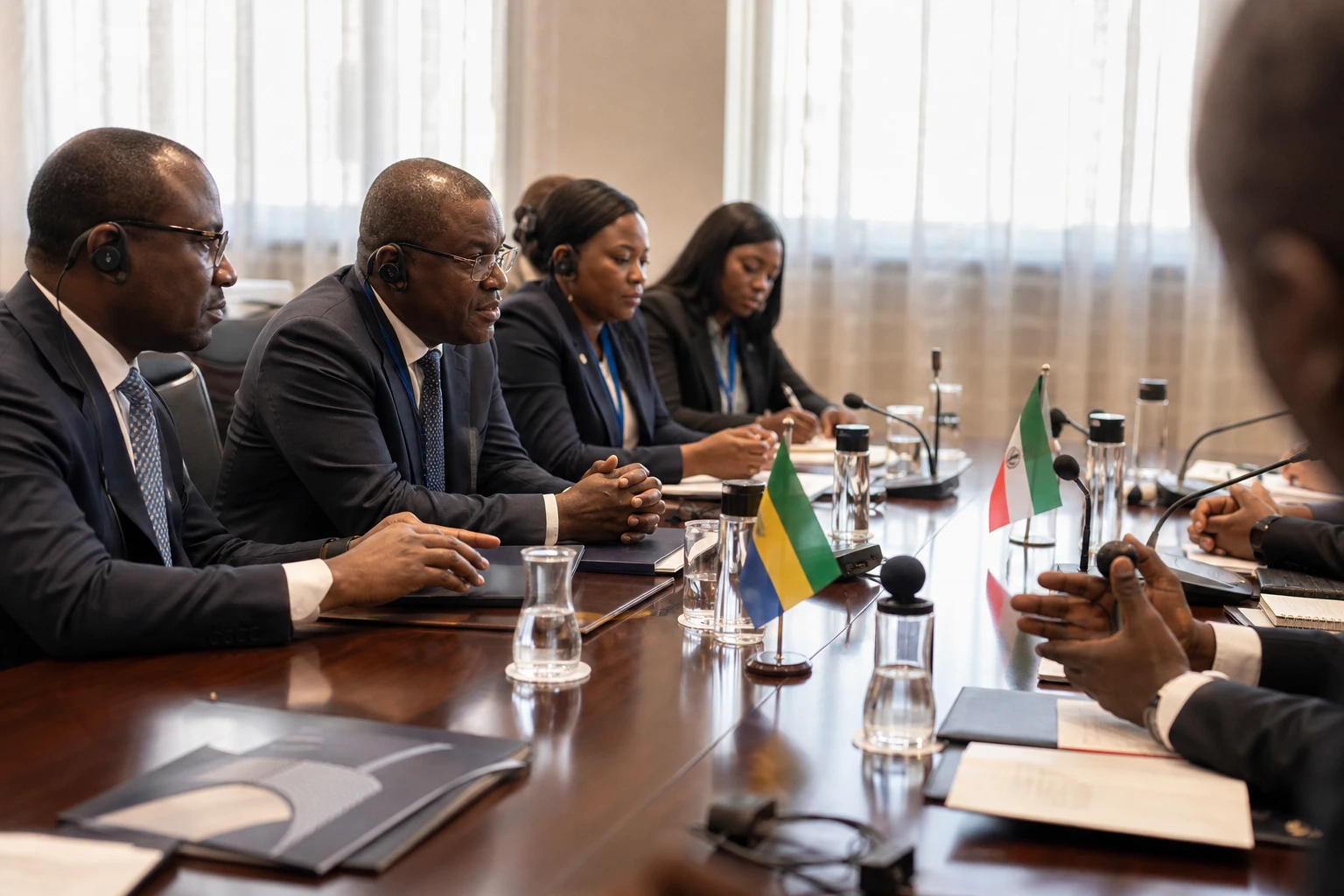
In Libreville, a border dispute is no longer at a diplomatic impasse
Between Gabon and Equatorial Guinea, the question of the islands of Mbanié, Cocotiers and Conga is not merely a legal matter. It concerns sovereignty, the sea, resources and how two Central African neighbours choose to communicate when a long-standing disagreement becomes sensitive. In the Gulf of Guinea, where maritime boundaries carry strategic weight, every gesture matters as much as the court ruling itself.
On Tuesday 28 July 2026, in Addis Ababa, the two countries took a further step by signing a joint commitment agreement on implementing the judgment delivered by the International Court of Justice on 19 May 2025. The text was signed on the sidelines of the 49th ordinary session of the African Union Executive Council, in the presence of AU Commission chairperson Mahmoud Ali Youssouf. Equatorial Guinea’s foreign minister, Simeón Oyono Esono Angüe, signed for his country. Gabon was represented by the president of its Constitutional Court, Dieudonné Aba’a Owono.
The initiative does not erase the dispute, but it changes how it is handled. The African Union is setting up a joint consultation and mediation mechanism to monitor implementation of the judgment and maintain technical dialogue between Libreville and Malabo. Mahmoud Ali Youssouf welcomed a commitment “to dialogue, cooperation, good neighbourliness and the peaceful settlement of disputes”, a phrase that neatly sums up what is at stake: turning a legal victory into a stable political process.
For Gabon, this step is part of a position the authorities have now openly adopted: respect international law without appearing to abandon national sovereignty. In April and again in July 2026, the Gabonese presidency had already received the AU special envoy tasked with monitoring the dispute, Albert Shingiro, to prepare a framework for an amicable resolution. In Libreville, the government emphasises peace, stability and regional integration. This language matters: it reassures partners while taking Gabonese public opinion into account.
The law has settled the matter; the boundary still needs to be demarcated
The roots of the dispute go back a long way. Since the early 1970s, Gabon and Equatorial Guinea have disputed sovereignty over Mbanié, an islet of about 30 hectares, and two smaller features, Cocotiers and Conga. In May 2025, the ICJ upheld Spain’s successor title to the islands, while noting that land and maritime delimitation should be based on the relevant legal instruments, including the 1900 colonial framework for the land boundary and the United Nations Convention on the Law of the Sea for the maritime area.
In other words, the Court did not merely award three islets. It also clarified the method to be followed for the rest of the boundary. This is precisely where the Addis Ababa agreement matters: it prevents the dispute from becoming a symbolic stand-off while leaving technical discussions on the sea and land boundary open. The AU is playing a useful facilitating role here, in a region where African mediation is increasingly becoming an institutional reflex.
The choice of Gabon’s Constitutional Court as a signatory is also revealing. It shows that the matter is no longer being treated solely as a conventional territorial dispute, but as an issue involving the legal architecture of the Gabonese state. The message to Gabonese people is clear: defending the country’s rights does not mean shutting the door on implementing an international decision. The message to Malabo is equally clear: settlement must proceed through agreed procedures, not escalation.
Economic caution prevails on the ground. The islets concerned are sparsely inhabited, but their maritime surroundings have long fuelled speculation about hydrocarbons and the strategic value of coastal areas. In the Gulf of Guinea, legal certainty over boundaries is never a minor matter for fishers, port operators, exploration companies or customs authorities. A clearly defined boundary reduces the risk of incidents and can safeguard cross-border cooperation, including in sectors such as energy and infrastructure.
A useful process for Central Africa and beyond
The significance of the move extends beyond the two capitals. In Central Africa, where the Economic and Monetary Community of Central Africa (CEMAC) is seeking to strengthen the movement of goods and trust between states, a border dispute resolved without a rupture is an important political signal. It shows that an international court ruling can be followed by an African implementation process, without public humiliation or a spectacle of winners and losers.
The process also comes at a particular moment for Gabon. Since its return to constitutional order, the country has sought to re-establish an image of stability and institutional credibility on the continental stage. The AU has also praised Gabon’s transition several times in 2026 as a positive sign for the region. In this context, handling the dispute with Equatorial Guinea is also a diplomatic test: Gabon must show that it can defend its interests while remaining a reliable regional neighbour.
The key point remains that the signature of 28 July 2026 is not an end, but a framework. The practical implementation of the agreement, the holding of technical consultations and the way the two states define the land and maritime boundary point by point will now need to be monitored. In Addis Ababa, the AU has set out a method. It is now up to Libreville and Malabo to give it lasting substance, in accordance with the law and regional balances.