Algeria
 Egypt
 Libya
 Morocco
 Sudan
 Tunisia
 Benin
 Burkina Faso
 Cabo Verde
 Côte d'Ivoire
 Ghana
 Guinea
 Guinea-Bissau
 Liberia
 Mali
 Mauritania
 Niger
 Nigeria
 Senegal
 Sierra Leone
 The Gambia
 Togo
 Central African Republic
 Chad
 DR Congo
 Equatorial Guinea
 Gabon
 Republic of the Congo
 São Tomé and Príncipe
 Burundi
 Comoros
 Djibouti
 Eritrea
 Ethiopia
 Kenya
 Madagascar
 Malawi
 Mauritius
 Mozambique
 Rwanda
 Seychelles
 Somalia
 South Sudan
 Tanzania
 Uganda
 Angola
 Botswana
 Eswatini
 Lesotho
 Namibia
 South Africa
 Zambia
 Zimbabwe
When silence at the top becomes a matter of state
In Cameroon, the absence of a head of state is measured not only in kilometres. It is felt in the corridors of power, in Yaoundé’s markets and in conversations about the country’s immediate future.
Since 7 June 2026, Paul Biya, 93, has been on a private stay in Europe, according to the Cameroonian presidency. The announcement came as the country was already waiting for clarification on the conduct of public affairs and the political calendar ahead.
This latest episode has reopened a sensitive question in Cameroon: how does a highly centralised state function when its principal arbiter disappears from public view for several weeks? And, above all, who embodies institutional continuity when succession remains unclear?
An institutional framework already reshaped in Yaoundé
The debate is not taking place in a legal vacuum. In April 2026, Cameroon’s parliament adopted a constitutional reform restoring the post of vice-president of the republic. The presidency subsequently promulgated the corresponding law on 14 April 2026. But, as things stand, no one has been appointed to the post.
The reform was presented as a means of ensuring the continuity of the state. It must also be viewed in light of an institutional architecture in which the presidency still concentrates most political initiative. In the event of a vacancy, the constitution provides for an interim arrangement, with the president of the Senate first in line, as long as there is no vice-president in office.
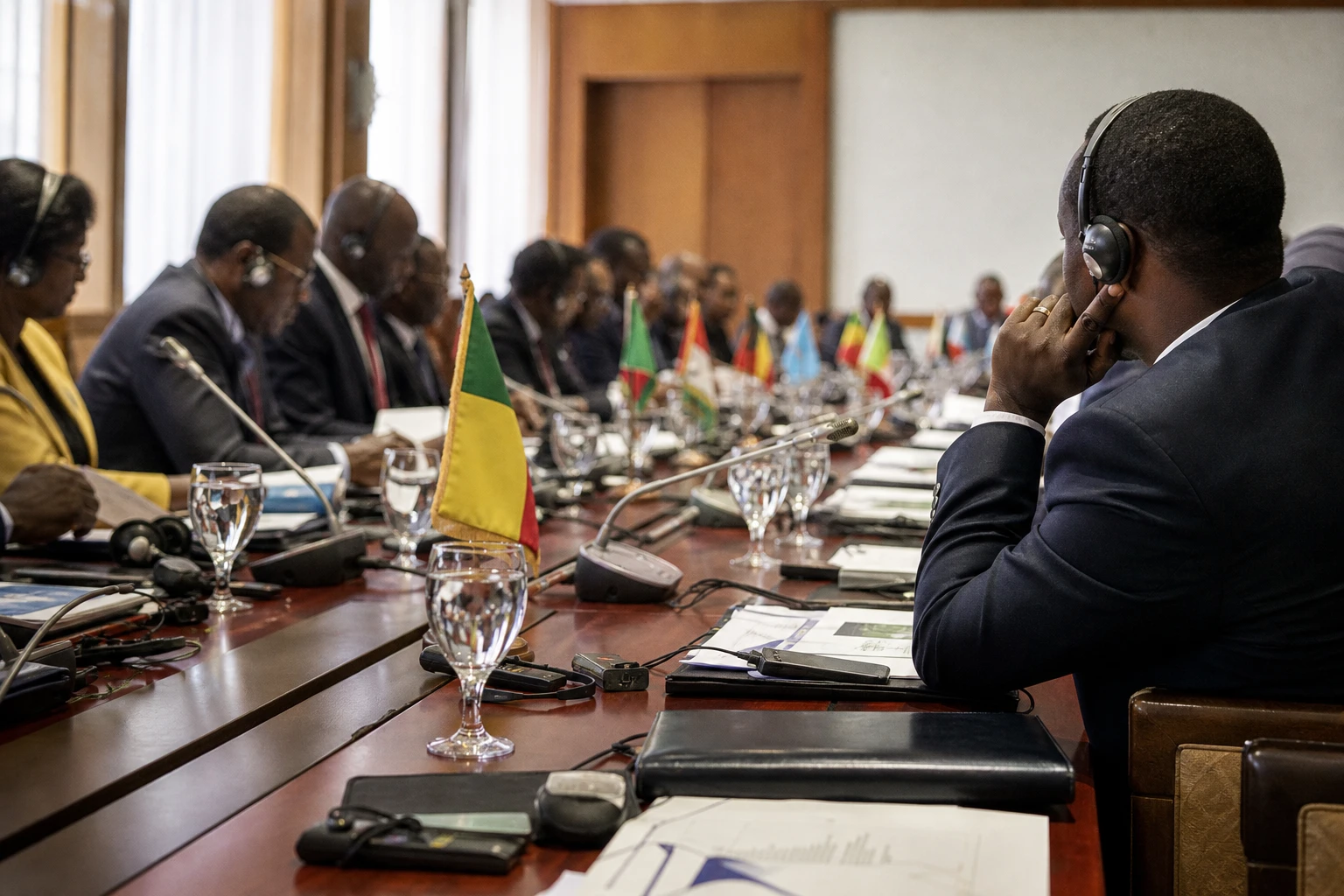
In the region, Cameroon remains a pillar of CEMAC, the Economic and Monetary Community of Central Africa. What happens in Yaoundé therefore carries weight beyond national borders, as the country’s institutional stability also influences Central Africa’s economic and political balance.
Absence acknowledged by the government, challenged by the opposition
Officially, the head of state left Yaoundé on 7 June 2026 “for a short private stay in Europe”, accompanied by his wife Chantal Biya and several members of the official entourage. The wording was clear, but it was not enough to dispel questions.
In the days and weeks that followed, the opposition spoke of an institutional vacuum and remote governance. A meeting of senior officials from the ruling party, convened in Yaoundé on 22 July, also showed that the question was no longer merely political: it had become a matter of internal discipline and control of the public narrative.
The government, for its part, says the president continues to follow issues and make decisions. This line of defence is not new. It is intended to reassure the public about the continuity of the state, but it also sustains a paradox: the more the head of state is presented as active from afar, the more his physical absence fuels speculation about succession and how the institutions really function.
At the same time, public perceptions are shaped by recent political events. The 2025 presidential election kept Paul Biya in power, and the tensions surrounding it left a climate of mistrust between some young people, the opposition and a tightly controlled state apparatus. The president’s prolonged absence is therefore being added to an already fragile period.
Succession, age and the mechanics of power
The real issue is not just absence. It is preparation for what comes next. At 93, Paul Biya embodies a political longevity that has itself become an institutional fact. In Cameroon, this raises a question of approach: can a system remain stable when it rests on such a highly personalised concentration of power?
The April reform was designed as a response to this question. But a reform is not enough if the rules governing its activation remain unclear in practice. The failure to appoint a vice-president fuels uncertainty. It leaves succession scenarios open while keeping the regime’s internal balance under presidential control.
For administrative and political elites, the issue is immediate: preserve the chain of command, avoid any impression of a vacancy and prevent internal rivalries from spilling into the open. For the public, the issue is even more concrete: knowing who makes decisions, how quickly, and under what political mandate in a country where social expectations are high, from youth employment to the quality of public services.
Urban areas, more connected to information and political networks, are already discussing the post-Biya era openly. In rural regions, the question takes a different form, through the effective presence of the administration, access to services and the state’s ability to maintain a minimal public profile. This gap between the political capital and the regions also fuels the sense that power is concentrated at the top.
What Central Africa is watching now
Cameroon is not alone in this episode. Across Central Africa, continuity of the state, the transfer of power and the management of transitions have become recurring subjects. Yaoundé is watching its neighbours, and its neighbours are watching Yaoundé. CEMAC, already facing economic challenges, has no interest in seeing prolonged uncertainty take hold in its most structurally important economy.
At continental level, this situation highlights a broader reality: in several African countries, institutional stability still depends too often on one man’s agenda rather than on fully transparent mechanisms. The Cameroonian case shows that constitutional reform only has an effect if it is followed by clear steps, particularly on the appointment of office-holders and the conditions for an interim arrangement.
What needs to be watched now is simple: the remainder of the president’s stay, the possible appointment of a vice-president, and, above all, how the government organises the handling of upcoming political milestones. Until these points are addressed, the question of continuity of the state in Cameroon will remain open, with consequences far beyond Yaoundé.