Algeria
 Egypt
 Libya
 Morocco
 Sudan
 Tunisia
 Benin
 Cabo Verde
 Côte d'Ivoire
 Ghana
 Guinea
 Guinea-Bissau
 Liberia
 Mali
 Mauritania
 Niger
 Nigeria
 Senegal
 Sierra Leone
 The Gambia
 Togo
 Cameroon
 Central African Republic
 Chad
 DR Congo
 Equatorial Guinea
 Gabon
 Republic of the Congo
 São Tomé and Príncipe
 Burundi
 Comoros
 Djibouti
 Eritrea
 Ethiopia
 Kenya
 Madagascar
 Malawi
 Mauritius
 Mozambique
 Rwanda
 Seychelles
 Somalia
 South Sudan
 Tanzania
 Uganda
 Angola
 Botswana
 Eswatini
 Lesotho
 Namibia
 South Africa
 Zambia
 Zimbabwe
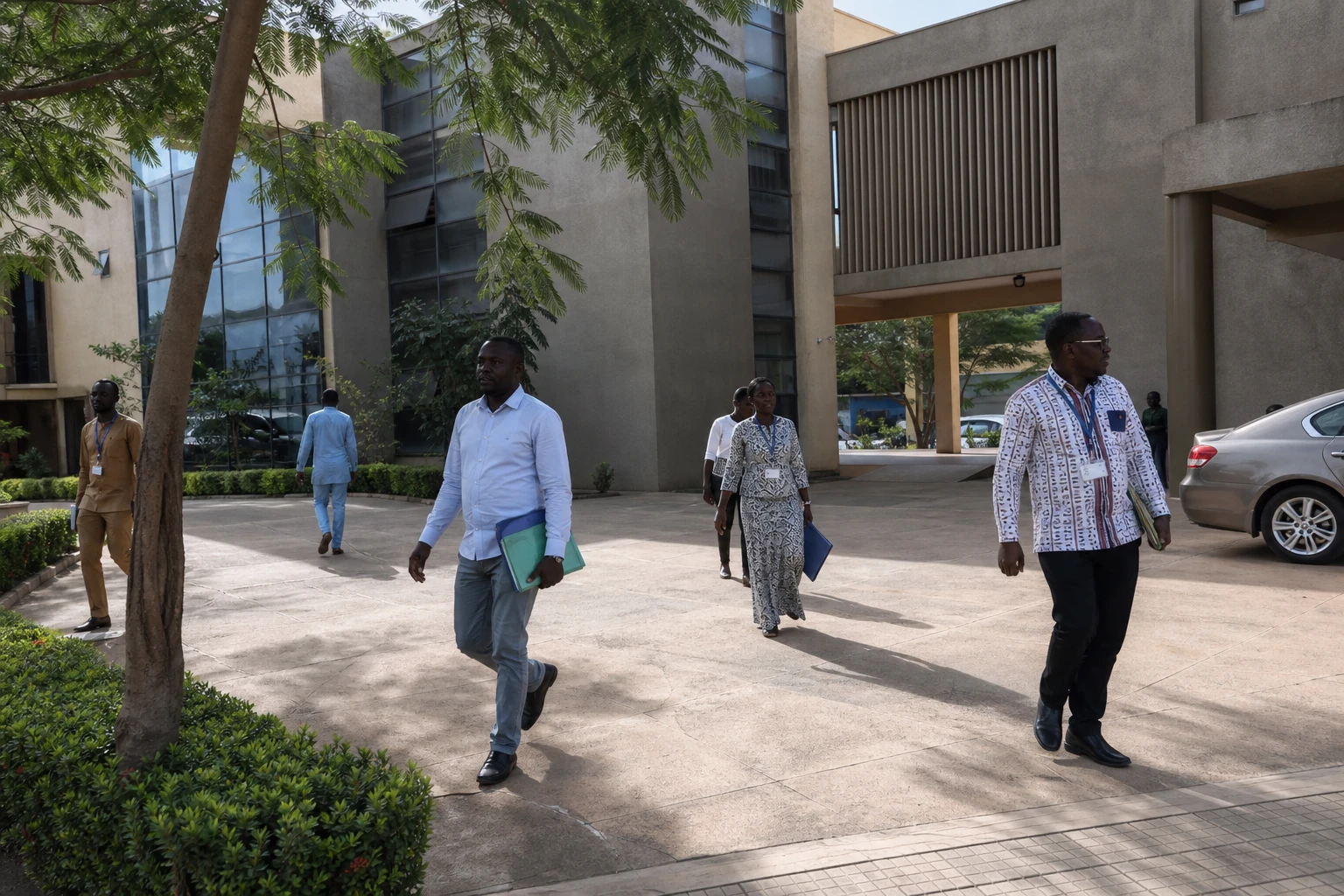
A sporting showcase amid a new political moment
Hosting an Africa Cup of Nations is about more than staging matches. For a country, it is also a matter of infrastructure, image, security and international credibility. In Burkina Faso’s case, the stakes therefore extend well beyond the pitch. They concern the country’s place in West Africa, its ability to lead a joint project with Mali and Niger, and how Africa now views the Alliance of Sahel States, the AES.
The joint bid comes as the three countries undertake a profound political and institutional reshaping. It also falls within the timetable set by the Confederation of African Football, which opened the bidding process in early July for the 2028, 2032 and 2036 Africa Cup of Nations tournaments. The final decision will therefore depend not on a declaration of intent, but on a robust technical, financial and political bid.
The CAF opens the door, without promising an outcome
On 18 July 2026, in New York, CAF president Patrice Motsepe met the heads of the football federations of Burkina Faso, Mali and Niger. After the meeting, the Niger Football Federation said that the three countries’ expression of interest in hosting the 2032 Africa Cup of Nations had been formally acknowledged by the continental governing body. Several African media outlets subsequently confirmed the news, including APAnews and the Burkinabe press.
The CAF’s wording remains cautious. It does not name a favourite. It means that the Burkinabe, Malian and Nigerien trio is entering the same process as the other bidders. That is the message from the CAF president: the three countries will have the same chances as their competitors, provided they submit a bid that meets the required criteria. The CAF also recalled that it had launched a transparent framework for awarding the 2028, 2032 and 2036 editions.
Institutionally, this point is essential. The CAF is not simply choosing a capital or a stadium. It is assessing the ability of a country, or group of countries, to host a major competition. This requires approved stadiums, reliable roads, accommodation, medical capacity, security resources and coordinated organisation among federations, governments and local committees.
The AES gamble: football, integration and political messaging
For Burkina Faso, this bid says more than football. It gives a new regional configuration a continental stage. The AES is seeking to establish itself as a confederal space, even as its three members broke with ECOWAS in January 2024 and pursue their own path to integration. In this context, a joint sports bid serves as a test of practical cooperation. It shows whether calls for unity can produce a visible, clear and credible project.
Burkina Faso, whose capital is Ouagadougou, could benefit on several fronts. First, its image: co-hosting would place the country back on a positive sporting map, away from crisis narratives alone. Then there is the local economy: construction, transport, hospitality, small businesses and temporary jobs often benefit from major competitions, especially in host cities. Finally, there is sports diplomacy: a tournament hosted by three countries could become an argument for sovereignty, provided the promise is followed by real investment.
But the bid also faces constraints. Organisers will have to convince the CAF on security, a central issue in the Sahel. They will also need to show that the infrastructure is in place or can be delivered on time. Local people, for their part, will judge the tangible benefits above all: roads, facilities, jobs, mobility, service prices and the lasting use of stadiums after the competition. Without a tangible legacy, the sporting showcase would remain fragile.
What this bid reveals about West Africa
The developments also say a great deal about West Africa in 2026. Sport continues to serve as a common language, even in a politically fragmented region. By agreeing to assess the bid from Burkina Faso, Mali and Niger on a comparable basis to those of other member associations, the CAF is underscoring that a sporting project can bridge diplomatic ruptures. Competition does not erase regional tensions, but it obliges states to consider cooperation, scheduling and governance.
For the region, the real test will begin after the expression of interest. Bidders will have to specify venues, costs, guarantees and their organisational model. They will also have to show that the bid is more than a symbol, and is a realistic project. That is where Burkina Faso, Mali and Niger will be judged: not on a narrative of intent, but on their ability to turn a shared ambition into a solid bid. The next decisive stage will therefore be the formal submission of bids and the CAF’s technical assessment.
At continental level, the stakes are greater still. The CAF wants to make its senior men’s competitions an annual fixture, outside World Cup years, and strengthen the credibility of its award procedures. In this context, the AES bid will be seen as a test: can a major African competition be organised in a Sahelian region undergoing change without sacrificing either technical rigour or political balance? The answer will say a great deal about African football, but also about how the continent chooses to tell its story differently.
For Burkina Faso, the key is this: turn an announcement into a project, and then a project into results. The 2032 Africa Cup of Nations will not be won through a slogan, but by convincing the CAF that Ouagadougou and its partners can welcome Africa in dignified, safe and sustainable conditions.