Algeria
 Egypt
 Libya
 Morocco
 Sudan
 Tunisia
 Burkina Faso
 Cabo Verde
 Côte d'Ivoire
 Ghana
 Guinea
 Guinea-Bissau
 Liberia
 Mali
 Mauritania
 Niger
 Nigeria
 Senegal
 Sierra Leone
 The Gambia
 Togo
 Cameroon
 Central African Republic
 Chad
 DR Congo
 Equatorial Guinea
 Gabon
 Republic of the Congo
 São Tomé and Príncipe
 Burundi
 Comoros
 Djibouti
 Eritrea
 Ethiopia
 Kenya
 Madagascar
 Malawi
 Mauritius
 Mozambique
 Rwanda
 Seychelles
 Somalia
 South Sudan
 Tanzania
 Uganda
 Angola
 Botswana
 Eswatini
 Lesotho
 Namibia
 South Africa
 Zambia
 Zimbabwe
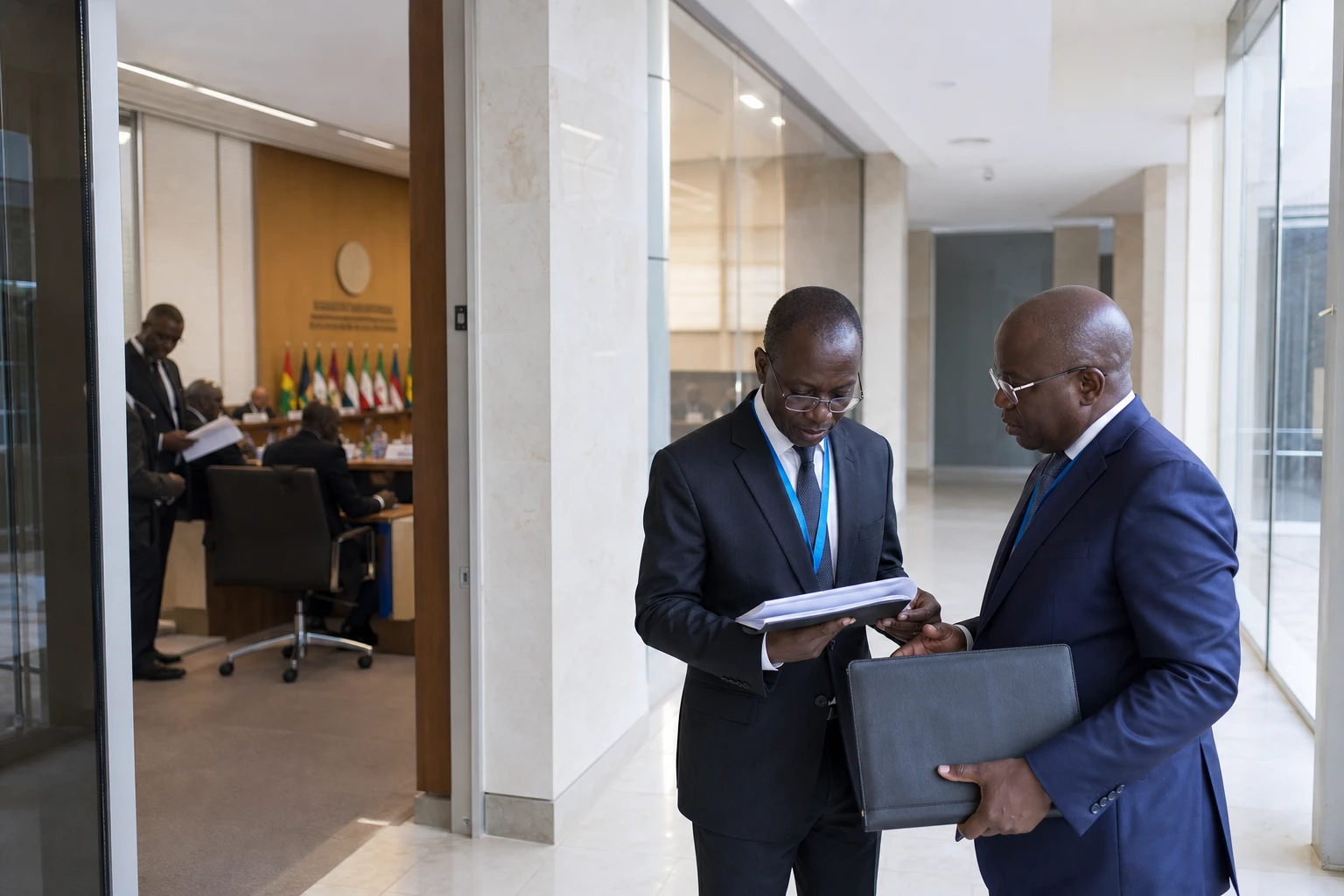
When diplomacy aims to become a practical economic tool
In Cotonou, the signatures do not tell the whole story. What often matters is what they set in motion: business flows, better-managed mobility and projects that are clearer for companies. The stakes between Benin and Morocco therefore go beyond ceremony. They concern Benin’s ability, as a coastal West African country, to diversify its partners without losing sight of its priorities for production, employment and regional integration.
This rapprochement is taking place amid a more assertive economic diplomacy in Benin. Porto-Novo, the country’s political capital, is now looking as much towards trade corridors as diplomatic salons. Morocco, meanwhile, is pursuing a long-term presence in West Africa, built on investment, training and institutional links. This approach also fits within the West African space, where ECOWAS and WAEMU remain key frameworks for movement, trade and regional coordination.
Fourteen agreements and a method: monitor, finance, deliver
On Tuesday 21 July 2026, the two countries signed 14 agreements in Cotonou at the 7th session of their joint cooperation commission. The authorities have not yet provided details of each text. But discussions covered economic and trade exchanges, investment, academic cooperation, culture, mobility and consultation on regional and international issues.
The most concrete point is the determination to involve the private sector more closely. This is often where agreements gain or lose their real impact. Without companies, banks, logistics operators and implementation timetables, cooperation remains a diplomatic promise. With them, it becomes a delivery chain. The two sides also decided to establish a monitoring committee. This mechanism is not a secondary matter. It is intended to verify that commitments are being implemented and to relaunch the sectoral mechanisms envisaged by the bilateral agreements.
Trade between the two countries was valued at $164.2 million in 2025, according to figures cited by the Beninese authorities and sourced from the International Trade Centre. For a partnership that remains relatively modest compared with Africa’s major trade flows, this level of exchange points above all to potential that remains underexploited. The challenge is not just to increase the value of trade. It is also to distribute the gains more effectively among large companies, SMEs, transport operators, service providers and graduates.
Mobility, scholarships and e-Visas: issues that matter to families and businesses
Cooperation is not limited to trade figures. In higher education, Rabat has announced an increase in scholarships for Beninese students. For many families, this decision matters as much as an investment agreement. It opens up paths to education, professional networks and, sometimes, the return of skills that can benefit the local market.
Another important signal: Morocco said it was ready to consider a visa exemption for Beninese holders of ordinary passports. Benin already has an e-Visa system available online, and Africans can enter the country visa-free for 90 days, according to the official Beninese platform. Any further facilitation with Morocco would simplify travel for entrepreneurs, students, researchers and families. It would also reduce an invisible but real cost: time lost to procedures and administrative uncertainty.
On the ground, expectations differ widely between stakeholders. For the Beninese state, the goal is clear: attract capital to industry, construction, agriculture and services. For Moroccan operators, the aim is to consolidate a presence in West Africa and use Cotonou as a regional entry point. For workers and consumers, the issue is simpler: to see projects, jobs and services emerge rather than remain confined to speeches.
Why Cotonou also matters to Atlantic Africa
This bilateral engagement did not emerge from nowhere. A few days earlier, on 13 July 2026, Cotonou hosted the 7th ministerial meeting of the African Atlantic States Process, co-organised with Morocco. This framework brings together several countries along Africa’s Atlantic coast to discuss maritime security, green logistics corridors, economic integration and the sustainable energy transition. In other words, Benin and Morocco are not working only with each other. They are also seeking to influence a broader regional structure, in which the ocean is a strategic space as well as a commercial horizon.
The link with West Africa is direct. Benin remains part of ECOWAS and WAEMU mechanisms while seeking to broaden its partnerships beyond its immediate neighbourhood. This is a strategy of diversification. It responds to a simple reality: an economy with only a few markets is more vulnerable. Conversely, building more links with North Africa, West Africa and the continent’s business networks helps spread risks and widen opportunities.
For Morocco, Benin is more than a market. It is a gateway to a region where demand for infrastructure, financial services, logistics and training remains high. For Benin, Morocco can provide access to expertise developed in industrial zones, higher education, finance and tourism. The issue is therefore not only diplomatic. It is also technical, industrial and territorial.
What happens next will depend on the details. A monitoring committee can speed things up, but only if ministries, investment promotion agencies, companies and universities turn the 14 agreements into projects with clear deadlines. That is where the strength of a partnership is measured: not in the group photograph, but in the ability to enable people to move, finance projects and create value between Cotonou, Porto-Novo, Rabat and the secondary cities that depend on regional trade.