Algeria
 Egypt
 Libya
 Morocco
 Sudan
 Tunisia
 Benin
 Burkina Faso
 Cabo Verde
 Côte d'Ivoire
 Ghana
 Guinea
 Guinea-Bissau
 Liberia
 Mali
 Mauritania
 Niger
 Nigeria
 Senegal
 The Gambia
 Togo
 Cameroon
 Central African Republic
 Chad
 DR Congo
 Equatorial Guinea
 Gabon
 Republic of the Congo
 São Tomé and Príncipe
 Burundi
 Comoros
 Djibouti
 Eritrea
 Ethiopia
 Kenya
 Madagascar
 Malawi
 Mauritius
 Mozambique
 Rwanda
 Seychelles
 Somalia
 South Sudan
 Tanzania
 Uganda
 Angola
 Botswana
 Eswatini
 Lesotho
 Namibia
 South Africa
 Zambia
 Zimbabwe
When the engine becomes a way forward
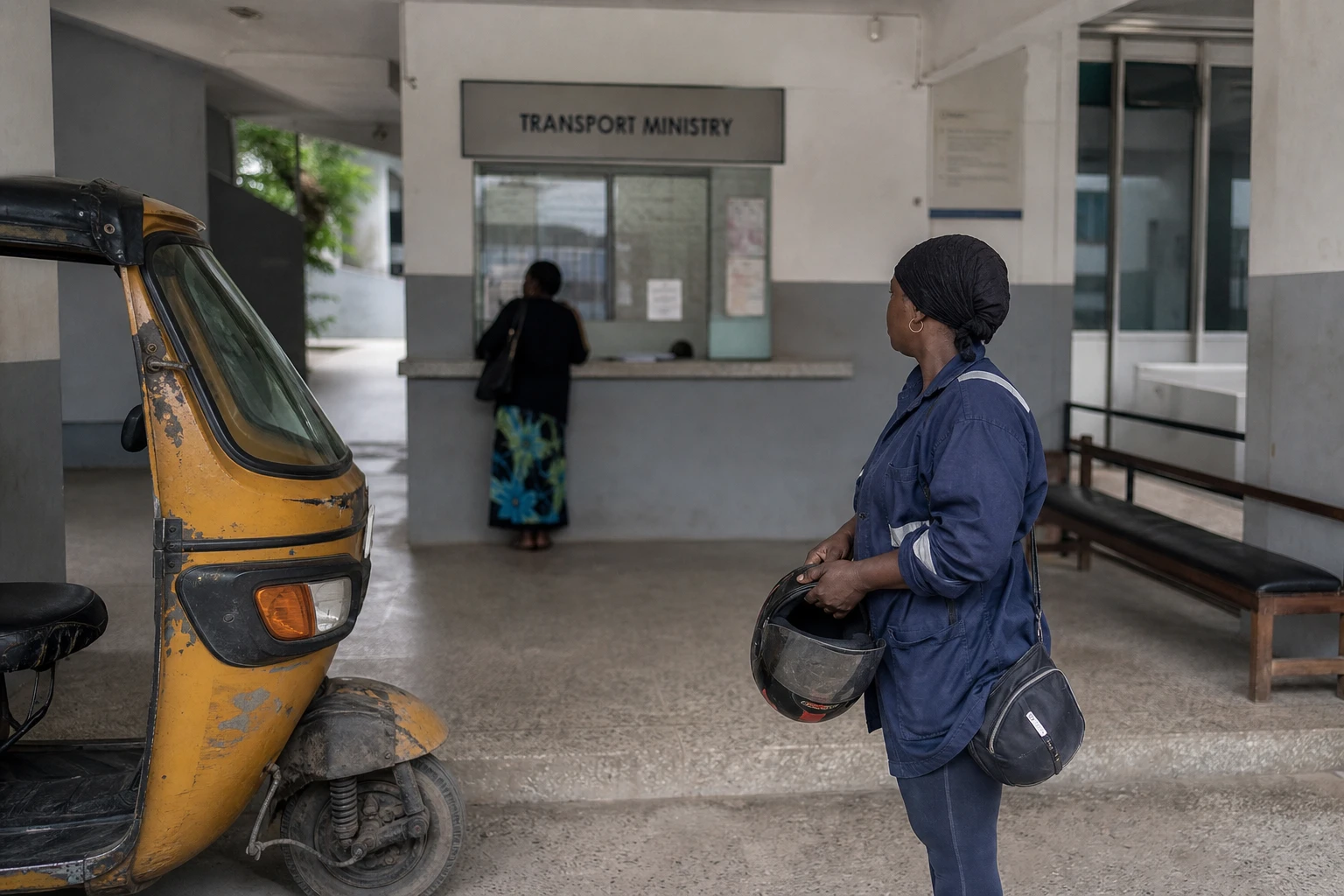
In Freetown, the steering wheel of a kekeh — a motorised tricycle used for urban transport — is no longer reserved for men. For educated Sierra Leonean women, mothers and young people seeking an income, it has become a route into meaningful work, even when paid employment remains elusive. In a capital where journeys still depend heavily on informal options, the growing presence of women drivers reflects both household resourcefulness and the limits of the labour market.
The trend is part of an economy in which the informal sector carries considerable weight. The United Nations Development Programme said in 2024 that informal businesses accounted for about 90% of Sierra Leone’s economy. The International Monetary Fund and the World Bank also describe a country where formal employment remains limited, while self-employment absorbs a large share of the workforce. In this context, urban transport is not just a service; it has become a market for everyday livelihoods.
In Freetown, mobility also shapes employment
Freetown, Sierra Leone’s capital, has now expanded well beyond the infrastructure plan that shaped it. The city has grown rapidly, while the public transport network has not kept pace. The result is visible on the roads: kekeh, poda-poda and motorcycles have become essential for connecting central neighbourhoods with less well-served areas. Academic research on urban mobility in Freetown also estimates that informal services account for a very large share of public transport, with kekeh at the heart of the system.
This dependence helps explain the appeal of the work. When buses are scarce, expensive or unable to cover every route, driving a kekeh can generate a daily income. The logic is simple: passengers pay for availability, flexibility and the ability to reach streets where larger vehicles struggle to go. For many women, this is not an ideal choice. It is a trade-off between the lack of stable jobs and the need to bring money into the household.
The authorities have tried to rebalance services. The government launched the Integrated and Resilient Urban Mobility Project, then supported the introduction of 50 Waka Fine buses from January 2024 to strengthen connections in Freetown. But even with these buses, the system remains hybrid. Formal transport is expanding, while informal operators continue to fill the gaps. It is in this space that women kekeh drivers are finding their place.
Women enter a male-dominated sector
The change is not only economic. It is social too. In the agency report on these drivers, Hawa Mansaray and Alimatu Kamara describe a path marked by rapid learning, perseverance and stigma. One learned by paying a trainer; the other says she chose the kekeh after a long, unsuccessful search for a job. Their accounts shed light on a common reality in Sierra Leone: a degree does not automatically open the door to formal employment.
The legal framework has nevertheless evolved. The Gender Equality and Women’s Empowerment Act, adopted in 2022, provides for a minimum of 30% women’s representation in several public and private spaces, as well as provisions on access to training, employment and credit. In 2023, general elections also raised women’s representation to higher levels in Parliament and some local councils, according to UN Women. But this institutional progress does not automatically translate into the street economy, where most income is earned outside large companies and government agencies.
The Ministry of Labour, echoed by partner organisations, acknowledges that women’s participation in the formal labour market remains below 30%. World Bank data also show that women’s labour-force participation is lower than is often assumed, even though it is rising. The challenge, then, is not simply to “give women jobs”, but to make work safer, better paid and compatible with the family responsibilities that still fall overwhelmingly on them.
What the rise in women drivers reveals
The growing presence of women in the kekeh sector first reveals the scale of youth underemployment. World Bank estimates show that underemployment remains high in Sierra Leone, and is more pronounced among women than men. In other words, the issue is not only unemployment in the strict sense. It also concerns the quality of available jobs, their duration, income and stability. Many Sierra Leoneans are already working. But they do not earn enough, or earn regularly enough, to escape precarity.
Informal transport thus acts as a social safety net. It absorbs the crisis, but does not solve it. It allows a graduate without a job to work, a single mother to support her household, and a young woman to gain an independence that an office job denies her. At the same time, it exposes them to other risks: fatigue, accidents, street harassment, variable earnings and limited access to credit to buy their own vehicle. In a capital where mobility determines access to school, the market, hospital and work, transport is also an issue of substantive equality.
The issue extends beyond Sierra Leone. Across West Africa, cities are growing faster than their transport networks, and the informal sector is stepping in. Across ECOWAS, demographic pressure, youth employment and women’s place in urban economies will remain major issues. Freetown’s experience shows that mobility policy is not just about roads and buses. It also determines who can work, who can move around and who can turn a survival activity into a recognised profession.