Aljeria
 Libya
 Misri
 Moroko
 Sudan
 Tunisia
 Benin
 Burkina Faso
 Gambia
 Ghana
 Gine
 Ginebisau
 Kepuvede
 Kodivaa
 Liberia
 Mali
 Moritania
 Niger
 Nigeria
 Senegal
 Sierra Leone
 Togo
 Chadi
 Gaboni
 Guinea ya Ikweta
 Jamhuri ya Afrika ya Kati
 Kamerun
 Kongo
 Sao Tome na Principe
 Burundi
 Eritrea
 Ethiopia
 Jibuti
 Kenya
 Komoro
 Madagaska
 Malawi
 Morisi
 Msumbiji
 Rwanda
 Shelisheli
 Somalia
 Sudan Kusini
 Tanzania
 Uganda
 Afrika Kusini
 Angola
 Botswana
 Eswatini
 Lesoto
 Namibia
 Zambia
 Zimbabwe
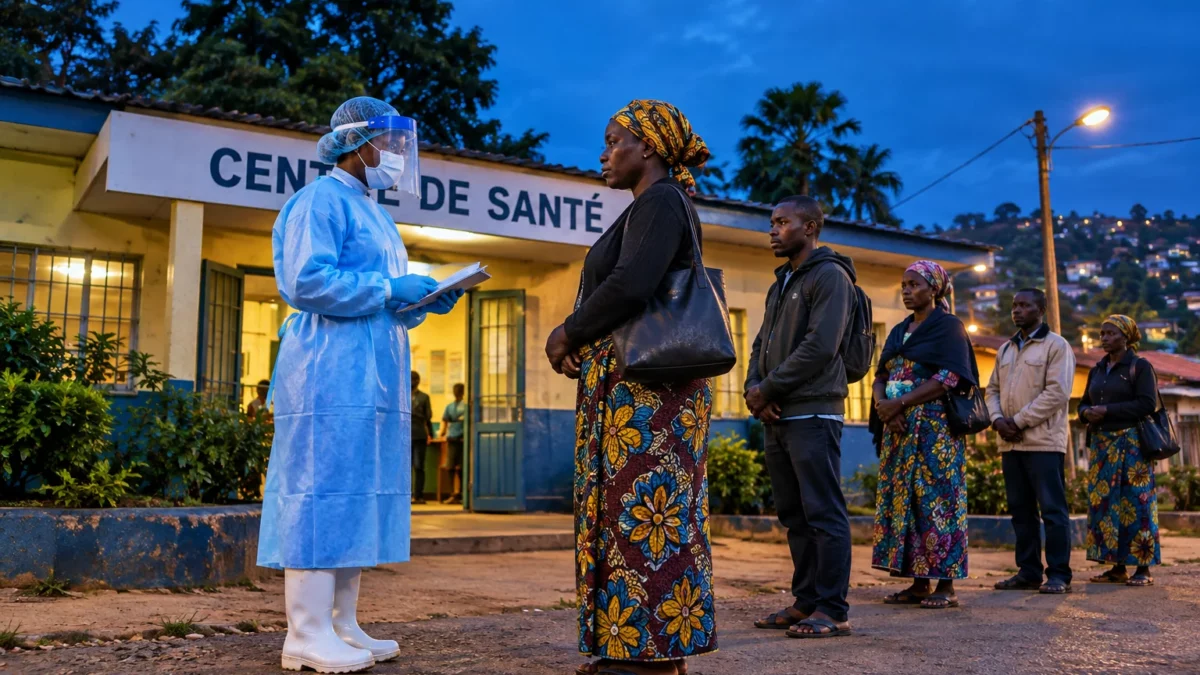
In the Democratic Republic of the Congo (DRC), the spread of Ebola is putting more than health services to the test. It is testing the ability to detect infections, protect teams and maintain trust in regions where insecurity is already making travel difficult.
The toll of 5,471 deaths among 11,197 cases reflects figures recorded as of 11 November 2026. A review of bulletins from the National Institute of Public Health (INSP) confirms this count. The report of 14 November, published the following day, subsequently recorded 11,376 cases and 5,568 deaths. These figures remain those reported by health authorities, rather than an independent count of deaths. The review of INSP health bulletins helps distinguish between these different reports.
An outbreak that began in Ituri and became a regional challenge
Congolese authorities declared the outbreak on 15 May 2026. It is the country’s 17th recorded Ebola outbreak since 1976. The World Health Organization (WHO) says the first identified clusters were in the Mongbwalu, Rwampara and Bunia health zones in Ituri, in the country’s northeast. The virus belongs to the Bundibugyo species, distinct from the one that caused the major West African outbreaks of 2014-2016.
This distinction matters for the medical response: at the time of the alert, there was no approved vaccine or specific treatment for the Bundibugyo virus. Early supportive care remains essential. WHO declared the episode a public health emergency of international concern on 17 May, after cases were detected in the DRC and Uganda. The region is therefore involved in cross-border surveillance, but this does not make neighbouring countries part of a single epidemic outbreak.
The outbreak later spread beyond Ituri. The national bulletin of 7 November reported cases in eight provinces, including North Kivu and Tshopo, and in 67 health zones. These local units are the operational areas where care and surveillance are organised. Ituri still accounted for most cumulative cases, while North Kivu recorded sustained transmission. Figures vary according to the reporting cut-off date, so they should always be read alongside their reference period.
The death toll does not tell the whole story of the response
The number of deaths is high, but it is not enough to describe the epidemic’s trajectory. According to Congolese authorities, the 11 November toll represented about 48.9 deaths per 100 confirmed cases. This ratio does not precisely measure an individual’s risk of dying: not all recent cases have reached an outcome, and some infections may go undetected. The date, case definition and quality of surveillance are therefore essential for any comparison.
The 7 November tally included deaths in communities, in addition to those recorded at treatment centres. When a sick person remains at home or is not identified in time, relatives and caregivers may be exposed. Contact tracing, prompt voluntary isolation and access to safe care then become crucial. These measures require teams on the ground, transport and a relationship of trust with residents.
However, armed conflict and attacks targeting health workers or facilities in some areas of the east are complicating fieldwork. The Associated Press reported on 15 November difficulties with contact tracing and isolation, as well as delayed pay for some health workers. These points are attributed to findings reported by the agency and the actors it cited; they do not describe health services across the entire country uniformly. In practice, the effects are concentrated where access to patients is most difficult.
Mobility, healthcare and public trust
The epidemic is also affecting everyday activities. Travel to markets, schools or health centres may become riskier when community transmission continues. Conversely, poorly targeted restrictions can disrupt trade and household incomes. The challenge is therefore to reduce risks without conflating health controls with a lasting shutdown of trade. The DRC, whose provinces are linked by roads, waterways and cross-border movement, must adapt surveillance to these realities.
Kinshasa, the capital, launched the “Congo River Ebola-Free” initiative in August, intended to strengthen prevention along a major transport and trade route. The initiative brings together public institutions and health partners. It illustrates a challenge specific to the geography of the DRC: protecting major mobility corridors while ensuring a response in remote outbreak areas. Surveillance at crossing points cannot replace local care or dialogue with communities.
Trust matters as much as equipment. Rumours or mistrust of response teams can delay alerts and consultations. But residents are not merely messengers of instructions: their participation also depends on the availability of care, transparency about figures and respect for local practices, particularly during funerals. A credible response must explain the risks without stigmatising affected families or areas.
What the coming weeks need to clarify
The situation in the DRC is part of regional coordination, notably with Uganda and neighbouring countries in Central Africa and the Great Lakes region. The international emergency declared by WHO is intended to strengthen this cooperation, not to assign collective responsibility to people living along borders. The information to monitor is concrete: changes in new cases by province, the speed of contact tracing, continuity of care and teams’ access to affected areas.
The DRC has already mobilised a national response, with support from WHO and other partners, and deployed preventive measures along transport routes. But the available tallies show that the epidemic remains active. Comparisons with the 2014-2016 West African epidemic should be treated with caution: the viruses, contexts and counting methods differ. For the Congolese, the immediate issue is less a place in the history books than the chance to be diagnosed and treated in time, whether they live in a city or a hard-to-reach area.