
 Aljeria
 Libya
 Misri
 Moroko
 Sudan
 Tunisia
 Benin
 Burkina Faso
 Gambia
 Ghana
 Gine
 Ginebisau
 Kepuvede
 Kodivaa
 Liberia
 Mali
 Moritania
 Niger
 Nigeria
 Senegal
 Sierra Leone
 Togo
 Chadi
 Gaboni
 Guinea ya Ikweta
 Jamhuri ya Afrika ya Kati
 Kamerun
 Kongo
 Sao Tome na Principe
 Burundi
 Eritrea
 Ethiopia
 Jibuti
 Kenya
 Komoro
 Madagaska
 Malawi
 Morisi
 Msumbiji
 Rwanda
 Shelisheli
 Somalia
 Sudan Kusini
 Tanzania
 Uganda
 Afrika Kusini
 Angola
 Botswana
 Eswatini
 Lesoto
 Namibia
 Zambia
 Zimbabwe
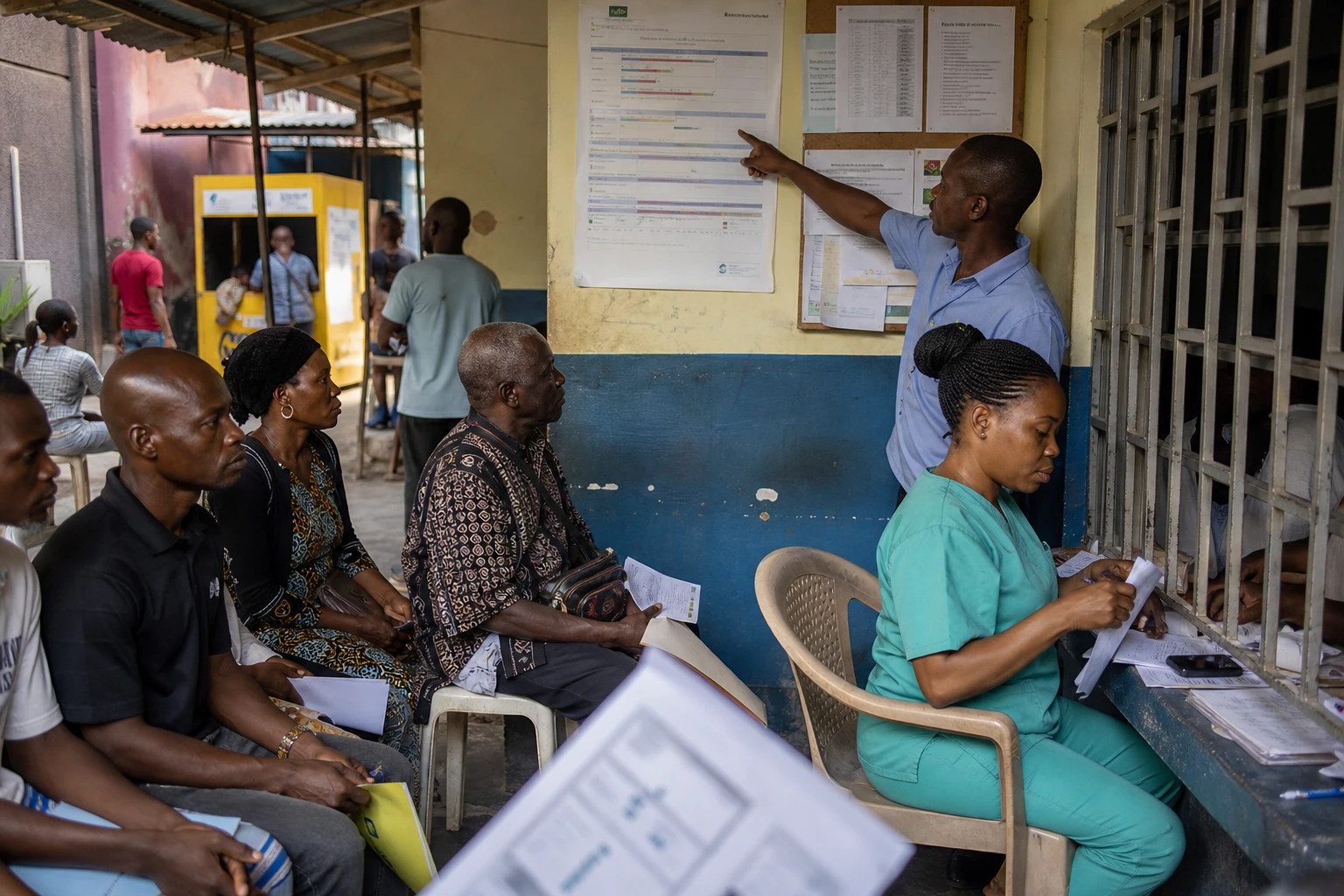
When a health response also becomes a test of governance
In Kinshasa, the fight against Ebola is not being waged only in treatment centres. It is also playing out in funding spreadsheets, decision-making channels and the Congolese state’s ability to retain control of a response fragmented among several donors. In a country where the east lives with a constant stream of health and security emergencies, the question is not simply how to find money. It is who manages it, according to which priorities, and for how long.
The Democratic Republic of the Congo has faced this equation for years. Ebola returns in successive waves, often in hard-to-reach areas and sometimes amid insecurity, directly affecting health services, families’ mobility and communities’ trust. Ituri, North Kivu and neighbouring provinces are not merely epidemiological hotspots; they are also places where the administration, health workers, local leaders and international partners must deal with realities very different from those in Kinshasa.
A broader response plan, but one that is harder to manage
The heart of the problem lies in the scale of the operation. According to the World Health Organization, the first national response to Ebola was built around a three-month plan costing $240 million. The new plan presented by the government, which now aims not only to fight the virus but also to maintain essential health services, amounts to $940 million. This increase makes one thing clear: the response is no longer limited to the epidemic alert; it affects the entire health system.
At the same time, funding is coming through several channels. In 2019, the WHO said it faced a critical shortfall, with $98 million needed for its own contribution to the response, of which only $44 million had been received at the time. It also warned that other partners were scaling back or suspending some activities because of a lack of financial certainty. In other words, the problem was not only the amount of funding, but also how it was dispersed.
The United States, for its part, mobilised substantial funding for the DRC. A USAID document shows that in FY 2019, US aid earmarked for Ebola preparedness and response in the country reached $184.6 million, while total USG funding for preparedness and response in the DRC and neighbouring countries reached $266.4 million over 2018–2020. But this funding architecture operates through partners and mechanisms specific to Washington. It is not automatically channelled into a single fund managed from Kinshasa or by the WHO.
Kinshasa wants one plan, one budget, one chain of command
This is precisely the fragmentation that the Congolese authorities are seeking to reduce. The health minister supports the idea of “one plan, one budget, one coordination mechanism”, a formula that captures a political as well as a technical issue. In a system where international partners often fund activities directly, the government wants a clearer map of donors, fewer overlaps and a more visible role in managing the response. President Félix Tshisekedi had already called for donors and their interventions to be mapped, showing that the issue goes beyond the health ministry alone.
This demand has a practical rationale. If the salaries of doctors and nurses, diagnostics, logistics, surveillance and community engagement are funded through different channels, it becomes harder to adjust the response quickly. In urban areas, this complicates a rapid response. In rural areas, it can leave pockets of transmission without sufficient support. So the problem is not merely bureaucratic. It directly affects the ability to trace contacts, protect health workers and maintain routine care during the epidemic.
Recent experience also shows that Ebola is not brought under control by supplies alone. It recedes when communities accept the presence of health teams. The WHO has said clearly that without political cooperation and community ownership, the epidemic cannot be stopped sustainably. In eastern Congo, where attacks on health teams have already hampered the response, local legitimacy matters as much as the availability of funds.
What this crisis reveals beyond the DRC
The Ebola response in the Democratic Republic of the Congo goes beyond the national level. It requires the Great Lakes region to consider links between health surveillance, cross-border movement and coordination among neighbouring countries. Cases detected in Uganda after infection in the DRC have served as a reminder that the virus does not recognise administrative borders. The WHO, the countries concerned and regional partners therefore have an interest in harmonising their detection and response tools.
The issue also says something about the balance of power between African capitals and international donors. When funding arrives in fragments, without the country concerned having a complete picture, budgetary sovereignty is effectively limited, even if the health emergency justifies external support. Conversely, when Kinshasa calls for central coordination, it is not simply asking for more resources. It is demanding decision-making power commensurate with the burden shouldered by the Congolese system.
The next steps will therefore depend less on a dramatic announcement than on a much more straightforward process: consolidating a single plan, clarifying funding flows, protecting teams and maintaining basic services. It is this combination that will determine whether the epidemic can be brought under control. It is also where, in practice, the strength of an African response to an African crisis, led by African actors, will be measured.



