Algeria
 Egypt
 Libya
 Morocco
 Sudan
 Tunisia
 Benin
 Burkina Faso
 Cabo Verde
 Côte d'Ivoire
 Ghana
 Guinea
 Guinea-Bissau
 Liberia
 Mali
 Mauritania
 Niger
 Nigeria
 Senegal
 Sierra Leone
 The Gambia
 Togo
 Cameroon
 Central African Republic
 Chad
 DR Congo
 Equatorial Guinea
 Gabon
 Republic of the Congo
 São Tomé and Príncipe
 Burundi
 Comoros
 Djibouti
 Eritrea
 Ethiopia
 Kenya
 Madagascar
 Malawi
 Mauritius
 Mozambique
 Rwanda
 Seychelles
 South Sudan
 Tanzania
 Uganda
 Angola
 Botswana
 Eswatini
 Lesotho
 Namibia
 South Africa
 Zambia
 Zimbabwe
In Somalia, setting a date is not enough to ensure that an election will be recognised by all. The timetable announced for 2027 marks a new step towards direct voting, but comes as the federal government, several federal member states and opposition figures remain at odds over the rules of the game.
Direct elections, but no political agreement
The National Electoral Commission announced on 15 October 2026 that elections for the two chambers of the Federal Parliament would be held on 15 April 2027. The presidential vote is scheduled for 15 May. The body says it is acting under the Constitution and electoral legislation. Somali outlet Hiiraan Online has also reported these dates and the first administrative deadlines. Somalia’s announced 2027 election timetable
The timetable is being challenged even before the official start of the campaign. Former president Mohamed Abdullahi Mohamed, known as Farmaajo, believes that proceeding without agreement among the main actors risks leading to competing electoral processes. Sharif Sheikh Ahmed, also a former head of state, has warned of the risk of political escalation. These statements express the opposition’s position; they do not mean that a parallel election is already being organised.
The disagreement also concerns the length of terms in office. The government considers that the constitutional amendments adopted in 2024 and subsequently incorporated into the revised Constitution provide for five-year terms. Its opponents dispute their application to the current institutions and argue that the parliamentary and presidential terms expired in April and May 2026. The two sides therefore hold incompatible interpretations of the timetable’s legality. Opposing positions on terms of office and electoral rules
The reform also reshapes the federal balance
For decades, national elections have relied largely on an indirect system: clan-linked representatives choose MPs, then elected members choose the president. The universal direct suffrage project aims to give voters more power and organise political competition around parties. The government presents the reform as an expansion of citizen participation. Not all opponents reject the principle of direct voting; they mainly dispute the arrangements, the timetable and the role given to federal member state authorities.
This distinction matters. The conflict is not simply a clash between modernisation and the defence of clans. The indirect system is also a mechanism for sharing power in a federal state where the central authority and the regions are still negotiating their respective powers. Puntland and Jubaland reject the constitutional changes and refuse to accept the electoral framework imposed by Mogadishu. For these administrations, the issue concerns the distribution of power between the centre and the federal member states, not just the choice of voting method.
The federal government, for its part, says the reform and the election should strengthen national institutions. The Prime Minister’s Office presents the 2024 amendments as introducing direct suffrage, a multi-party system and five-year terms. This official account sets out the legal basis claimed by Mogadishu, but does not resolve the question of political consent from the regions and the opposition. Constitutional amendments presented by the Somali government
The precedent of 2021 weighs on the discussions. A dispute over the timetable and the extension of terms in office then triggered a serious political crisis and clashes in Mogadishu. Constitutional reform itself has remained a subject of negotiation since the adoption of the Provisional Constitution in 2012. International IDEA notes that issues of federalism and electoral procedure have regularly fuelled tensions between the federal government and member states. The federal issues behind constitutional reform
From local vote to national test
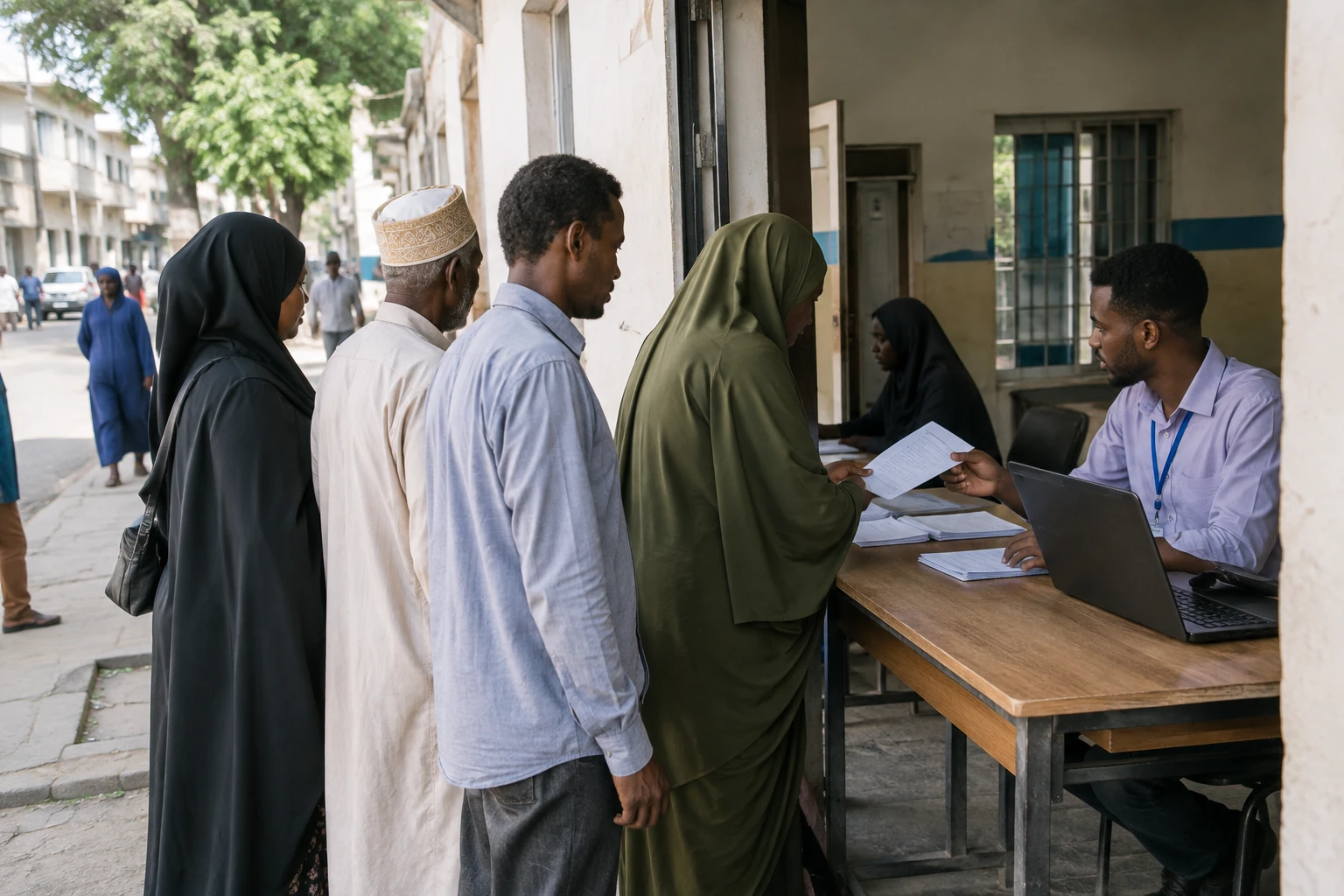
Somalia has already held a direct election in Mogadishu, in December 2025, for local councils. The vote marked an important return to direct elections in the capital, but does not on its own amount to national validation of the model. Mogadishu’s special status, differences between regional administrations and security conditions complicate the organisation of a countrywide vote. Al-Shabaab, an armed group fighting the federal government, retains the ability to operate in some areas of central and southern Somalia.
The obstacles are not the same everywhere. In the capital, the authorities can concentrate administrative and security resources. In regions far from centres of power, access to polling stations, voter registration and security may pose additional difficulties. Political leaders and parties are negotiating control of the institutions; for citizens, the practical question will be whether they can register, vote and see their choice recognised, including outside major cities.
The commission has published several preparatory milestones: voter and political organisation registration is due to resume on 1 November 2026; provisional lists are expected on 21 January 2027, followed by final lists on 15 March. These deadlines give a sense of the work to be completed in a few months. They do not, however, answer the central question: will the actors challenging the current framework take part in putting it into practice?
An issue followed across the Horn of Africa
The crisis concerns Somalia first and foremost, but its consequences extend beyond its borders. The Intergovernmental Authority on Development (IGAD), a regional organisation in the Horn of Africa, monitors issues of stability and co-operation among its members. Prolonged contestation in Mogadishu could complicate federal co-ordination in a country facing security challenges and sensitive negotiations with its neighbours. Conversely, an electoral compromise accepted by the regions would strengthen the institutions’ ability to speak on behalf of the country.
The 2027 vote therefore depends less on the announcement of dates than on whether common rules can be established. The coming months will show whether negotiations can bring the government, Puntland, Jubaland and the opposition closer on the timetable, the commission’s authority and the constitutional transition. Without such an agreement, the principle of “one person, one vote” risks remaining a disputed institutional project rather than a recognised national election.