Algeria
 Egypt
 Libya
 Morocco
 Sudan
 Tunisia
 Benin
 Burkina Faso
 Cabo Verde
 Ghana
 Guinea
 Guinea-Bissau
 Liberia
 Mali
 Mauritania
 Niger
 Nigeria
 Senegal
 Sierra Leone
 The Gambia
 Togo
 Cameroon
 Central African Republic
 Chad
 DR Congo
 Equatorial Guinea
 Gabon
 Republic of the Congo
 São Tomé and Príncipe
 Burundi
 Comoros
 Djibouti
 Eritrea
 Ethiopia
 Kenya
 Madagascar
 Malawi
 Mauritius
 Mozambique
 Rwanda
 Seychelles
 Somalia
 South Sudan
 Tanzania
 Uganda
 Angola
 Botswana
 Eswatini
 Lesotho
 Namibia
 South Africa
 Zambia
 Zimbabwe
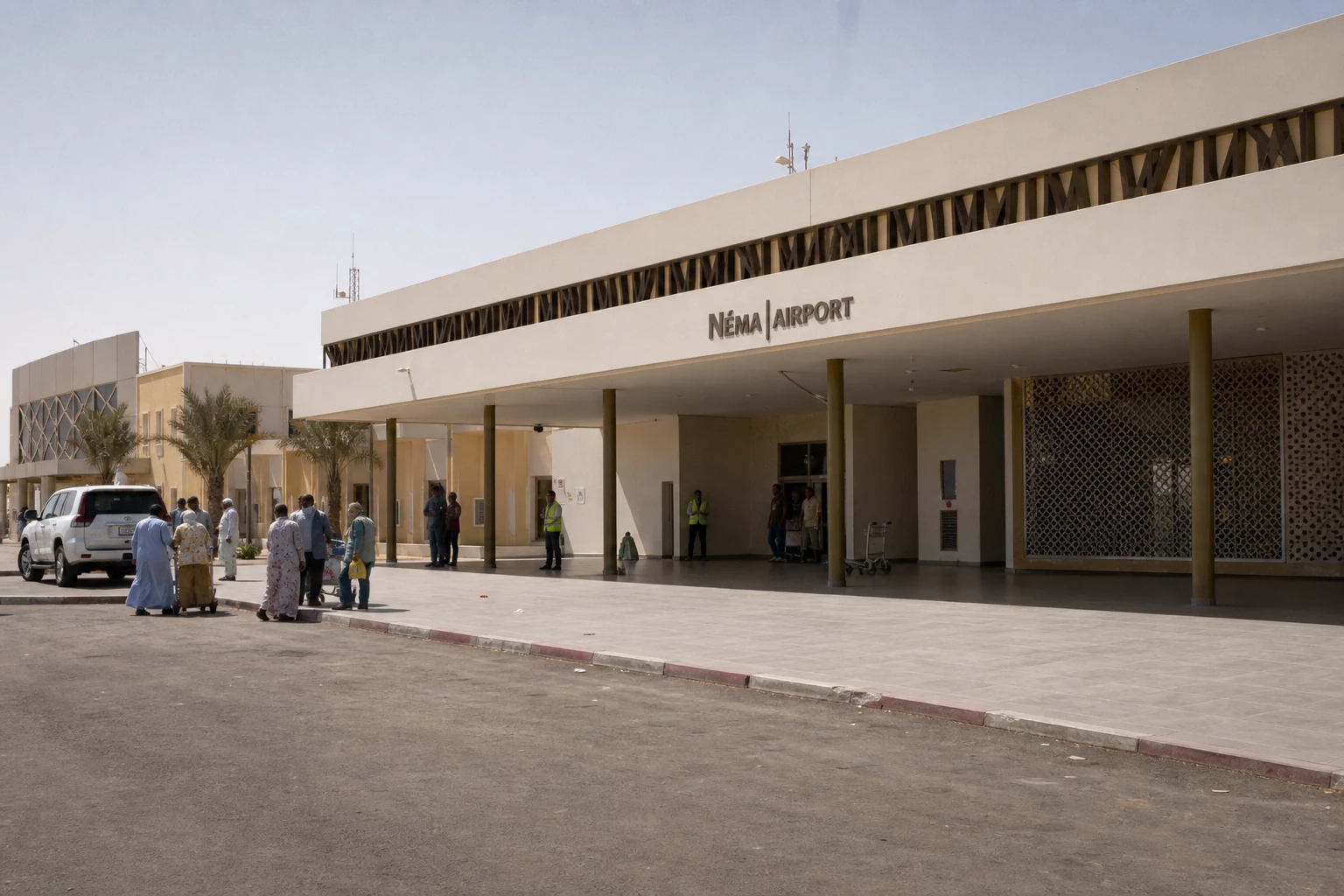
In Néma, families’ return brought a tense period to a close
In eastern Mauritania, a special flight brought back far more than passengers. It brought back traders and relatives, and a measure of calm to families who had spent several days in the anguish of waiting. In Néma on 12 August, the welcome given to these Mauritanians made one thing clear: when family and commercial mobility collides with security suspicion, an entire local economy is shaken.
The case comes amid an already tense regional context. Mauritania shares a long and sensitive border with Mali, crossed by flows of trade, transit and refuge, and sometimes mistrust. Nouakchott remains a member of the African Union and the Arab Maghreb Union, but is outside ECOWAS, placing its relations with Bamako in a more direct bilateral framework, without a West African regional safety net to ease tensions. In south-eastern Mauritania, particularly in Hodh Ech Chargui, the issue of border crossings is often intertwined with security, the rainy season and daily income.
Arrests in Mali, followed by swift action from Nouakchott
According to accounts given by those repatriated, several dozen Mauritanians were arrested on Malian territory the previous week as they were returning from Côte d’Ivoire. Most were heading to their families in Mauritania to spend the rainy season at home. One of them said the bus they were travelling in suffered a puncture near Bamako, before Malian soldiers intervened and arrested them. The men were then taken to a police station, questioned about their identity, origin and destination, and held before being released.
On 12 August, they were repatriated on the orders of Mauritanian President Mohamed Ould Cheikh El Ghazouani aboard a special flight. The aircraft landed at noon at Néma airport, where families were waiting for their loved ones. Images shared on social media showed scenes of relief after several days of anxiety. The Mauritanian authorities thus opted for a swift response, favouring evacuation and de-escalation over a prolonged public confrontation with Bamako.
This episode is not isolated. For several months, Mauritanian-Malian relations have been marked by friction over security, mutual accusations and tensions involving trading communities. In May, Nouakchott had already protested after calls for violence targeting Mauritanians outside its embassy in Bamako. In March, Mauritania’s interior ministry condemned repeated attacks on Mauritanian citizens on Malian soil. The traders’ release is therefore part of a policy of diplomatic restraint, but also of active protection for nationals.
Cross-border trade, security and protection for Mauritanians abroad
The case goes beyond a diplomatic incident. In Mauritania, traders travelling between Côte d’Ivoire, Mali and the eastern regions are part of a very real economic fabric, often discreet but essential. They support families, link markets and sustain supply chains that are largely absent from official statistics. When a check escalates, household incomes, the movement of goods and confidence in trade routes all suffer.
For the Mauritanian state, the issue is also political. In recent months, Mohamed Ould Ghazouani has sent repeated signals that Mauritanians living abroad will be protected. The foreign ministry has said it is following several cases concerning the safety of nationals and dialogue with neighbouring countries. At the same time, the authorities are promoting an image of stability and responsibility, while Mauritania itself hosts more than 300,000 refugees and asylum seekers, according to figures cited by UN agencies and the Mauritanian authorities. This makes border management even more sensitive.
South-eastern Mauritania bears part of this burden. In Hodh Ech Chargui, arrivals linked to the Malian crisis, the needs of host communities and security requirements are putting pressure on public services, roads, water supplies and markets. The repatriation to Néma is therefore a reminder of a frequently overlooked reality: the border is not an abstract line. It is a place where people live and work, and one that can be weakened by decisions made far from villages and bus stations.
What the episode says about Mauritania and the Sahel
The significance of this episode is regional. It shows that relations between neighbouring states in the Sahel are played out not only in foreign ministries. They also play out on buses, at weekly markets, along transit routes and in displacement camps. When Mali tightens its security climate and Mauritania protects its nationals, the border becomes a test of trust between two administrations that need to co-operate despite tensions.
For the African Union, the issue points to a broader challenge: how to protect mobility in the Sahel without criminalising travellers or playing down security threats. For the region, the case is also a reminder that no system can work without ongoing dialogue between border services, consular diplomacy and local authorities. The next point to watch is whether exchanges between Nouakchott and Bamako continue. As long as the movement of people and traders remains exposed to suspicion, any roadside check could reignite a crisis that the capitals are trying to extinguish.