Algeria
 Egypt
 Libya
 Morocco
 Sudan
 Tunisia
 Benin
 Burkina Faso
 Cabo Verde
 Ghana
 Guinea
 Guinea-Bissau
 Liberia
 Mali
 Mauritania
 Niger
 Nigeria
 Senegal
 Sierra Leone
 The Gambia
 Togo
 Cameroon
 Central African Republic
 Chad
 DR Congo
 Equatorial Guinea
 Gabon
 Republic of the Congo
 São Tomé and Príncipe
 Burundi
 Comoros
 Djibouti
 Eritrea
 Ethiopia
 Kenya
 Madagascar
 Malawi
 Mauritius
 Mozambique
 Rwanda
 Seychelles
 Somalia
 South Sudan
 Tanzania
 Uganda
 Angola
 Botswana
 Eswatini
 Lesotho
 Namibia
 South Africa
 Zambia
 Zimbabwe
A sector that carries significant weight in Côte d’Ivoire’s economy
In Côte d’Ivoire, cocoa is more than an export crop. It is a pillar of economic stability, a source of income for hundreds of thousands of families and a strategic issue for the state, whose capital is Yamoussoukro. As prices have fluctuated, the debate is no longer just about volumes sold, but about how to retain more value locally.
The country remains the world’s leading cocoa producer, with a decisive share of international supply. According to the ICCO, Côte d’Ivoire produced 1.681 million tonnes in the 2024/2025 season, ahead of increasingly active African and Latin American competitors. This dominant position gives Abidjan influence, but also exposes the Ivorian economy to every tremor in the global market.
In this context, cocoa accounts for more than 40% of the country’s export revenues, explaining the attention paid to the sector by the authorities and private operators. The price shock of 2024 and 2025 brought home a simple reality: when raw beans do not move smoothly, an entire swathe of the formal and informal economy comes under pressure, from farmers in the forested west to the ports and factories on the coast.
Traceability, producer cards and new commercial discipline
Côte d’Ivoire’s response starts with traceability. The Coffee-Cocoa Council has launched the National Traceability System, which is already being rolled out on the ground, and is accelerating the distribution of producer cards. These bring together the farmer’s identity and the area of the plantation and, under the announced system, the plantations’ geolocation. The card is set to become mandatory for commercial transactions from 1 September 2026.
The timetable is significant. The European Commission has confirmed that the regulation on deforestation, known by the acronym EUDR, will apply from 30 December 2026 to large and medium-sized companies. Cocoa is among the commodities covered. Operators will have to prove that their consignments do not come from areas deforested after 31 December 2020 and comply with the laws of the country of production.
For Côte d’Ivoire, the stakes are commercial as well as regulatory. Without robust traceability, beans risk facing greater barriers to entry into the European market, the main destination for Ivorian cocoa. Through this system, the state is seeking to secure sales, limit payments outside official channels and narrow the gap between the farmgate price set by the authorities and what some producers actually receive.
Figures released by the regulator show the scale of the rollout. More than one million producers have been registered, nearly 900,000 cards produced and distributed, and around three million hectares of cocoa plantations geolocated. Between 1 October 2025 and 31 March 2026, more than 160,000 tonnes are reported to have been traded through the system. These figures should be read as indicators of deployment, not as proof that the entire sector is covered.
Abidjan no longer wants to face the global market alone
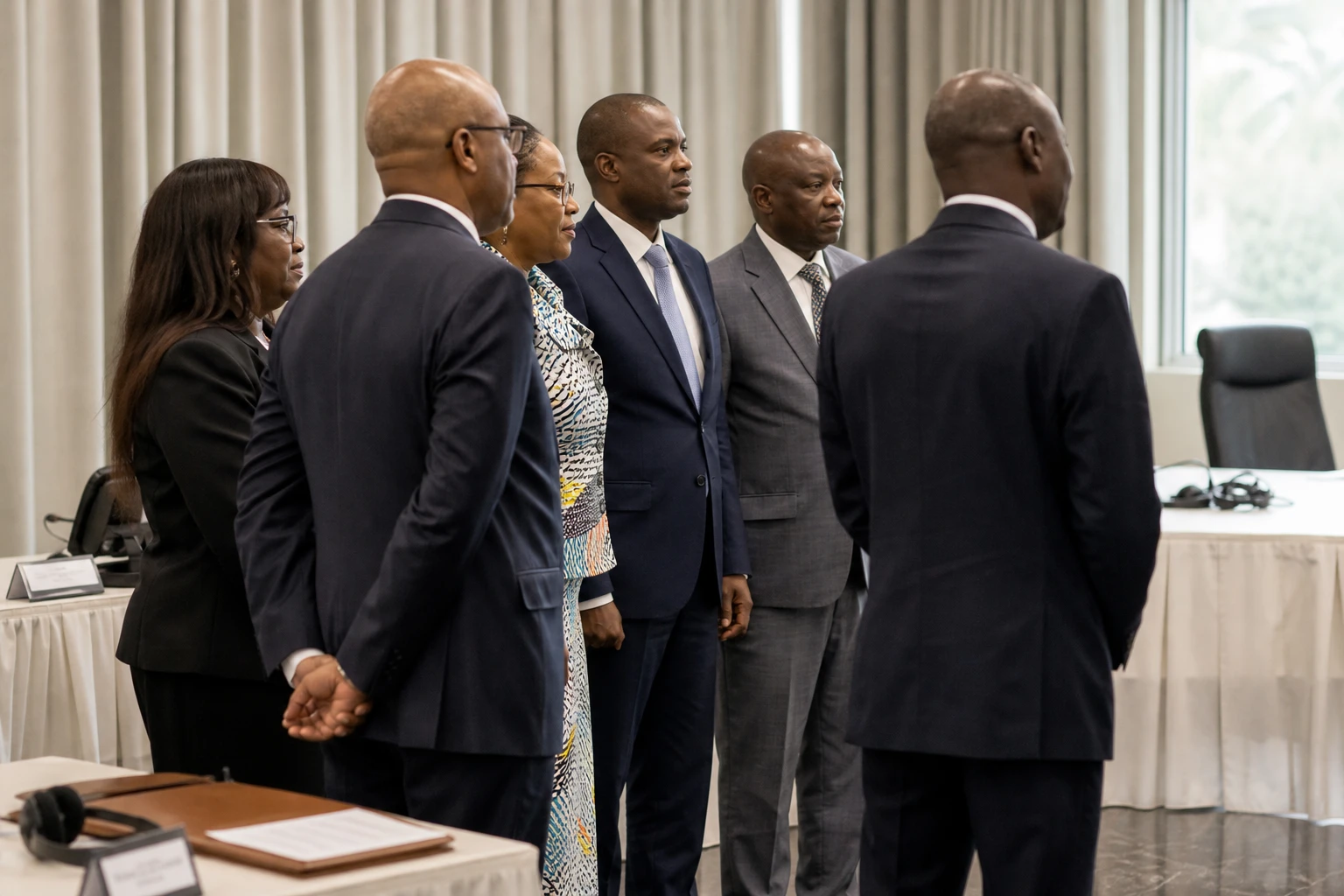
The second response is political and regional. On 16 June 2026, Côte d’Ivoire and Ghana held a high-level summit in Abidjan on their joint cocoa initiative. A few weeks later, on 14 July 2026 in Abuja, the initiative widened to include Nigeria and Cameroon with the creation of the Cocoa Value Addition Alliance, formalised by the Abuja Declaration.
This African front has a clear ambition: to co-ordinate production, marketing and processing policies in order to gain greater leverage with international buyers. The secretariat of the Côte d’Ivoire-Ghana initiative notes that the four countries together account for an overwhelming share of global supply. According to several corroborating sources, they represent around 75% of world cocoa production, although the percentage varies according to calculation methods and seasons.
The political message matters for West Africa. It shows that producers are no longer content to call for a better price; they are also seeking to build sector-focused diplomacy. In a highly concentrated market, co-ordination between Côte d’Ivoire, Ghana, Nigeria and Cameroon can reduce arbitrage between neighbouring countries, curb smuggling and make negotiations more transparent.
Processing more to capture greater value
The third priority is industrial. Côte d’Ivoire wants to move beyond its status as a simple exporter of raw beans. The country already has significant grinding capacity, operated by local and international groups, and the authorities have now set a more ambitious target: 50% local processing by the 2027/2028 season, followed by 100% by 2030.
The challenge is well known. The more beans are shipped raw, the more value added escapes to foreign factories, ports and end-product brands. The more processing takes place locally, the more the state gains in jobs, taxes, skills and industrial margins. The USDA estimated that 42% of national production was processed locally in 2025. Progress is therefore being made, but remains incomplete given the country’s weight in the global sector.
This move up the value chain is not limited to large companies. It also affects co-operatives, transport, logistics, seasonal finance and digital services linked to traceability. For farmers, the stakes are twofold: to sell with greater certainty and, ultimately, to take a better share in a value chain that no longer stops at the edge of the field. For buyers, it marks the end of a grey area in which opacity was cheaper than compliance.
At continental level, the Ivorian case goes beyond cocoa alone. It tests African producers’ ability to speak with one voice on traceability, processing and the distribution of value. It also shows that economic sovereignty in agricultural sectors depends less on slogans than on practical tools, shared timetables and common rules. The next step to watch will be the EUDR’s entry into force on 30 December 2026 and how the 2026/2027 season adjusts to this new discipline.