Algeria
 Egypt
 Libya
 Morocco
 Sudan
 Tunisia
 Benin
 Burkina Faso
 Cabo Verde
 Ghana
 Guinea
 Guinea-Bissau
 Liberia
 Mali
 Mauritania
 Niger
 Nigeria
 Senegal
 Sierra Leone
 The Gambia
 Togo
 Cameroon
 Central African Republic
 Chad
 DR Congo
 Equatorial Guinea
 Gabon
 Republic of the Congo
 São Tomé and Príncipe
 Burundi
 Comoros
 Djibouti
 Eritrea
 Ethiopia
 Kenya
 Madagascar
 Malawi
 Mauritius
 Mozambique
 Rwanda
 Seychelles
 Somalia
 South Sudan
 Tanzania
 Uganda
 Angola
 Botswana
 Eswatini
 Lesotho
 Namibia
 South Africa
 Zambia
 Zimbabwe
In Sokoro, electricity is no longer measured only by whether a light comes on. It can be seen in a mill that runs for longer, drinks sold chilled and a classroom that remains bright when rain darkens the sky. In this village in northern Côte d’Ivoire, the commissioning of the Ferké Solar power plant is already beginning to change daily routines.
In northern Côte d’Ivoire, energy becomes a tool for work
Sokoro has around 500 residents. The village lies at the entrance to Ferkessédougou, in the Tchologo region of northern Côte d’Ivoire. Local activity relies largely on small businesses, grain processing and agricultural work. In this kind of economy, a power cut is more than an inconvenience. It can halt a sale, leave a machine idle or directly reduce the day’s income.
Lamoussa, who runs a mill, says power cuts regularly disrupted his business. They could also damage the motors. Before the improvement seen in recent weeks, he says he sometimes earned barely 1,000 CFA francs in a day.
Since the plant was connected to the grid, he has noticed fewer daytime power cuts. His mill runs for longer and his takings are now said to reach 8,500 CFA francs on some days. This remains an individual account. On its own, it cannot measure the stability of the entire grid. It nevertheless shows the direct link between the quality of the electricity supply and income from small businesses.
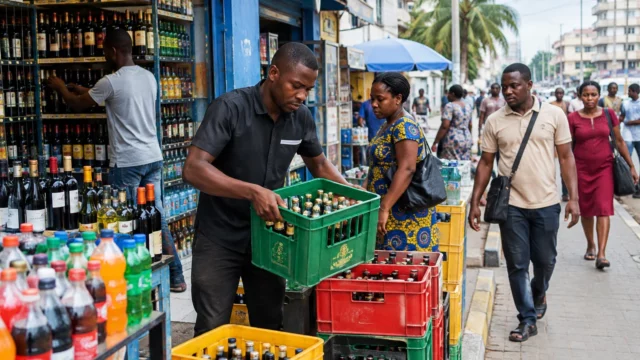
At Méyérégué’s shop, electricity offers another opportunity: to store and sell fresh products. The shopkeeper uses two refrigerators when demand rises. This allows her to offer chilled drinks, particularly during ceremonies and gatherings that punctuate social life in the region.
For rural businesses, this ability to preserve goods broadens the range of products on offer and limits losses. It also makes business more regular. However, access to electricity alone does not guarantee profitability. The cost of equipment, its maintenance and local purchasing power remain decisive.
A 52 MWp plant serving a national target
The Ferké Solar plant is located in Sokoro 2, in the department of Ferkessédougou. It was officially connected to the grid on 3 July 2026. The project has a stated capacity of 52 megawatt-peak, a unit that measures the maximum theoretical output of panels under standard conditions.
According to figures released in connection with the project, the plant is expected to feed nearly 90 gigawatt-hours of electricity a year into the national grid. This contribution remains limited on the scale of Côte d’Ivoire. It is nevertheless part of a series of investments aimed at diversifying the country’s electricity generation.
The project was developed as a public-private partnership. Official information states that the plant will be operated by PFO Énergies before being transferred to the state. The concession agreement was approved by the Ivorian government in 2024.
The plant builds on the momentum of the Boundiali solar power plant, also located in the north of the country. Ivorian authorities aim to raise the share of renewable energy in the electricity mix to 45% by 2030. The national roadmap now sets a target of 46.3% by 2035.
These figures include several sources, notably hydropower, solar and biomass. Solar power is, however, playing an increasing role in new projects. It makes it possible to add generation capacity quickly, particularly in areas with favourable levels of sunshine.
At school, an immediate boost to learning
The improved electricity supply is also benefiting Sokoro’s public primary school. When the sky clouds over on rainy afternoons, pupils can now continue to consult their documents in better conditions.
Zié Konaté, a member of the school’s management, says classrooms used to become too dark when rain reduced natural light. He believes the availability of electricity now makes it possible to continue lessons more regularly.
The school also has a computer room equipped with around 30 computers. More than 200 pupils are expected to be introduced to digital tools there. The issue goes beyond lighting classrooms. It also concerns access to skills that have become essential for education, administration and employment.
This progress will, however, need to be monitored over time. Use of a computer room depends on computer maintenance, teacher training and the availability of a suitable internet connection. Electricity creates the opportunity. It does not replace the other conditions needed for sustainable digital education.
A local issue with regional implications
The Ferkessédougou plant is part of a national policy seeking to meet two needs at once: to keep pace with growing demand and to reduce dependence on thermal power plants. Côte d’Ivoire remains a major player in the West African electricity system. It already exports electricity to several neighbouring countries and takes part in the regional market led by the West African Power Pool, the electricity interconnection system of ECOWAS.
In this context, every new capacity addition can strengthen security of supply nationally and regionally. But integrating more solar power also raises a technical question. Output varies with sunshine. The grid therefore needs the means to manage and transmit electricity and, eventually, to store it in order to maintain the balance between supply and demand.
ECOWAS is working specifically to strengthen interconnections and create a more reliable regional electricity market. Côte d’Ivoire is involved in several projects intended to improve exchanges with its neighbours, including Ghana. The success of these infrastructures will depend as much on investment as on coordination between national electricity companies.
For Sokoro, the first indicator is tangible: a mill that stops less often, a refrigerator that can run and a classroom that stays lit. For Côte d’Ivoire, Ferké Solar is another step towards building a more diversified grid. The next challenge will be to turn this local improvement into a stable, affordable and sustainable service for all areas, from urban centres to rural communities.