Algeria
 Egypt
 Libya
 Morocco
 Sudan
 Tunisia
 Benin
 Burkina Faso
 Cabo Verde
 Côte d'Ivoire
 Ghana
 Guinea
 Guinea-Bissau
 Liberia
 Mali
 Mauritania
 Niger
 Senegal
 Sierra Leone
 The Gambia
 Togo
 Cameroon
 Central African Republic
 Chad
 DR Congo
 Equatorial Guinea
 Gabon
 Republic of the Congo
 São Tomé and Príncipe
 Burundi
 Comoros
 Djibouti
 Eritrea
 Ethiopia
 Kenya
 Madagascar
 Malawi
 Mauritius
 Mozambique
 Rwanda
 Seychelles
 Somalia
 South Sudan
 Tanzania
 Uganda
 Angola
 Botswana
 Eswatini
 Lesotho
 Namibia
 South Africa
 Zambia
 Zimbabwe
As the campaign moves on to screens, truth becomes a target
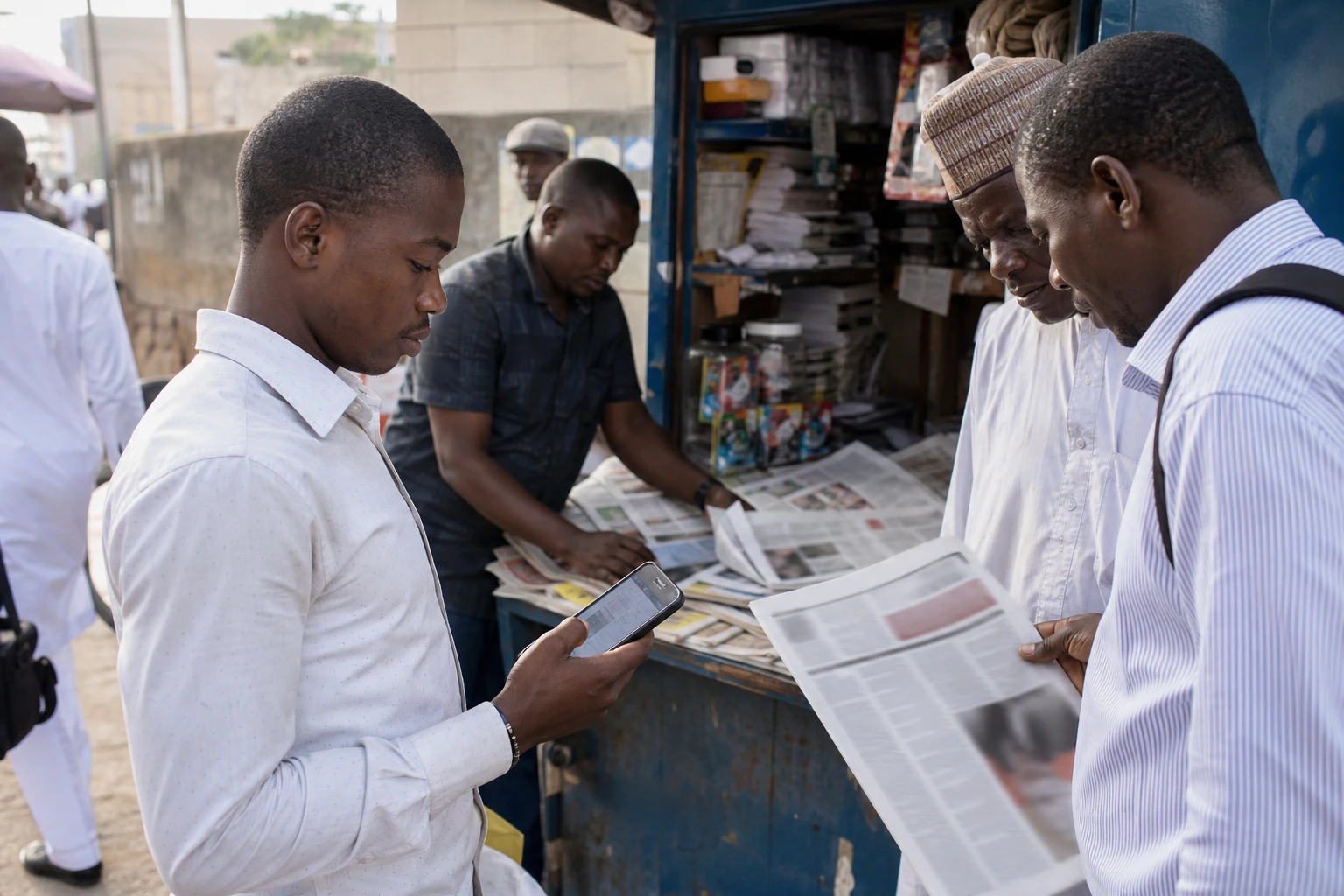
In Nigeria, the electoral battle is no longer fought only at rallies, on radio and in markets. It is also being waged in WhatsApp feeds, on X and through screenshots imitating well-known newspapers. This image war carries significant weight, because it affects a country where the press remains a major political reference point and where the presidential election of 16 January 2027 is already on the electoral commission’s official calendar.
The phenomenon is not trivial. It exploits a deeply rooted reading habit: many Nigerians recognise a newspaper by its front page before even checking the content. It is precisely this trust that is being hijacked. Fake covers create an illusion of credibility, then spread invented promises, fabricated quotes and political announcements that never existed within a matter of hours.
An electoral calendar already under way, with a tight race expected
The federal electoral commission, INEC, has confirmed that the presidential election and national legislative elections are scheduled for 16 January 2027. Its official timetable also provides for the publication of the final list of candidates within the deadlines set by the Electoral Act 2022. The electoral machinery is therefore in motion, with the formalities for nominations, withdrawals and ticket adjustments now shaping the race.
In this landscape, Bola Ahmed Tinubu remains at the centre of power, while Atiku Abubakar and Peter Obi continue to command space in the national opposition. Negotiations between parties and party realignments are fuelling a campaign in which each side is seeking to establish its narrative before the vote. The ADC, the African Democratic Congress, has also emerged in this period as one of the platforms through which Atiku Abubakar is pursuing his political ambitions.
The fake front page: a simple and potent weapon
The method is familiar, but growing in potency. A fabricated page copies the typography of a credible daily newspaper, reproduces its colours and adds a striking line. In Atiku Abubakar’s case, the fake front page attributed to him a promise of rent-free housing for all Nigerians. It went even further, adding an imaginary penalty for landlords. The ploy was crude, but sufficient to circulate widely. Fact-checks published by media outlets and fact-checking platforms concluded that it was fabricated. The former vice-president’s team itself rejected the quote.
One detail further undermines the hoax: the fake image used “The Daily Tribune”, a name that does not correspond to the Nigerian Tribune, a real and well-known newspaper in the country’s media landscape. Guides published by the newspaper also explain how to identify an authentic front page by its logo, graphic design and layout. In other words, the fake seeks less to convince through coherence than to exploit the speed of dissemination.
The same pattern has been used against Bola Ahmed Tinubu and Taiwo Oyedele, the Finance Minister and economic coordinator. Another doctored front page claimed that petrol would cost 5,000 naira per litre from 29 May 2027. Here again, independent fact-checks concluded that it was invented. This type of narrative is designed to hit people in the pocket, since fuel immediately affects transport, food prices, distribution and small-business costs.
What these manipulations really change for voters
The fake cover is not only used to deceive. It is also used to degrade public debate. By attributing implausible statements to candidates, it makes voters wary of everything, including accurate information. It is a strategy of confusion. When everything seems fabricated, trust fractures. And in an already tense campaign, suspicion becomes a political tool.
The consequences are tangible. In cities, where information travels quickly, fake front pages reach young urban residents, digital workers and audiences in messaging groups. In rural areas, where access to immediate verification is more limited, a screenshot sometimes circulates faster than a rebuttal. The risk is not just an isolated mistake. It is the development of a general reflex of doubt, which weakens debate on housing, fuel, employment or the cost of living.
The economic context makes these manipulations even more sensitive. Nigeria continues to face persistent price pressures, debates over the cost of fuel and strong expectations around reforms. In this context, an invented promise on rent or a fictitious announcement about petrol touches on issues that directly affect households and the informal sector, which accounts for a large share of daily economic activity. Disinformation does not float above society. It latches on to it.
A warning that extends beyond Abuja and concerns all of West Africa
Nigeria is not an isolated case. As in several African countries, the pre-election period is becoming a testing ground for visual manipulation, fake documents and montages accelerated by artificial intelligence. The country is playing a large-scale testing role here, because its media market is vast, its public debate highly mobile and its regional influence within ECOWAS, the Economic Community of West African States, considerable. What spreads there can then be reused elsewhere, with different faces and slogans.
For now, the dividing line is clear: on one side, political actors seeking to impose their agenda; on the other, fact-checking teams, newsrooms and readers who must trace information back to its source before sharing it. The tools for checking are available. Newspapers themselves publish guides to recognising their genuine front pages. Fact-checkers have documented the method. But the coming months will be decisive: as the 16 January 2027 election approaches, each fake front page could serve as a dress rehearsal for a broader attack on the credibility of democratic debate.