Algeria
 Egypt
 Libya
 Morocco
 Sudan
 Tunisia
 Benin
 Burkina Faso
 Cabo Verde
 Côte d'Ivoire
 Ghana
 Guinea
 Guinea-Bissau
 Liberia
 Mali
 Mauritania
 Niger
 Nigeria
 Senegal
 Sierra Leone
 The Gambia
 Togo
 Cameroon
 Central African Republic
 Chad
 DR Congo
 Equatorial Guinea
 Gabon
 Republic of the Congo
 São Tomé and Príncipe
 Burundi
 Comoros
 Eritrea
 Ethiopia
 Kenya
 Madagascar
 Malawi
 Mauritius
 Mozambique
 Rwanda
 Seychelles
 Somalia
 South Sudan
 Tanzania
 Uganda
 Angola
 Botswana
 Eswatini
 Lesotho
 Namibia
 South Africa
 Zambia
 Zimbabwe
A more stable connection in a school or health centre can transform very practical tasks: sending records, printing reports or communicating with an administration without waiting. In Djibouti, extending fibre to public services is intended to support precisely these uses. It is also a reminder that a major role in international cables does not, by itself, guarantee affordable access for residents.
Public buildings connected, from Djibouti to the regions
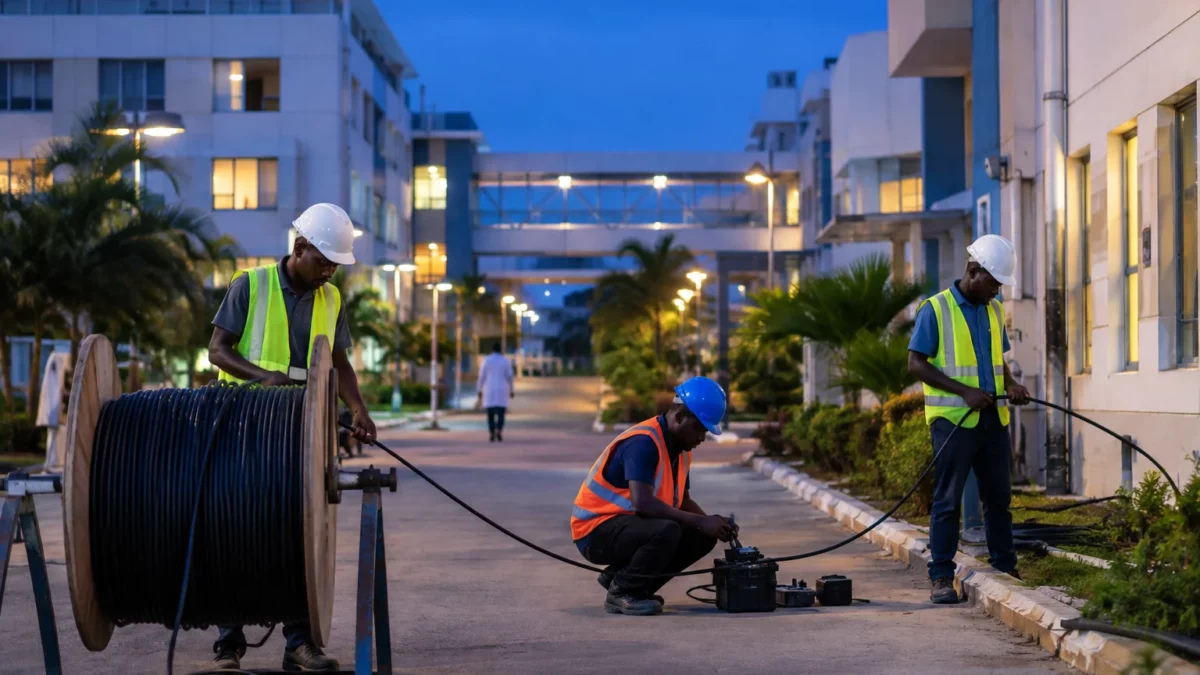
On 23 November 2026, technicians laid fibre between buildings at Peltier Hospital in the capital, Djibouti. The work is part of a phase that plans to connect 104 sites, including schools, health centres and administrative buildings. The authorities aim to complete the work by December 2026 at the latest, according to the Djiboutian Information Agency (ADI). That deadline therefore remains in the future.
This stage expands a pilot phase that connected 33 public sites. The work involves more than bringing a line to a building’s entrance. The internal network must also be installed or adapted so that the different services can actually use the connection. At Peltier Hospital, for example, connecting the buildings is a separate step from bringing fibre to the neighbourhood.
The expected benefits are first measured in the day-to-day operation of services. In June 2025, the ADI reported that at Arta High School, the connection had made it easier to print reports and communicate with the Ministry of Education. A health centre in the region was also among the facilities equipped. These examples indicate possible uses, but on their own they do not establish the impact of the new phase across the country.
Public infrastructure in a market still facing constraints
The Djibouti Digital Foundations programme is not solely about cables. Approved in December 2021 and backed by $10 million in financing from the International Development Association, it also provides support for digital skills and changes to the telecommunications regulatory framework. Its stated objectives include the gradual introduction of competition and private investment.
This ambition addresses a disparity identified in the World Bank’s 2024 digital economy diagnostic. Djibouti is an important transit point for international connections, but domestic access to broadband continues to face affordability and accessibility challenges. The report also describes a sector dominated by Djibouti Telecom, the state-owned operator that provides the main fixed and mobile services.
Connecting government bodies can therefore improve exchanges between institutions and central services, but it will not automatically resolve the difficulties facing households and businesses. Fibre installed in a public hospital does not mean patients will have cheaper internet access at home. Similarly, schools and administrative offices may gain capacity without coverage or the price of commercial offers changing to the same extent.
Results will also depend on how the connections are used
For public servants, a reliable connection can reduce transmission delays and make it easier to share documents. In regions far from Djibouti City, the challenge is also to bring services closer to central government bodies, without routinely requiring people to travel to the capital. Health facilities and schools can benefit, provided they have the necessary equipment, electricity, maintenance and skills.
This final condition matters as much as the cable. Infrastructure that is unused, poorly maintained or lacks a suitable local network will not produce the same results as a service fully integrated into day-to-day activities. Monitoring should therefore cover not only the number of connected sites, but also the actual quality of the connection and the uses it enables.
In its project monitoring cited for September 2025, the World Bank reported that 29 public and private institutions had benefited from improved access, against a target of 60 by June 2027. These figures describe a stage before the current work: they should not be confused with the 104 sites planned in this new phase. The number of connections actually completed by December remains to be verified.
A Djiboutian challenge with regional significance
The issue extends beyond public services alone. Djibouti occupies a strategic position in data exchanges across the Horn of Africa, thanks in particular to its international links and connections with neighbouring countries. IGAD, a regional organisation bringing together states in East Africa and the Horn of Africa, includes regional integration among its areas of co-operation. But being a transit hub does not guarantee that local residents and institutions benefit to the same degree from this capacity.
The project therefore offers a concrete test: can Djibouti turn its transit infrastructure into more accessible and efficient digital services at home? Connecting the 104 sites would be a welcome step for the government bodies and institutions concerned. What follows will depend on completing and maintaining the work, as well as on reforms capable of widening access beyond the public sector.