Algeria
 Egypt
 Libya
 Morocco
 Sudan
 Tunisia
 Benin
 Burkina Faso
 Cabo Verde
 Côte d'Ivoire
 Ghana
 Guinea
 Guinea-Bissau
 Liberia
 Mali
 Mauritania
 Niger
 Senegal
 Sierra Leone
 The Gambia
 Togo
 Cameroon
 Central African Republic
 Chad
 DR Congo
 Equatorial Guinea
 Gabon
 Republic of the Congo
 São Tomé and Príncipe
 Burundi
 Comoros
 Djibouti
 Eritrea
 Ethiopia
 Kenya
 Madagascar
 Malawi
 Mauritius
 Mozambique
 Rwanda
 Seychelles
 Somalia
 South Sudan
 Tanzania
 Uganda
 Angola
 Botswana
 Eswatini
 Lesotho
 Namibia
 South Africa
 Zambia
 Zimbabwe

When a factory becomes a market asset
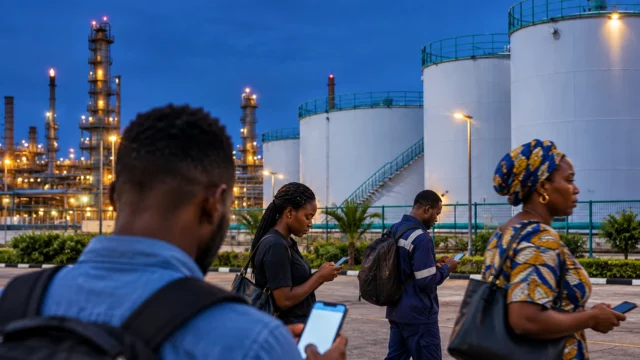
In Lagos, some of the first buyers saw more than a financial opportunity. They also felt they were touching a national symbol: a giant refinery, long presented as an industrial gamble, then turned into an investment product accessible to small investors. The minimum purchase of 10 shares, or 5,250 naira, was enough to bring thousands of Nigerians into a world they had considered the preserve of the wealthy.
This trend says something broader about Nigeria. In a country where inflation has weighed on households and savings are seeking more rewarding havens, the stock market is now attracting people well beyond the circle of professional investors. Young Nigerians have already embraced trading apps, digital savings products and mobile investments. The offer for Aliko Dangote’s refinery therefore sits at the intersection of two trends: highly visible industrialisation, and the incomplete but real democratisation of investment.
What Dangote’s offer actually entails
The initial public offering was launched on Monday 14 September 2026 on the Nigerian Exchange in Lagos. It comprises 4.1 billion ordinary shares, priced at 525 naira each, with a target value of about 2.15 trillion naira, or $1.6 billion. The subscription window is due to remain open until 13 October 2026. The offer is open to retail and institutional investors, as well as certain eligible African investors.
Nigeria’s Securities and Exchange Commission approved the transaction and reiterated that applications and payments must be made only through officially designated channels. This reminder is significant. A few months earlier, the regulator had already warned against misleading solicitations linked to a purported share offer in the refinery. The message is clear: stock market enthusiasm does not remove the need for caution or regulatory oversight.
The initial success is also explained by the industrial narrative surrounding the project. The Lekki refinery in Lagos State is described by its operator as capable of processing 700,000 barrels of crude a day, following a gradual ramp-up. The complex was inaugurated in 2023 and then began commercial operations before reaching, according to the company, a capacity of more than 650,000 barrels a day, with a stated target of 1.4 million barrels a day in the longer term. The Nigerian Oil and Gas Free Zones Authority confirms that it is the continent’s largest single-train refining site.
Between national pride and stock market risk
Its popular appeal rests on a simple promise: to take part, even modestly, in a company seen as strategically important. For decades, Nigeria, Africa’s largest crude producer, imported much of its refined fuel because it lacked sufficient domestic capacity. The refinery’s ramp-up has already changed part of that equation. It has reduced dependence on imports, reorganised supply chains and shifted some of the added value onto Nigerian soil.
But euphoria should not obscure how the stock market normally works. A share can rise. It can also fall. Several analysts made precisely that point when the offer was launched. The risks are well known: disruptions to crude supply, operational challenges, regulatory changes and volatility in demand for refined products. In other words, buyers today are not purchasing a guaranteed income stream, but exposure to the industrial, energy and financial cycles of a capital-intensive company.
This caution is all the more important because Nigeria’s secondary market can react sharply to major investment events. Ahead of the offer, market participants had already reported pressure on other listed shares, as investors sold some holdings to raise cash. Digital platforms, meanwhile, came under strain as retail demand surged. The trend shows that a “stock market for the people” depends on more than a slogan. It also depends on brokers, fintechs and market infrastructure being technically capable of handling a large influx.
What this says about Nigeria and West Africa
For Abuja, the deal goes beyond the success of a private conglomerate. It touches on Nigeria’s credibility as a regional financial centre in ECOWAS, the Economic Community of West African States. The fact that an offer of this size is being made through the Nigerian Exchange and also targets certain African investors shows that Nigeria’s market wants to extend its influence beyond its borders. Lagos is not just selling shares; it is seeking to sell expertise in raising capital on a continental scale.
The political and economic context reinforces this reading. Nigeria still faces the familiar challenge of processing raw materials locally. The Dangote project serves as a showcase: a major industrial asset on Nigerian soil, capable of supplying fuel, attracting capital and fuelling the idea of popular ownership. For households, the immediate impact is more modest: a small investment, sometimes bought more out of enthusiasm than strategy. For the state, however, the stakes are structural. The aim is to show that private capital can support a domestic productive base without replacing the role of public regulation.
What happens next will unfold on two timelines. The first is financial, with the offer closing on 13 October 2026. The second is industrial, with the refinery needing to secure its supplies, sustain its output and turn today’s enthusiasm into lasting performance. If the offer succeeds, it could serve as a model for other large African companies seeking to open their ownership to the public. If it disappoints, it will be a reminder that an asset’s popularity cannot replace operational discipline or market rigour.