Algeria
 Egypt
 Libya
 Morocco
 Sudan
 Tunisia
 Benin
 Burkina Faso
 Cabo Verde
 Ghana
 Guinea
 Guinea-Bissau
 Liberia
 Mali
 Mauritania
 Niger
 Nigeria
 Senegal
 Sierra Leone
 The Gambia
 Togo
 Cameroon
 Central African Republic
 Chad
 DR Congo
 Equatorial Guinea
 Gabon
 Republic of the Congo
 São Tomé and Príncipe
 Burundi
 Comoros
 Djibouti
 Eritrea
 Ethiopia
 Kenya
 Madagascar
 Malawi
 Mauritius
 Mozambique
 Rwanda
 Seychelles
 Somalia
 South Sudan
 Tanzania
 Uganda
 Angola
 Botswana
 Eswatini
 Lesotho
 Namibia
 South Africa
 Zambia
 Zimbabwe
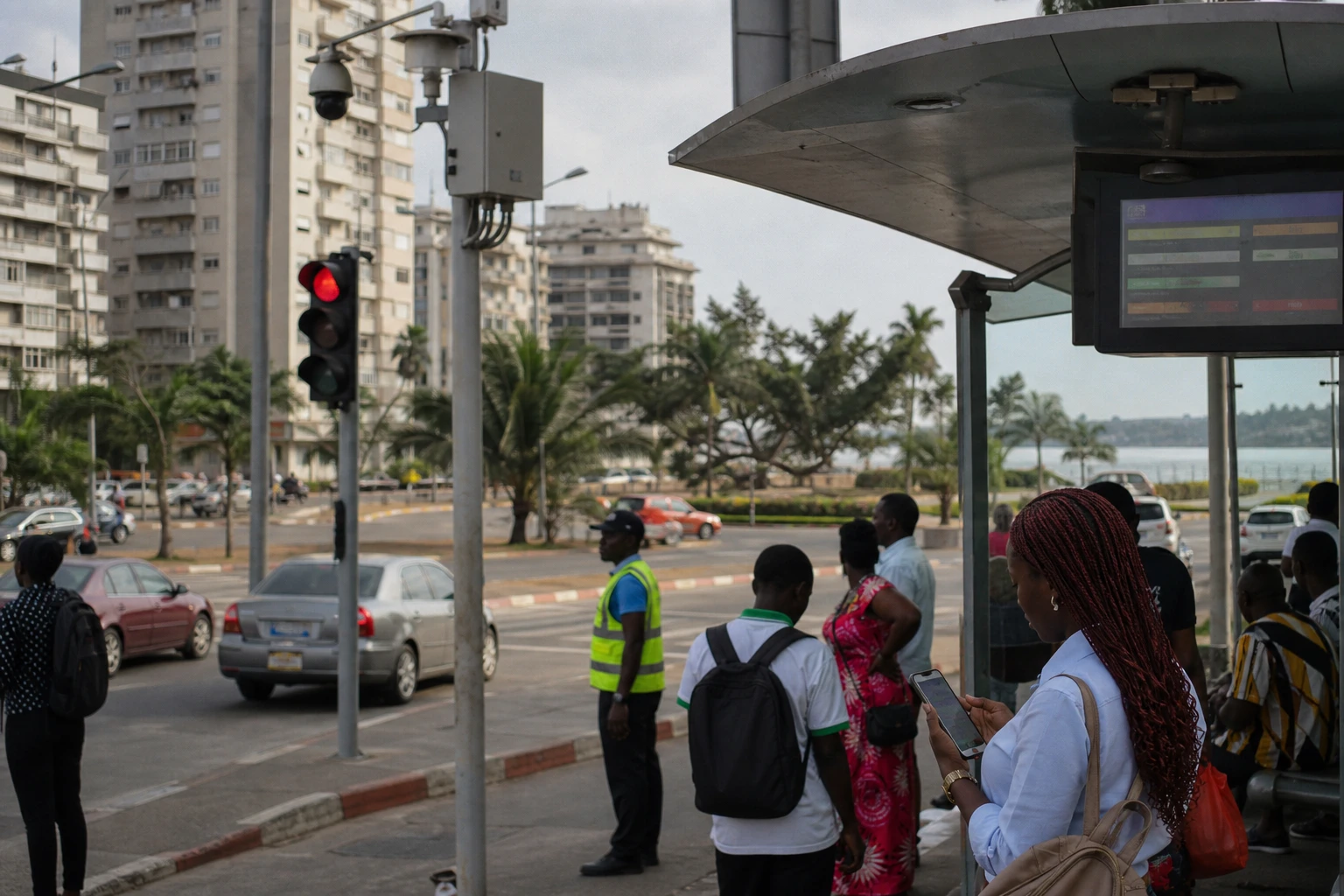
In Abidjan, saving a few minutes in traffic has become an economic concern. Côte d’Ivoire now wants to make greater use of data, cameras and digital networks to make journeys more predictable. This shift must, however, go beyond simply monitoring the roads.
Mobility under pressure in Abidjan
Abidjan accounts for a large share of Côte d’Ivoire’s economic activity. Every day, the metropolis sees more than 10 million journeys, according to an estimate by the World Bank. Households spend considerable time and income on travel, while businesses face delivery delays and difficulties accessing areas of economic activity.
The World Bank estimated the combined annual cost of transport expenditure and time lost travelling at about CFAF 1,200 billion. At the time, this represented nearly 4 to 5% of gross domestic product. The figures date from 2019, but they shed light on a problem that remains central to Côte d’Ivoire’s urban development.
Traffic is particularly sensitive at the main crossing points between the north and south of the city, at access routes to industrial areas and where roads cross the lagoon. The effects are not the same for everyone. Formal-sector employees can lose several hours a day travelling. Workers in the informal economy, meanwhile, are directly affected by fluctuations in transport costs and demand.
The economic capital is not the only area affected. The main roads linking Abidjan to Yamoussoukro, Bouaké, Daloa, Ouangolodougou and Noé also play a role in the movement of people and goods. Improving their safety is therefore important for domestic trade and corridors to neighbouring countries in the Economic Community of West African States, ECOWAS.
A second phase for the intelligent transport system
Côte d’Ivoire is preparing a new phase of its intelligent transport system, or ITS. The system brings together equipment and software designed to monitor traffic, detect certain offences and improve the management of traffic flows.
According to information released after an Ivorian mission to China from 14 to 22 September 2026, the authorities want to increase ITS coverage to 40%, from 16.8% at present. The figures were presented during discussions led by Transport and Maritime Affairs Minister Amadou Koné. The announced target must still be assessed in light of the timetable, funding and precise scope of the equipment involved.
In Beijing and Shanghai, the Ivorian delegation studied solutions related to connected transport, smart cities, digital infrastructure and cybersecurity. The visit is part of an initiative already under way with technology partners, and follows other missions examining models developed in the United States and Japan.
The first phase focused mainly on automated traffic enforcement. In December 2023, Côte d’Ivoire’s transport ministry said its nationwide rollout had exceeded 90%. The Abidjan-Yamoussoukro, Yamoussoukro-Ouangolodougou, Yamoussoukro-Daloa and Abidjan-Noé routes were among the corridors then fully equipped.
The system records certain offences, including speeding, using a mobile phone while driving and failing to wear a seat belt. The images are then used as part of the process for issuing fines. Since January 2024, the system has also been extended to several inland routes, including those towards Bouaké, Daloa and Grand-Bassam.
Encouraging, but still fragile, results
Ivorian authorities point to improvements in several road safety indicators. Between 2021 and 2023, the number of injury accidents fell from 10,054 to 8,089, a decrease of 24%. The death toll dropped from 833 to 765 over the same period. These figures come from the review of the 2021-2025 National Road Safety Strategy and have also been reported by regional media.
This trend does not establish that all risks are declining over the long term. Accidents remain frequent, and trends can vary according to the period, road category and type of vehicle. The points-based driving licence, which came into force on 1 March 2023, complements automated traffic enforcement by linking certain offences to driver behaviour.
The next phase is intended to go beyond enforcement. The authorities are considering a national vehicle monitoring system, a National Transport Operations Centre and a secure platform for managing commercial vehicles. The aim would be to gain a more complete picture of journeys, particularly for freight transport and public services.
Digital technology cannot replace investment in physical infrastructure
An ITS can detect a slowdown, adjust the duration of a traffic light or speed up the response to an incident. It cannot, however, create an extra lane, a bus or an interchange station. To reduce congestion over the long term, digital tools will therefore have to accompany investment in infrastructure.
Abidjan’s sustainable and integrated urban mobility project combines several measures: rapid bus services, a metro, lagoon transport and an intelligent transport system. This multimodal approach is intended to give residents credible alternatives to travelling by private car and better connect outlying municipalities to employment centres.
Access remains a key concern. A digital service that is useful to public authorities and operators must also deliver visible benefits for passengers. This requires reliable timetable information, better coordination between buses, trains and boats, and consideration of journeys in neighbourhoods with poorer transport links.
Maintenance will be another test. Cameras, sensors, connected traffic lights and transmission networks require long-term contracts, local expertise and a stable electricity supply. Without maintenance, the equipment risks quickly becoming ineffective, as has happened with many digital projects rolled out without robust operating arrangements.
An issue of sovereignty and regional integration
The expansion of the ITS also raises questions about data protection. Number plates, traffic images and information related to commercial vehicles are sensitive. Côte d’Ivoire will have to clarify the rules on access, how long data is retained and the responsibilities of public and private operators.
Compatibility between the different platforms will be just as important. The systems used by the police, transport services, local authorities, mobility operators and corridor managers will need to exchange information under clear rules. This interoperability could improve safety on national roads and facilitate regional travel.
For Côte d’Ivoire, the challenge therefore goes beyond modernising Abidjan. It is about building mobility that is safer, smoother and better integrated into West African trade. The success of this second phase will be measured less by the number of cameras installed than by shorter journey times, fewer accidents and the quality of service provided to users.