Algeria
 Egypt
 Libya
 Morocco
 Sudan
 Tunisia
 Benin
 Burkina Faso
 Cabo Verde
 Côte d'Ivoire
 Ghana
 Guinea
 Guinea-Bissau
 Liberia
 Mali
 Mauritania
 Niger
 Nigeria
 Senegal
 Sierra Leone
 The Gambia
 Togo
 Cameroon
 Central African Republic
 Chad
 DR Congo
 Equatorial Guinea
 Gabon
 Republic of the Congo
 São Tomé and Príncipe
 Burundi
 Comoros
 Djibouti
 Eritrea
 Ethiopia
 Kenya
 Madagascar
 Malawi
 Mauritius
 Mozambique
 Rwanda
 Seychelles
 Somalia
 South Sudan
 Tanzania
 Uganda
 Angola
 Botswana
 Eswatini
 Lesotho
 Namibia
 Zambia
 Zimbabwe
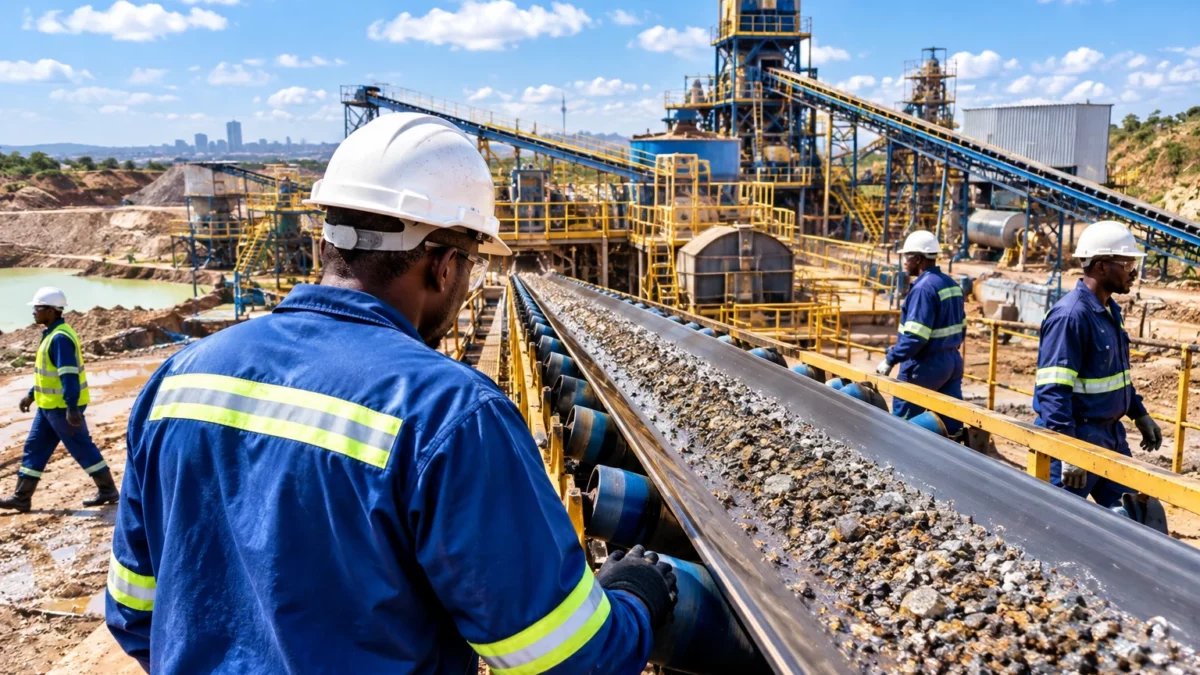
Extracting a mineral does not guarantee lasting benefits for the country that produces it. Value is also created in the factories, electricity networks, skills and jobs built around the mine. South Africa aims to address this industrial challenge with a new financing mechanism open to projects in several sub-Saharan African countries.
From the ground to industrial capacity
The context is growing global demand for raw materials used in batteries, electricity networks, renewable energy and digital technologies. For producing countries, the challenge is not to stop at extracting and exporting raw minerals. Processing and refining locally can retain more activity and skills in African economies.
South Africa set out this direction in its 2025 Critical Minerals and Metals Strategy. The document focuses in particular on local processing, energy security, infrastructure, financing and regional integration. In December 2025, the government approved an implementation plan organised around six pillars, including exploration, local value creation and regulatory harmonisation. South Africa’s critical minerals strategy is therefore part of a broader industrial policy, not just a mining initiative.
At regional level, this ambition aligns with that of the Southern African Development Community (SADC), which promotes cross-border value chains and resource processing. It also echoes the African Union’s Green Minerals Strategy, which advocates value creation at source and regional industrialisation. SADC’s approach to value chains highlights the benefits of linking countries’ productive capacities rather than treating each project in isolation.
Financing announced at €300 million
The European Investment Bank (EIB) and the Industrial Development Corporation (IDC), South Africa’s state-owned industrial development finance institution, have agreed a facility of up to €300 million. The announcement was published on 26 November 2026. However, the EIB’s project summary gives a signature date of 16 November. The bank estimates that its financing could help mobilise up to €900 million in total investment. These figures are ceilings and estimates, not proof that all the funds have already been committed to projects. The EIB financing summary sets out the dates and planned amounts.
The IDC is to use the facility to finance eligible projects in critical minerals value chains. The activities covered range from extraction to processing, refining, recycling and material substitution. The mechanism can also support some of the infrastructure required for these activities, particularly in energy, transport, logistics and digital services. Water is also among the infrastructure areas cited in the South African authorities’ presentation of the agreement.
The announced scope extends beyond South Africa’s borders: projects in other sub-Saharan African countries may qualify, subject to eligibility criteria. South Africa’s Minister of Trade, Industry and Competition, Parks Tau, described the mechanism as covering the entire value chain and said it could support projects beyond the country. This regional dimension matters, but it does not mean that every country or every mineral will automatically benefit from funding. The IDC sets out the facility’s expected role and its aim of strengthening processing and industrial activity.
Long-term finance, a decisive link
For a company, a processing or refining plant often requires heavy investment, long lead times and reliable infrastructure. Long-term financing can therefore help reduce the risk perceived by other investors and advance projects that struggle to find suitable capital. But it cannot replace affordable and reliable electricity, roads, rail, water, skills or stable regulations.
The EIB presents the operation as a way to diversify and secure supplies of raw materials needed for the energy and digital transitions. This European goal is explicit in its project summary. It exists alongside South Africa’s aim of developing local processing and employment. The interests may converge, but they are not identical: Europe is also seeking resilient supply chains, while Pretoria wants to increase the industrial value retained in the country and strengthen its role in regional trade.
For workers and local businesses, the outcome will depend on the projects that are actually financed, their requirements for employment and training, and the suppliers they use. Benefits may be concentrated in industrial and mining hubs, while communities near sites will expect tangible returns and responsible resource management. The announcement of financing alone is not enough to conclude that these effects will materialise.
Regional impact will be tested by the projects
The EIB describes the agreement as its first operation outside the European Union dedicated to critical minerals since the launch of its sector initiative in 2025. It adds to international competition to secure resources and processing capacity. For African countries, the challenge is to negotiate partnerships that also support their production priorities and ensure that regional co-operation goes beyond simply moving minerals to external markets.
The next step will therefore be less about the headline amount than the selection of investments: which minerals, which countries, which infrastructure and what share of processing will take place locally? It will also be important to track projects’ ability to build links between producers and industries in the region, in line with the ambitions of SADC and the African Continental Free Trade Area (AfCFTA), which aims to facilitate trade between African countries. It is at this level that the agreement’s real contribution to industrialisation in South Africa and Africa will be measured.