Algeria
 Egypt
 Libya
 Morocco
 Sudan
 Tunisia
 Benin
 Burkina Faso
 Cabo Verde
 Côte d'Ivoire
 Ghana
 Guinea
 Guinea-Bissau
 Liberia
 Mali
 Mauritania
 Niger
 Nigeria
 Senegal
 Sierra Leone
 The Gambia
 Togo
 Cameroon
 Central African Republic
 Chad
 DR Congo
 Equatorial Guinea
 Republic of the Congo
 São Tomé and Príncipe
 Burundi
 Comoros
 Djibouti
 Eritrea
 Ethiopia
 Kenya
 Madagascar
 Malawi
 Mauritius
 Mozambique
 Rwanda
 Seychelles
 Somalia
 South Sudan
 Tanzania
 Uganda
 Angola
 Botswana
 Eswatini
 Lesotho
 Namibia
 South Africa
 Zambia
 Zimbabwe
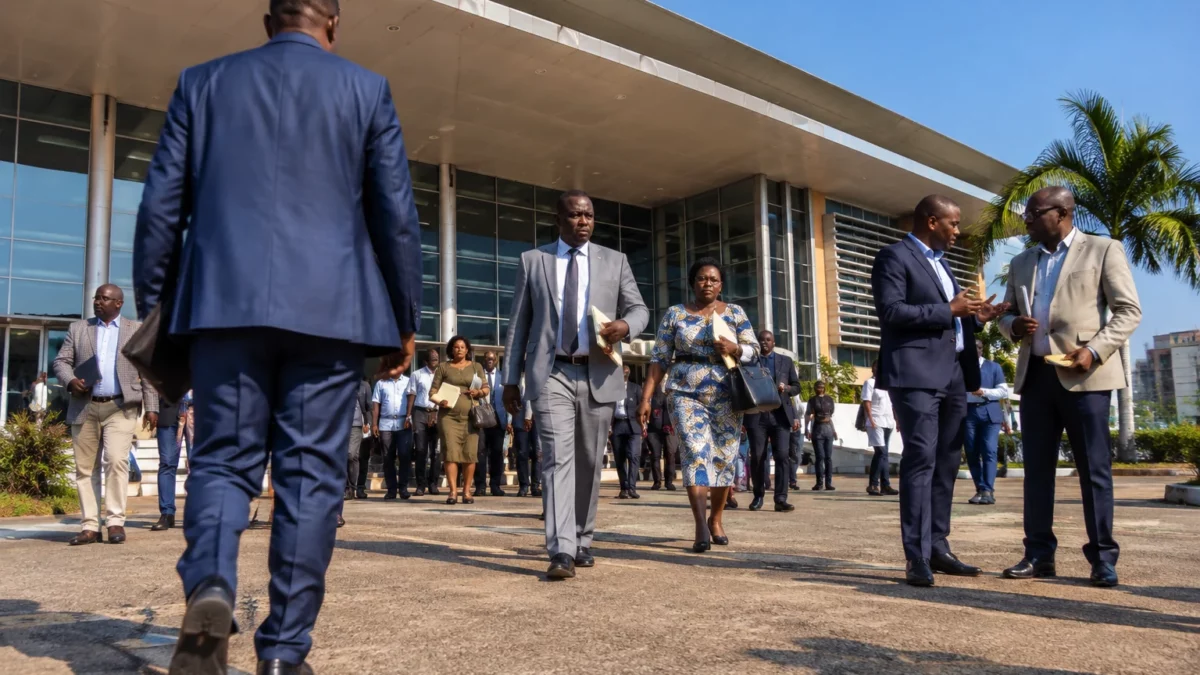
In Gabon, political parties rallying around the head of state raise a practical question: how can they support the government without erasing the differences between them? In Libreville, an answer is taking shape this week between two congresses, as the former dominant party tries to resolve its own divisions.
A merger on the eve of two congresses
On 26 November, the Rally for the Homeland and Modernity (RPM) approved its merger by absorption into the Democratic Union of Builders (UDB), the party of President Brice Clotaire Oligui Nguema. The decision was taken at an extraordinary RPM congress in Libreville. Its leader, Alexandre Barro Chambrier, the vice-president of the Republic, presented the move as a way to contribute to joint political action.
The timing is revealing. The ordinary congress of the Gabonese Democratic Party (PDG) opens on 27 November and is due to run until the 29th. Then, on 5 December, the UDB will hold its first ordinary congress. These events, close together, showcase two distinct dynamics: the gathering of parties around the presidential party and the search for a new direction for the PDG.
The RPM had already declared its support for Oligui Nguema and his 2025 presidential candidacy. Its merger therefore marks less a change of alliance than a change of status: the party is giving up its independent existence to join the UDB. In October, a similar move was announced concerning Réagir, another party close to the government.
The PDG seeks its place after the 2023 rupture
The PDG dominated Gabonese political life for several decades, until the coup of 30 August 2023 ended Ali Bongo Ondimba’s rule. Since then, the party has been riven by a leadership dispute. Blaise Louembé, elected as its president in January 2025, is preparing for the Libreville congress. Ali Bongo, in exile in Paris, disputes his leadership and says that the bodies established at the 2022 congress remain legitimate. Ali Akbar Onanga Y’Obegue, who presents himself as the party’s secretary-general, has also challenged the congress timetable.
The disagreements are not only internal. The congress must also clarify the PDG’s relationship with Oligui Nguema and the UDB. Blaise Louembé’s leadership has expressed support for the president’s policies. It must, however, decide between a more formal rapprochement and preserving a distinct identity. The outcome of the meeting will not, by itself, resolve the legitimacy dispute with Ali Bongo’s camp.
This reshuffle comes after a return to the constitutional electoral timetable. Oligui Nguema, who came to power in the 2023 coup, was elected president in April 2025. In legislative elections that same year, the UDB won the largest number of seats in the National Assembly, while the PDG won three in the first round, according to provisional results reported by the Associated Press.
What the merger changes — and what it does not resolve
Gabon’s law on political parties sets out precise rules for such mergers. A merger by absorption leads to the dissolution of the absorbed party’s legal personality. The elected representatives concerned must then declare their membership of the party receiving them; otherwise, they become independents. The law therefore does not provide for them to change their party affiliation automatically as a result of the merger alone.
This point matters when assessing the parliamentary impact of the move. The RPM had elected representatives in Parliament, but the reported number of MPs and senators has not been confirmed here by an independent source. It is therefore important to distinguish the party’s political decision from its practical effects on parliamentary groups, which will depend on the individual steps taken by its elected representatives.
For the UDB, the arrival of new figures and networks could strengthen its national presence. But bringing together leaders with different backgrounds under one banner guarantees neither a common line nor lasting support from party members. The 5 December congress will be an early test of organisation and internal representation. For the PDG, the Libreville meeting will show above all whether its leadership can stabilise the party without giving up all political autonomy.
An issue extending beyond Libreville
This development also affects the institutions and political balances of Central Africa. Gabon is a member of the Central African Economic and Monetary Community (CEMAC), which brings together six countries in economic and monetary co-operation. The choices made in Libreville are thus part of a region where several states are closely monitoring political transitions and the return to constitutional institutions.
At national level, the issue goes beyond party machinery. A broader majority can facilitate government action, but the concentration of defections around the presidential party makes internal party life and the space left for competing voices all the more important. The next developments to watch are the PDG congress resolutions, the choices made by its various leadership factions and the formal decisions of RPM elected representatives. These will show whether Gabon is moving towards a better-structured majority or a less pluralistic party landscape.