Algeria
 Egypt
 Libya
 Morocco
 Sudan
 Tunisia
 Benin
 Burkina Faso
 Cabo Verde
 Côte d'Ivoire
 Ghana
 Guinea
 Guinea-Bissau
 Liberia
 Mali
 Mauritania
 Niger
 Senegal
 Sierra Leone
 The Gambia
 Togo
 Cameroon
 Central African Republic
 Chad
 DR Congo
 Equatorial Guinea
 Gabon
 Republic of the Congo
 São Tomé and Príncipe
 Burundi
 Comoros
 Djibouti
 Eritrea
 Ethiopia
 Kenya
 Madagascar
 Malawi
 Mauritius
 Mozambique
 Rwanda
 Seychelles
 Somalia
 South Sudan
 Tanzania
 Uganda
 Angola
 Botswana
 Eswatini
 Lesotho
 Namibia
 South Africa
 Zambia
 Zimbabwe
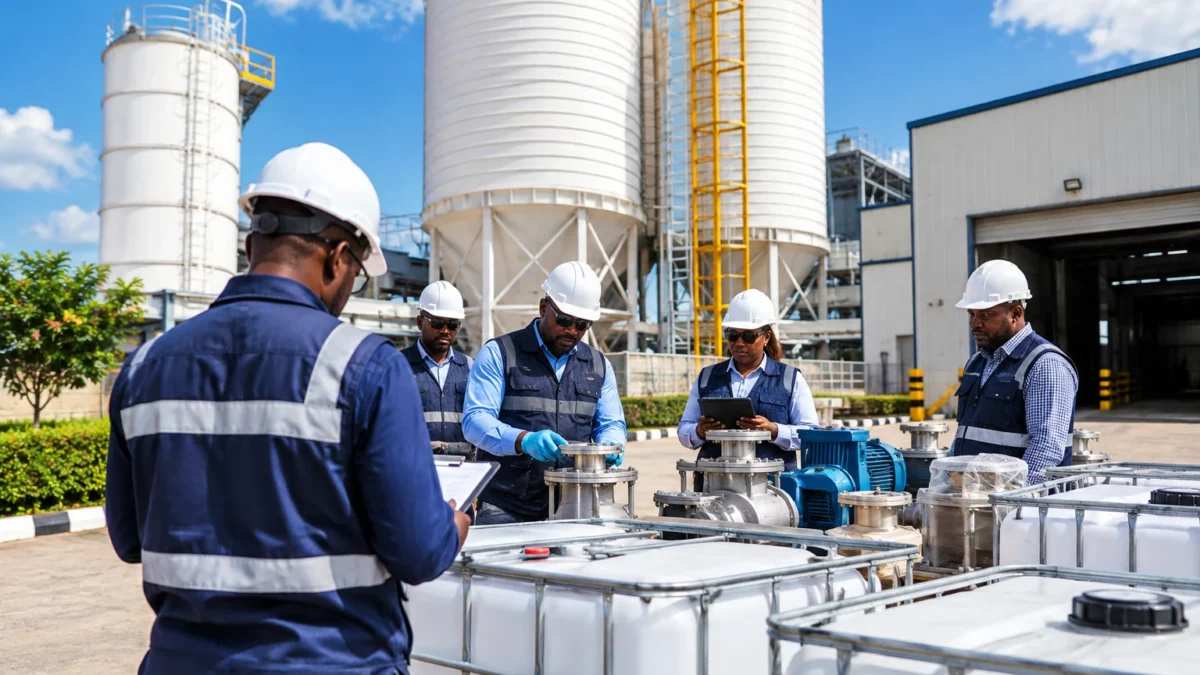
The discovery of a methamphetamine laboratory in Enugu points to a new scale of operations for criminal networks in Nigeria: production is no longer limited to imported or transit shipments. It now involves industrial facilities, expertise from abroad and local operatives.
Operation follows months of surveillance
On 11 November 2026, officers from Nigeria’s National Drug Law Enforcement Agency (NDLEA) raided a compound in Enugu State, in the south-east of the country. The operation led to the arrest of five Mexican nationals and Chuks Enoch Ezeike, a 63-year-old Nigerian whom the agency identified as the suspected owner of the laboratory.
The NDLEA says it seized 1,512kg of methamphetamine, a synthetic stimulant drug, in finished form or in the process of being produced. It values the consignment at $226.8mn, or about 303.9bn naira. Officers are also said to have discovered 6.68 tonnes of precursor chemicals and industrial equipment. These figures and this valuation are those provided by the agency; on their own, they do not measure the price at which the drugs would actually have been sold.
According to the NDLEA’s account, reported by Nigerian media, the investigation began in April. The five Mexicans are said to have been turned back after first arriving in Abuja, then to have returned to Nigeria via Benin using false passports. The agency says it monitored their movements before the raid. These details reflect investigators’ preliminary findings: individual responsibility will have to be established by the courts.
NDLEA chairman Mohamed Buba Marwa described a multi-tiered organisation: alleged sponsors based in Mexico, a Nigerian intermediary responsible for setting up the operation and its logistics, and a Mexican production team. This account comes from the anti-drugs agency. At this stage, it does not establish the involvement of any particular cartel, nor should the allegations be treated as having been proven.
Nigeria shifts from corridor to production site
Nigeria is a member of ECOWAS, the Economic Community of West African States, whose countries share land borders and extensive commercial ties. For the authorities, the Enugu case therefore raises a question that extends beyond the state concerned: how can networks be prevented from using regional connections to move people, equipment and chemicals?
The case follows several anti-drugs operations in Nigeria in 2026. In May, the authorities announced a large seizure in Ogun State, in the south-west. Researchers at the Institute for Security Studies (ISS), who analysed this development in June, note that the country has long been a transit route, but is also developing capacity to produce synthetic drugs. Enugu fits this trend, although the case alone is not enough to establish the overall scale of this activity.
Precursor chemicals are central to the investigation. Their import and circulation can pass through legitimate commercial channels before they are diverted to clandestine production. Investigators must therefore track not only laboratories, but also suppliers, transport, financing and intended markets. Seizing raw materials can disrupt a facility; it does not automatically reveal where the finished products were to be sold.
Effects extend beyond seizures
For people in the region, the suspected presence of a production site raises practical concerns: risks associated with chemicals, accidental exposure, pressure on communities and the possibility of reprisals between networks. The authorities have not announced any human toll linked to the operation. It would therefore be wrong to infer from the seizure alone that health or environmental harm has already occurred.
The impact also concerns public services. Investigators must establish how the equipment was acquired and transported, monitor movements across borders and protect legal proceedings from interference. In cities as well as rural areas, enforcement operations are no substitute for prevention, treatment and access to care for people affected by drug use.
At regional level, ECOWAS data show that West African countries report various drug seizures, including amphetamine-type stimulants and associated chemicals. The report does not, however, allow trends across the region to be equated with the Nigerian case. The response must combine police co-operation, precursor controls and public health policies, with information-sharing between neighbouring countries.
What the next steps must establish
What happens next will depend on the evidence presented in court: the precise role of each suspect, the origin of the chemicals, the financing of the facility and the intended destination of the methamphetamine. Investigators will also need to determine whether the network had other sites or logistics operatives in Nigeria and neighbouring countries. In Abuja, the federal authorities will have to co-ordinate the NDLEA’s work with immigration services and other relevant agencies.
The operation demonstrates the Nigerian state’s capacity to investigate and make seizures. At the same time, it exposes weaknesses that transnational networks can exploit. For ECOWAS, the challenge is to ensure the response does not amount to a series of successive national arrests: routes, precursors and financial channels cross borders. The Enugu case will therefore also be judged by what the investigation manages to dismantle beyond the laboratory.