Algeria
 Egypt
 Libya
 Morocco
 Sudan
 Tunisia
 Benin
 Burkina Faso
 Cabo Verde
 Côte d'Ivoire
 Ghana
 Guinea
 Guinea-Bissau
 Liberia
 Mali
 Mauritania
 Niger
 Nigeria
 Senegal
 Sierra Leone
 The Gambia
 Togo
 Cameroon
 Central African Republic
 Chad
 DR Congo
 Equatorial Guinea
 Gabon
 Republic of the Congo
 São Tomé and Príncipe
 Burundi
 Comoros
 Djibouti
 Eritrea
 Ethiopia
 Kenya
 Madagascar
 Malawi
 Mozambique
 Rwanda
 Seychelles
 Somalia
 South Sudan
 Tanzania
 Uganda
 Angola
 Botswana
 Eswatini
 Lesotho
 Namibia
 South Africa
 Zambia
 Zimbabwe
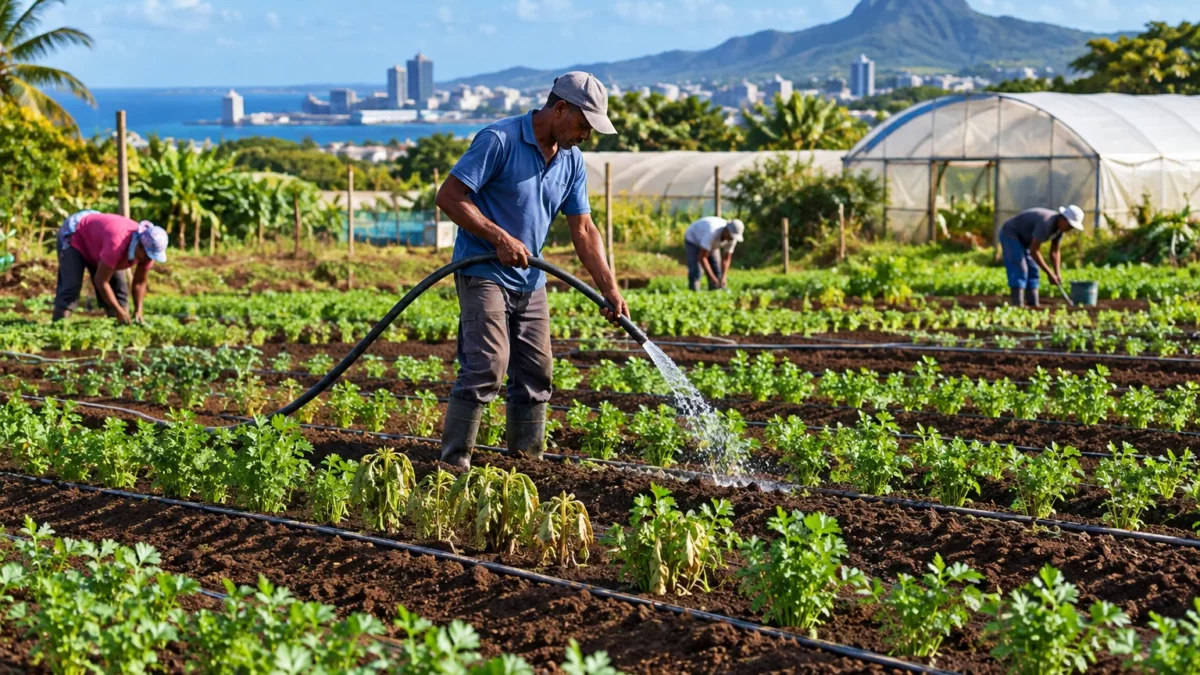
In Mauritius, the heat is measured not only by the thermometer: it can be seen in scorched peppers, reduced harvests and falling water reserves. For market-garden farms, the challenge is now to maintain production as irrigation needs increase.
A dry season puts water under pressure
The island is entering its southern summer, usually the hottest and wettest period of the year. But the expected rains are late. Forecasts by the Mauritius Meteorological Services for summer 2026-2027 predict a strengthened El Niño episode and seasonal rainfall that could be below average. El Niño is a periodic warming of the equatorial Pacific that can alter rainfall patterns in several regions of the world. However, it is not, on its own, enough to explain every local dry spell.
The Mauritius Meteorological Services expect the summer rains to begin around the last week of November. In their October bulletin, they said the El Niño episode was strengthening. These forecasts provide a risk framework, not certainty about how much rain will fall in each district.
Mare aux Vacoas reservoir, the country’s largest, is the focus of much attention. According to figures reported on 22 November, its level had fallen to 33% of capacity, compared with 74% at the same time a year earlier. The Water Resources Unit, the public body responsible for monitoring water resources, says the reservoir can hold 25.89 million cubic metres. It supplies water, among other areas, to the Plaines Wilhems and Moka districts.
Vegetables, from fields to greenhouses, under stress
Market gardeners around Port Louis say high temperatures are slowing the growth of vegetables. Dharshini Anishta, head of a local agricultural business, estimates that production at her farm has fallen by about 40% over three months. This estimate relates to her business; it is not a national assessment of the sector.
Greenhouse crops are not protected from the heat. Farmer Seesurrun Madhan reports a rise of two to three degrees both outside and inside his facilities. He attributes the scorching observed on his peppers to these temperatures. When the air heats up inside a greenhouse, the shelter alone is not enough to protect plants: ventilation and humidity control also become crucial.
Drought is also driving up production costs. Growers sometimes have to irrigate more while available water is becoming scarcer. Small farms, with less storage capacity or cooling equipment, may have less room to adapt than better-capitalised operations. This does not mean all farms are suffering the same losses, but it affects their ability to maintain output.
Higher costs and lower harvests can then feed through into vegetable prices. But this is not automatic: it also depends on imports, distribution channels, stocks and the harvest calendar. Consumers in Port Louis and other urban centres may quickly feel a squeeze in supply. Producers, meanwhile, first face falling sales and rising irrigation costs.
Responses that must be sustained over time
The government is highlighting the search for seeds better suited to water scarcity, as well as the development of storage infrastructure. Agro-Industry Minister Arvin Boolell said the Mauritian research centre was working on drought-resistant seeds. Adapted varieties can limit risks, but their development, distribution and cost determine their practical value to growers.
Local organisations are also advocating for smaller, nearby reservoirs to retain water close to plots. This type of facility can help producers when rainfall is irregular. It does, however, require rules for sharing water and regular maintenance. During shortages, decisions about allocating water to households, agriculture and other activities become more sensitive.
The challenge therefore goes beyond seeds alone. Reserve management, irrigation efficiency, soil protection and the rapid dissemination of weather forecasts also matter. Growers need sufficiently precise information to adjust their planting and watering. Investment must also remain accessible to small farms, not just businesses able to finance sophisticated greenhouses.
An issue for the Indian Ocean
Mauritius is an island state in the Indian Ocean and a member of the Southern African Development Community (SADC), a framework for regional co-operation. Water availability and dependence on food imports are also concerns for other islands in the region, although their climates and agricultural output differ. Mauritian responses can therefore inform regional exchanges on water management and agricultural adaptation, without constituting a universal solution.
In the short term, two indicators will be crucial: whether the rains actually arrive and how reservoir levels change. Over the longer term, it will be necessary to assess whether adapted seeds, local storage and irrigation techniques genuinely reduce losses. The current drought is testing Mauritian production; it also shows how much food security depends on water management that protects both households and farms.
The Mauritius Meteorological Services’ summer outlook anticipates a strengthening El Niño and the onset of rain towards the end of November. The official data on Mare aux Vacoas specify its capacity and the areas it supplies. Mauritian media had also reported growers’ concerns about the expected effects of El Niño as early as October.