Algeria
 Egypt
 Libya
 Morocco
 Sudan
 Tunisia
 Benin
 Burkina Faso
 Cabo Verde
 Côte d'Ivoire
 Ghana
 Guinea
 Guinea-Bissau
 Liberia
 Mali
 Mauritania
 Niger
 Nigeria
 Senegal
 Sierra Leone
 The Gambia
 Togo
 Cameroon
 Central African Republic
 Chad
 DR Congo
 Equatorial Guinea
 Gabon
 Republic of the Congo
 São Tomé and Príncipe
 Burundi
 Comoros
 Djibouti
 Eritrea
 Ethiopia
 Madagascar
 Malawi
 Mauritius
 Mozambique
 Rwanda
 Seychelles
 Somalia
 South Sudan
 Tanzania
 Uganda
 Angola
 Botswana
 Eswatini
 Lesotho
 Namibia
 South Africa
 Zambia
 Zimbabwe
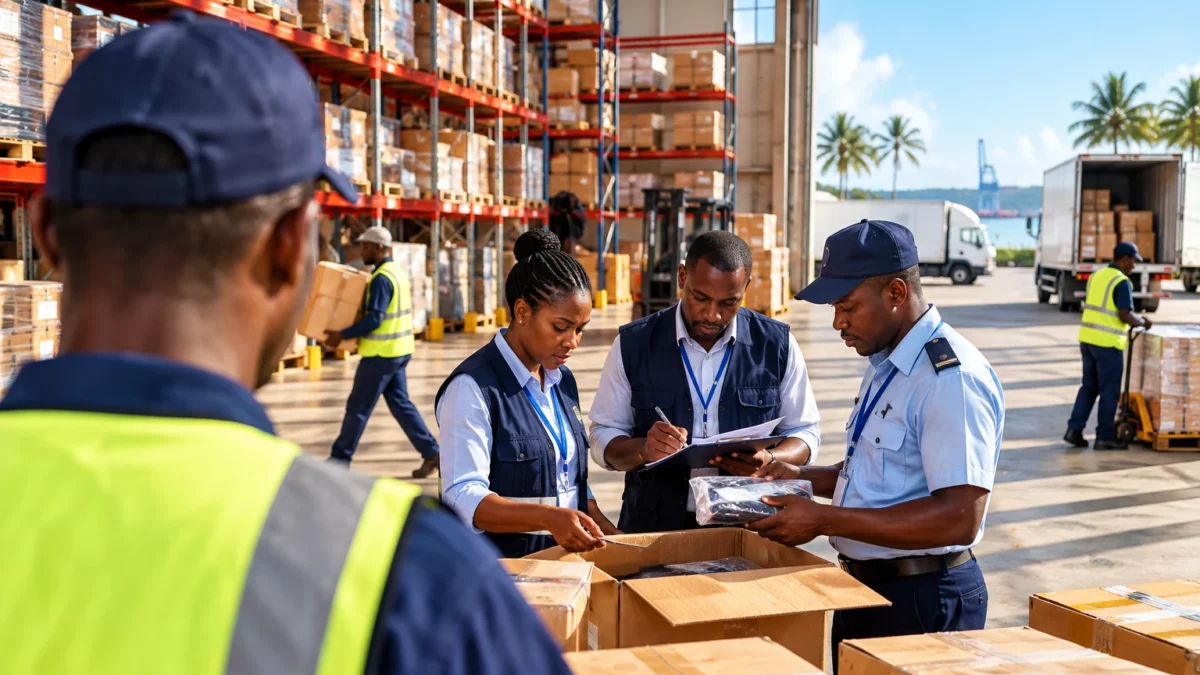
Illegal goods do not stop at the border: they can evade taxes, bypass standards and expose consumers to dangerous products. In Kenya, the challenge now is to connect government agencies that already have enforcement powers, but whose information and interventions need to be better coordinated.
A domestic challenge across regional borders
Kenya is a major trading hub in East Africa. Its ports, roads and markets connect it to neighbouring countries and international trade. This position encourages legal commerce, but also makes cooperation between customs, regulatory authorities and security services necessary, beyond national borders.
Within the East African Community (EAC), a regional organisation that brings the markets of its member states closer together, goods circulate in an increasingly integrated economic area. A misdeclared shipment or counterfeit product can therefore affect several countries. The fight depends not only on checks in Nairobi or at the ports: it also requires information-sharing and compatible practices across the region.
Kenya is not starting from scratch. The Anti-Counterfeit Authority (ACA) and several public bodies already have responsibilities in this area. An inter-ministerial workshop organised in 2026 by the State Department for Trade focused on coordinated measures and a work plan covering several budget cycles. The challenge is to turn existing mandates into a joint response, rather than multiply structures. Kenya’s State Department for Trade describes this coordination effort.
Seven priorities to better connect enforcement
On 18 November 2026, in Mombasa, the government presented a national assessment of illicit trade and an action framework built around seven priorities, according to Kenyan reports of the announcement. Principal Secretary for Trade Regina Ombam advocated a response involving government agencies, businesses and communities. The framework provides for better public-sector coordination, shared data and intelligence, and risk-based checks.
The other priorities concern market surveillance, product traceability, law enforcement, targeted regulatory reforms, and cooperation with the private sector and regional partners. The financial component aims to identify and dismantle networks that profit from illegal activities. The publicly available details describe a proposed strategy; on their own, they are not enough to establish that an implementation timetable, budget or performance indicators have already been adopted.
Traceability can help track a product from one checkpoint to another. But its effectiveness will depend on data quality, the sharing of information between agencies and their ability to act when anomalies emerge. Without operational resources or follow-up procedures, a digital platform alone cannot guarantee that a suspect product will be removed from the market or that a network will be prosecuted.
A significant but outdated figure
The ACA’s baseline assessment estimated the value of illicit trade at 826 billion Kenyan shillings in 2018, or 9.3% of gross domestic product that year. It also estimated public revenue losses at 153.1 billion shillings. The authority had already published these figures in its baseline survey, conducted in partnership with TradeMark East Africa. The ACA presents the findings of this national survey. The Kenya News Agency also reports the estimates of 826 billion and 9.3%.
These amounts describe 2018, not the current situation. They cover a range of practices: counterfeiting, adulterated or non-compliant products, the diversion of controlled medicines and the fraudulent reuse of packaging. The assessment also cites illicit financial flows, money laundering, the trafficking of natural resources and wildlife trophies, as well as human trafficking and labour exploitation. These activities do not follow the same routes or have the same consequences; an effective policy must therefore avoid treating them as a single phenomenon.
Different impacts on different groups
For consumers, non-compliant products can pose health and safety risks. For businesses that follow the rules, competition becomes more difficult when products evade taxes, standards or intellectual property obligations. For the state, lost revenue reduces the resources available for public services. Workers and communities are also affected when supply chains rely on exploitation or resource trafficking.
More coordinated enforcement could improve protection for consumers and legitimate businesses. It will, however, need to distinguish organised networks from small traders, and rely on verifiable procedures. Data on seizures, prosecutions and recovered revenue do not all measure the same thing: more seizures may reflect better enforcement, without proving on their own that the illegal market is shrinking.
The decisive test will therefore be implementation: effective intelligence-sharing, financial investigations, court decisions and measures that can be compared over time. Across the EAC, the challenge will also be to cooperate with neighbouring countries so that checks do not simply shift routes from one border post to another. For Kenya, the next step will be to clarify who is leading the seven priorities, with what resources and against which measurable results.