Algeria
 Egypt
 Libya
 Morocco
 Sudan
 Tunisia
 Benin
 Burkina Faso
 Cabo Verde
 Côte d'Ivoire
 Ghana
 Guinea
 Guinea-Bissau
 Liberia
 Mali
 Mauritania
 Niger
 Senegal
 Sierra Leone
 The Gambia
 Togo
 Cameroon
 Central African Republic
 Chad
 DR Congo
 Equatorial Guinea
 Gabon
 Republic of the Congo
 São Tomé and Príncipe
 Burundi
 Comoros
 Djibouti
 Eritrea
 Ethiopia
 Kenya
 Madagascar
 Malawi
 Mauritius
 Mozambique
 Rwanda
 Seychelles
 Somalia
 South Sudan
 Tanzania
 Uganda
 Angola
 Botswana
 Eswatini
 Lesotho
 Namibia
 South Africa
 Zambia
 Zimbabwe
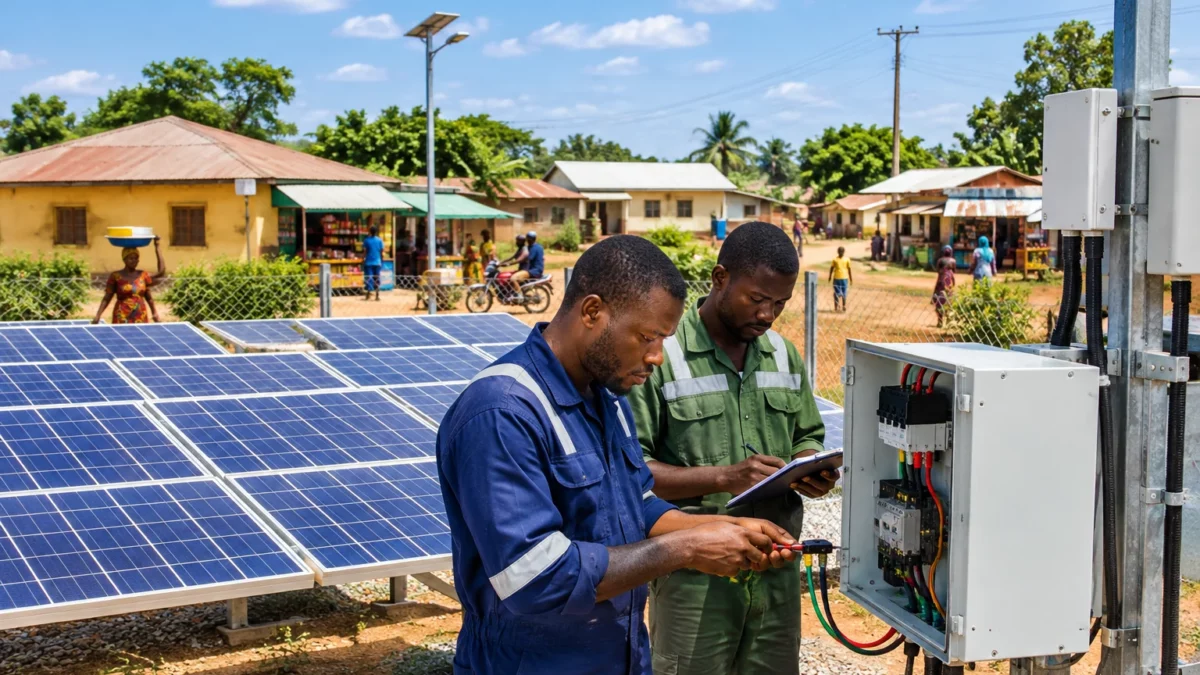
For a solar company seeking to equip a community far from the grid, the challenge is not just the panels or batteries. It must also finance the work before public subsidies linked to results are paid. A new agreement in Nigeria aims to address this timing gap.
A banking agreement to support off-grid projects
On 17 November 2026, in Abuja, Jaiz Bank and the Rural Electrification Agency (REA), Nigeria’s public agency tasked with supporting access to electricity, signed a 100 billion naira financing agreement. The amount is equivalent to about $74 million, according to reports published in Nigeria.
The mechanism targets developers eligible for REA programmes, including DARES. The bank is to provide financing to selected companies, while the agency will facilitate the associated grant agreements. The agreement sets out a financing capacity: it does not mean that the 100 billion naira has already been lent or spent. Punch and TheCable both reported the signing and the amount.
According to these Nigerian media outlets, the agreement brings to 450 billion naira the local commercial financing commitments mobilised by the REA for renewable energy projects. Jaiz is joining other financial institutions involved in these arrangements. Here too, the announced total should not be confused with actual disbursements or installations already completed.
DARES, a national programme with ambitious targets
The agreement is part of the Distributed Access through Renewable Energy Scale-up programme, or DARES. Funded in part by a $750 million allocation from the World Bank, it aims to provide new or improved access to electricity for more than 17.5 million Nigerians. The programme prioritises solar mini-grids and standalone solar systems for households and small businesses. The REA’s overview of DARES sets out these targets.
Progress is already measurable, but much remains to be done. In a monitoring report published in 2026, the World Bank says that 5.3 million people have gained new or improved access, mainly through individual solar systems and isolated mini-grids. This figure represents a stage in the programme, not its final target. The World Bank monitoring report also states that more than $430 million had been committed to the programme at the time of its review.
Mobilising domestic capital can help developers meet construction costs upfront, then obtain grants once the specified milestones have been reached. The aim is to reduce a practical obstacle: even a project considered worthwhile can remain on hold if its developer cannot finance the initial costs.
Benefits will depend on implementation
For people and businesses far from the grid, a mini-grid or an individual solar system can provide a solution where an immediate extension of the national grid would be difficult. A more regular power supply can support shops, workshops and local services. But the announcement of a funding facility guarantees neither the construction of an installation nor affordable tariffs for its users.
Results will depend on loan terms, the guarantees required, project selection and the pace of disbursements. They will also depend on installations’ ability to operate and be maintained over time. The needs of an urban shopkeeper, a rural health centre and a household living off-grid are not the same. Monitoring will therefore need to distinguish between financing commitments, infrastructure actually in operation and people newly served.
DARES relies heavily on private companies, with the state and its financial partners providing support and oversight. This approach could accelerate deployment, but the specific terms of grants and credit will be decisive. For developers, the agreement could provide an additional source of finance. For users, the question will be whether this capacity translates into a reliable and affordable service.
A Nigerian issue with resonance across West Africa
Lack of access to electricity remains a major challenge in Nigeria. A World Bank estimate published for 2021 put the number of people without access to electricity at more than 85 million. This dated figure gives an indication of the scale of the problem, but is not a current assessment. The government is also relying on decentralised solutions as part of a strategy linking energy, economic activity and access to services.
The implications extend beyond Nigeria’s borders. Across the ECOWAS region, where countries also need to expand and make their electricity systems more reliable, mini-grids and domestic financing offer a possible course of action, though not an identical solution for every country. Nigeria, a major demographic and economic force in the region, can help shape a market for companies and financial institutions in the sector.
The next step to watch is therefore less the announced size of the commitments than their conversion into projects. Data on loans actually granted, installations commissioned and beneficiaries served will show what the agreement changes, beyond its headline amount.