Algeria
 Egypt
 Libya
 Morocco
 Sudan
 Tunisia
 Benin
 Burkina Faso
 Cabo Verde
 Côte d'Ivoire
 Ghana
 Guinea
 Guinea-Bissau
 Liberia
 Mali
 Mauritania
 Niger
 Nigeria
 Senegal
 Sierra Leone
 The Gambia
 Togo
 Cameroon
 Central African Republic
 Chad
 DR Congo
 Equatorial Guinea
 Gabon
 Republic of the Congo
 São Tomé and Príncipe
 Burundi
 Comoros
 Djibouti
 Eritrea
 Ethiopia
 Madagascar
 Malawi
 Mauritius
 Mozambique
 Rwanda
 Seychelles
 Somalia
 South Sudan
 Tanzania
 Uganda
 Angola
 Botswana
 Eswatini
 Lesotho
 Namibia
 South Africa
 Zambia
 Zimbabwe
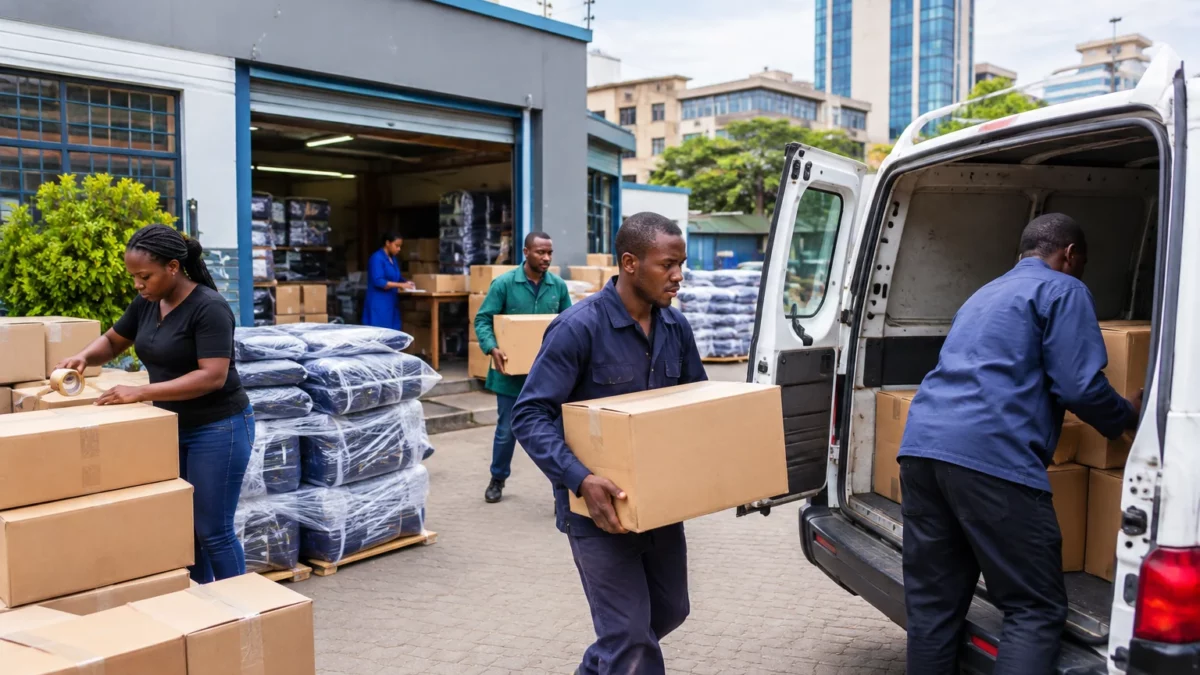
For a small Kenyan business, selling in Kampala or Goma can open up a market far larger than its county. But finding customers is not enough: financing, standards, transport and formalities can still slow the crossing of the border.
A regional market already vital to Kenya
In East Africa, trade between neighbouring countries is supported in part by the East African Community (EAC), a regional bloc that aims to facilitate the movement of goods and services. For Kenya, this trading proximity already carries considerable weight. Kenyan exports to other EAC members reached 351.2 billion shillings in 2025, according to figures from the Kenya National Bureau of Statistics (KNBS), cited by the public agency Kenya News Agency and the Kenyan daily The Star.
Uganda is Kenya’s leading African export market. Kenyan sales to the neighbouring country rose by 28.8% in 2025, reaching approximately 162.3 to 162.4 billion shillings. The KNBS reports 162.3 billion in its Economic Survey 2026; The Star, citing the survey data, gives 162.4 billion. This small discrepancy makes it more appropriate to cite an approximate figure than to suggest undue precision.
The Great Lakes region broadens this perspective further. It comprises countries linked by trade, infrastructure and stability concerns. The International Conference on the Great Lakes Region (ICGLR) has a Private Sector Forum, designed to involve businesses in regional economic integration.
Talks aim to link businesses with markets
The Kenya National Chamber of Commerce and Industry (KNCCI) and the United Nations Development Programme’s (UNDP) REST-GLR programme are considering strengthening their cooperation. According to information shared about their discussions, a meeting held in Nairobi on Monday 16 November focused on supporting small and medium-sized enterprises, their access to finance and their investment readiness.
Proposals discussed also include identifying new markets, providing technical assistance and potentially mobilising resources jointly. KNCCI member businesses could take part in future REST-GLR programme cohorts. The discussions also covered sustainable financing for SMEs, post-investment follow-up and internship programmes for young people.
KNCCI is present in all 47 Kenyan counties. It could therefore relay opportunities to businesses beyond Nairobi, the capital, and major business centres. Its regional network within the ICGLR Private Sector Forum could also facilitate cross-border contacts. These details describe a proposed partnership, however: no detailed public timetable, budget or quantified target has been set out in the available information.
The challenge: turning opportunities into viable businesses
Employment figures show why support for small businesses matters. Kenya recorded 822,100 additional jobs in 2025, according to the KNBS. About 87.2% of them were in the informal economy, meaning activities that are partly outside conventional social protection, financing or regulatory systems. The Kenyan media outlet The Standard also reported these figures from the Economic Survey 2026.
Regional exports can support local producers, traders and jobs. But the gains are not automatic. An SME must be able to finance its stock, meet the requirements of its target market and transport its products at an acceptable cost. Discussions on financing and post-investment support address these obstacles, but do not guarantee that businesses will obtain loans or gain access to markets.
The impact will also depend on how the programmes are delivered. Businesses based outside Nairobi may need support close to home. Young people may benefit from internships, but these are no substitute for sustainable jobs. Finally, informal businesses, which account for a large share of economic activity and job creation, risk being left out if programmes require procedures they cannot readily meet.
The two institutions also discussed business continuity ahead of Kenya’s next electoral period. This concern relates to businesses’ ability to maintain operations in the event of disruption. At this stage, it is one of the topics under discussion, rather than a concrete measure that has been announced.
A test for East African economic integration
The REST-GLR programme places trade and socio-economic integration within a broader effort to build resilience and cooperation in the Great Lakes region. In September 2026, representatives of countries in the region and organisations including the EAC, the ICGLR and the Common Market for Eastern and Southern Africa (COMESA) met in Nairobi to discuss the initiative.
The closer ties between KNCCI and the UNDP could therefore connect regional goals with businesses’ everyday needs. The next step will be to see whether the discussions lead to accessible mechanisms: admission criteria, financial support, assistance in the counties and measurable results for SMEs. The scale of trade with Uganda shows that regional demand already exists. The question is whether small businesses will be able to capture a greater share of it.