Algeria
 Egypt
 Libya
 Morocco
 Sudan
 Tunisia
 Benin
 Burkina Faso
 Cabo Verde
 Côte d'Ivoire
 Ghana
 Guinea
 Guinea-Bissau
 Liberia
 Mali
 Mauritania
 Niger
 Nigeria
 Senegal
 Sierra Leone
 The Gambia
 Togo
 Cameroon
 Central African Republic
 Chad
 DR Congo
 Equatorial Guinea
 Gabon
 Republic of the Congo
 São Tomé and Príncipe
 Burundi
 Comoros
 Djibouti
 Eritrea
 Kenya
 Madagascar
 Malawi
 Mauritius
 Mozambique
 Rwanda
 Seychelles
 Somalia
 South Sudan
 Tanzania
 Uganda
 Angola
 Botswana
 Eswatini
 Lesotho
 Namibia
 South Africa
 Zambia
 Zimbabwe
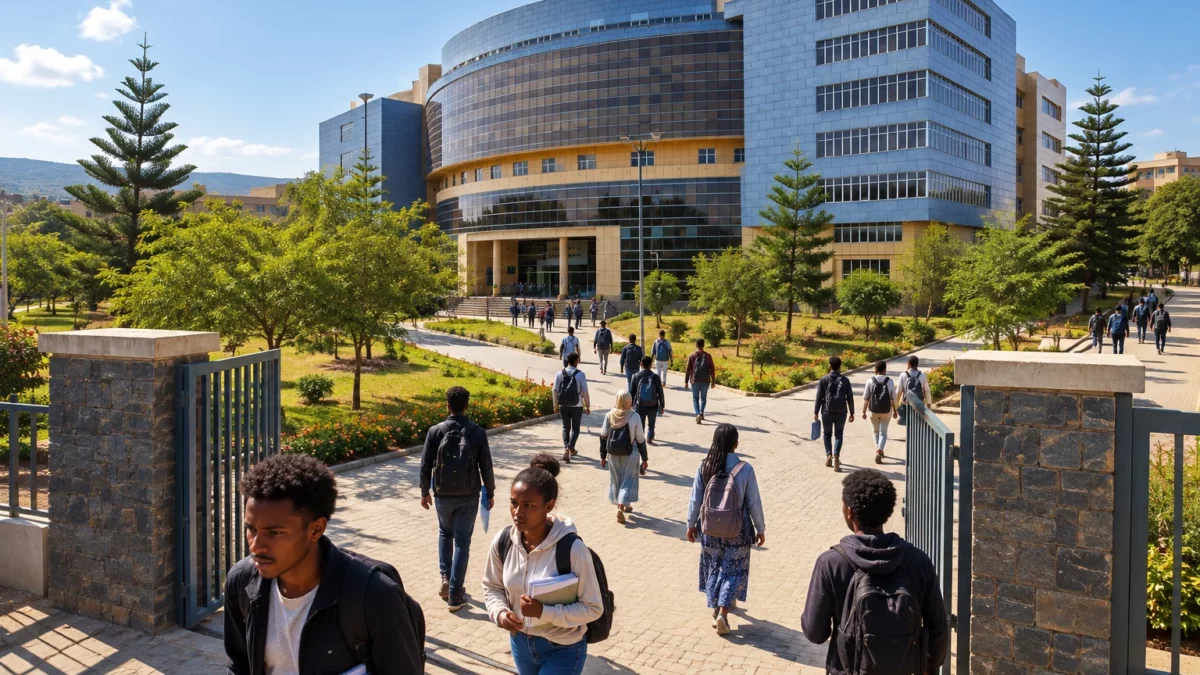
In Mekele, returning to their studies does not mean the war is behind them. For young people in Tigray, university represents both a chance to build a future and an institution weakened by fighting, displacement and political uncertainty.
Studying in a region where peace remains fragile
Tigray, in northern Ethiopia, is only just emerging from a fresh escalation. Clashes resumed in September 2026 between federal forces and the Tigray People’s Liberation Front (TPLF), the political movement that governed the region before the 2020-2022 war. On 4 October, fighters allied with the federal government entered Mekele after the TPLF withdrew. The African Union called for restraint, warning that tensions threatened the 2022 peace agreement.
Signed in Pretoria on 2 November 2022 under African Union mediation, the agreement ended large-scale fighting between the federal government and Tigrayan forces. It provided, among other things, for a cessation of hostilities and the restoration of public services. But it did not resolve all political tensions or security issues. The renewed fighting shows how vulnerable peace commitments remain when disagreements between Addis Ababa and the Tigrayan authorities are not resolved through negotiations.
The previous conflict left deep scars. The human toll remains contested and difficult to establish because of access restrictions and communication blackouts. Researchers at Ghent University estimated that about 500,000 civilians died between 2020 and 2022, from direct violence to the collapse of healthcare and food shortages. This figure is an estimate, not a verified official count.
Back in class, but reopening remains uncertain
In an account recorded in Mekele, Mariam, a 24-year-old law student, describes the relief of returning to classes after weeks of anxiety. The resumption of war has brought back memories of the previous conflict. She says she no longer knows whom to trust. Her experience is a reminder that physical safety alone is not enough to restore a sense of stability.
Her friend Betelhem fears that insecurity could also undermine livelihoods in the region. She is considering leaving after graduating and hopes to spare her future children a childhood marked by the same upheaval. Both students hope to obtain scholarships to continue their studies in Europe. This plan reflects a personal response to uncertainty, but also the risk that trained young people whom Tigray will need to rebuild may leave.
The situation at universities must, however, be described with caution. Students’ accounts refer to classes resuming in Mekele. Yet local reports published on 18 October said that federal institutions in Tigray were still assessing the conditions for reopening. The Ministry of Education had temporarily reassigned students to other universities, while institutions were seeking material and logistical support. At that point, no official reopening date had been announced. The resumption of classes therefore cannot be described as general or confirmed across all campuses.
This uncertainty comes on top of disruptions to communications and transport. Flights to Mekele had been suspended after Tigrayan forces took the airport, then resumed after forces allied with the government returned. Information from the region remains difficult to verify when telephone and internet networks are cut off. Individual accounts shed light on the human consequences, but are not enough to establish the situation of all students or every town.
Individual choices, a collective challenge
For the students, a degree guarantees neither employment nor safety. Fighting and displacement disrupt classes, economic activity and the services on which families depend. The effects vary according to location and resources: a student displaced to another campus may continue their studies but has to adapt to a new environment; a family remaining in an affected area may face interruptions to income, healthcare or transport. Available data do not make it possible to measure these disparities precisely, but accounts show their concrete consequences.
The federal government, for its part, installed a six-month interim administration in Tigray after retaking Mekele. This institutional change opens a new phase of political control, but does not automatically address the needs of campuses and students. The ministry must specify the conditions under which universities can operate, while regional and federal authorities remain at odds over governance and security.
The issue extends beyond classrooms. A university unable to accommodate its students weakens the training of future professionals and the region’s capacity to rebuild its services. Conversely, maintaining classes without guaranteeing safety, infrastructure and regular access can shift the risk on to students and staff. The response therefore depends as much on administrative decisions as on lasting de-escalation.
A crisis closely watched in the Horn of Africa
Tigray lies in a region where tensions between Ethiopia and Eritrea are raising fears of a wider conflict. Ethiopia told the UN Security Council that Eritrean forces had crossed the border; Eritrea disputed Ethiopia’s account, and the claims have not been independently verified. In this context, the Intergovernmental Authority on Development (IGAD), a regional organisation in the Horn of Africa, and the African Union are involved in efforts to mediate and prevent an escalation.
For neighbouring countries, a further deterioration could complicate cross-border movements and regional stability. For Tigrayans, the urgency is more immediate: knowing whether the fighting will spread, whether universities can reopen on a lasting basis and whether the Pretoria agreement can still serve as a basis for dialogue. Mariam and Betelhem’s experience highlights this contradiction: the hope of earning a degree remains, but for some students, the future it promises is already elsewhere.