Algeria
 Egypt
 Libya
 Morocco
 Sudan
 Tunisia
 Benin
 Cabo Verde
 Côte d'Ivoire
 Ghana
 Guinea
 Guinea-Bissau
 Liberia
 Mali
 Mauritania
 Niger
 Nigeria
 Senegal
 Sierra Leone
 The Gambia
 Togo
 Cameroon
 Central African Republic
 Chad
 DR Congo
 Equatorial Guinea
 Gabon
 Republic of the Congo
 São Tomé and Príncipe
 Burundi
 Comoros
 Djibouti
 Eritrea
 Ethiopia
 Kenya
 Madagascar
 Malawi
 Mauritius
 Mozambique
 Rwanda
 Seychelles
 Somalia
 South Sudan
 Tanzania
 Uganda
 Angola
 Botswana
 Eswatini
 Lesotho
 Namibia
 South Africa
 Zambia
 Zimbabwe
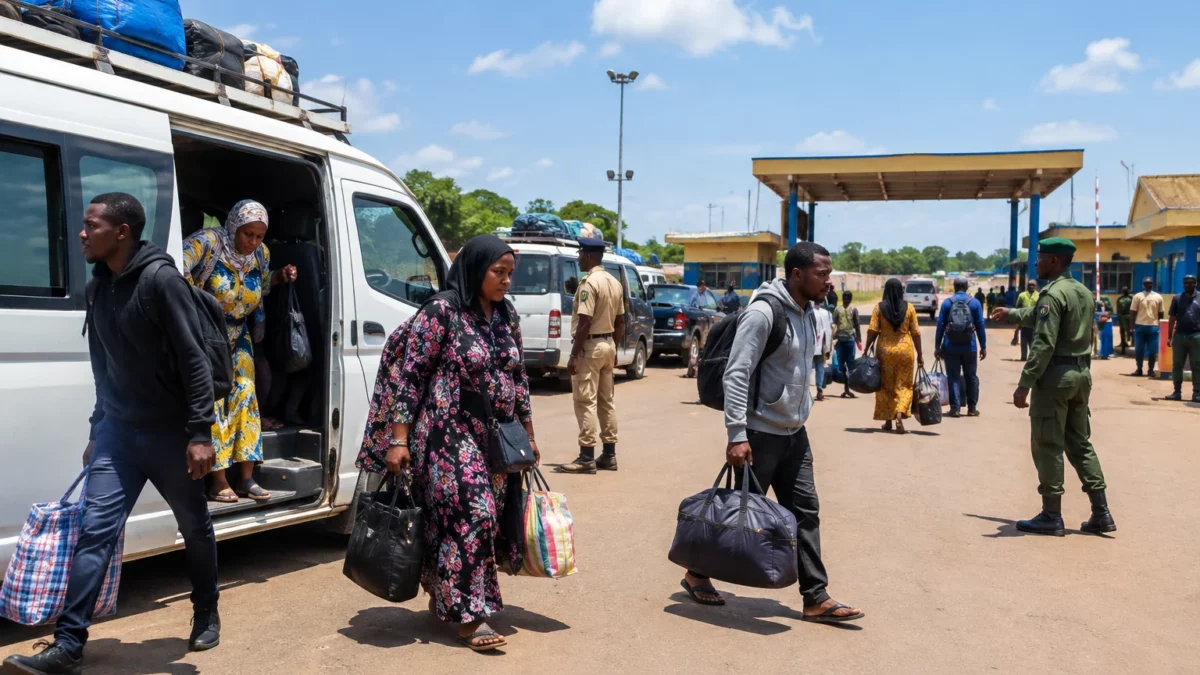
At Kourémalé, the border post between Guinea and Mali, an escorted convoy handed 1,557 people over to the authorities of neighbouring countries on 14 November 2026. The return of these workers highlights an issue that goes beyond expulsions: how to regulate gold mining without precipitating thousands of people into difficult-to-manage displacement?
A judicial and border operation
The people concerned, mainly Burkinabè and Malians, had been arrested at various mining sites in Guinea. Tried in Conakry, they received prison sentences of between 18 months and two years, then were granted early release on condition that they be expelled from the country.
The convoy left Conakry on Friday 13 November and arrived in Kourémalé the following day. Forty-four vehicles and a reinforced security deployment, including air support, accompanied the transfer. Burkinabè and Malian consular representatives were present at the border, according to reports of the operation.
This group represents only some of those affected by the campaign. In Burkina Faso, the National Council for Emergency Relief and Rehabilitation (CONASUR) reported that 59,724 people had been repatriated since the start of operations, as of 14 November. This cumulative total therefore does not refer only to the convoy of 1,557 people expelled from Guinea.
In Siguiri, the ban fuels tensions
Since the start of November, Guinean authorities have stepped up operations against illegal gold mining, particularly in the Siguiri gold-mining area in the north-east of the country. A joint order dated 2 November bans the activity. The government says it is seeking to combat unregulated mining and its environmental damage.
However, implementation of the ban has been marked by clashes. In Balato, on 11 November, protesters and security forces exchanged gunfire, according to a government statement published the following day. It reported ten deaths, including five foreign nationals whose identities had yet to be established, as well as 13 injured. This is the Guinean authorities’ toll and remains provisional. A pan-African news agency also reported differing local figures before the official statement was published.
In a region where artisanal gold mining supports workers as well as traders, transporters and service providers, the ban is disrupting an entire local economy. The operations target illegal mining activities, but their consequences extend to nearby communities and people who depend indirectly on the sites.
Return to Burkina Faso: a long-term operation
Burkinabè authorities are organising the reception and onward transport of people returning from Guinea, sometimes via Mali. The seventh convoy, which arrived on 14 November, carried 7,399 people. The total announced by CONASUR had reached 59,724, including 58,498 men and 1,226 women. The statement carried by several Burkinabè media outlets specifies that these figures cover all returns recorded since the operation began.
Beyond transport, public services must identify people without papers, direct them to their home areas and support their reintegration. The ministry responsible for the family has also called for particular attention to children who have dropped out of school and for young people to return to schools or training establishments. The risk of renewed departures to gold-mining sites remains a concern for families and local authorities.
These returns cannot be measured in convoys alone. They require transport capacity, reception facilities and income prospects in destination regions. Returning workers, children and young adults do not all have the same needs; a one-size-fits-all approach risks leaving some without a lasting solution.
A test of coordination between neighbours
The crisis reveals the interdependence of mining areas and West African migration. Guinea shares a border with Mali where Kourémalé serves as a crossing point. Burkina Faso, meanwhile, must absorb large numbers of returnees while arranging their transfer to different regions of the country.
The institutional dimension is also significant. Guinea regained full participation in ECOWAS, the Economic Community of West African States, in 2026. Burkina Faso and Mali, members of the Confederation of Sahel States alongside Niger, left the regional organisation in 2025. These changes do not erase ties between populations or the need for consular and humanitarian cooperation.
The next challenge will be to reconcile enforcement of mining rules, environmental protection and the safeguards owed to people arrested or displaced. For Conakry, this also means restoring public control over gold-mining sites. For neighbouring countries, the urgent task is to receive their nationals without turning a forced return into renewed hardship. The response will depend as much on judicial follow-up and border arrangements as on the economic solutions offered around mining areas.