
 Algeria
 Egypt
 Libya
 Morocco
 Sudan
 Tunisia
 Benin
 Burkina Faso
 Cabo Verde
 Côte d'Ivoire
 Ghana
 Guinea
 Guinea-Bissau
 Liberia
 Mali
 Mauritania
 Niger
 Senegal
 Sierra Leone
 The Gambia
 Togo
 Cameroon
 Central African Republic
 Chad
 DR Congo
 Equatorial Guinea
 Gabon
 Republic of the Congo
 São Tomé and Príncipe
 Burundi
 Comoros
 Djibouti
 Eritrea
 Ethiopia
 Kenya
 Madagascar
 Malawi
 Mauritius
 Mozambique
 Rwanda
 Seychelles
 Somalia
 South Sudan
 Tanzania
 Uganda
 Angola
 Botswana
 Eswatini
 Lesotho
 Namibia
 South Africa
 Zambia
 Zimbabwe
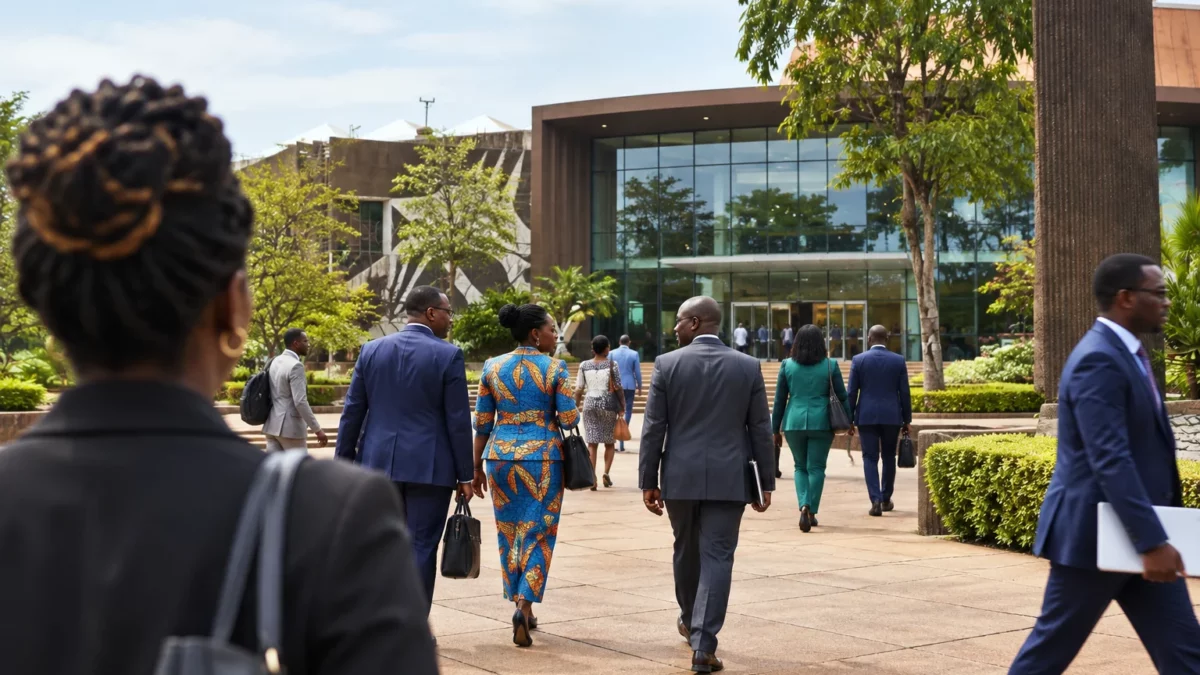
For a continental organisation, political independence also comes at a very practical cost: funding mediation, prevention and peace operations without relying almost entirely on external partners. In Accra, Nigeria proposed a substantial increase in the African Union’s (AU) resources, but the ambition remains under negotiation.
A Nigerian proposal, not yet an African decision
On 13 November 2026, at an extraordinary session of the AU Executive Council on funding the organisation, Nigeria’s Finance Minister, Taiwo Oyedele, argued for a target of $10bn for the Peace Fund over ten years. The meeting was held in Accra, Ghana, with African finance and foreign affairs ministers.
The figure far exceeds the $1bn target discussed as part of current reforms. However, it is neither a contribution announced by Abuja nor a decision adopted by the AU. Nigeria is asking financial experts to cost the options and assess their feasibility. The organisation, for its part, has discussed strengthening the Fund around the $1bn target and creating a sustainable replenishment mechanism.
Established in 1993, when the Organisation of African Unity was in existence, the Peace Fund was officially launched in 2018. It is intended to support African conflict prevention and management activities. In 2016, heads of state set a funding target of $400m, to be financed in part by a 0.2% levy on certain imports.
Preserving capital, funding interventions
Nigeria’s proposal draws on several sources: member state contributions, philanthropy and African capital. Oyedele also wants the Fund to follow management principles similar to those of a sovereign wealth fund. Investments would generate returns for peace initiatives, while the initial capital would be protected.
This cautious approach addresses a central trade-off. A fund that preserves its capital can support action over the long term, but may lack liquidity when a crisis requires a rapid response. Conversely, drawing directly on the principal can fund an emergency at the cost of reducing capacity in subsequent years. Nigeria argues that spending should rely on interest until a reliable replenishment mechanism is in place.
The minister also called on member states to pay their overdue contributions within an agreed timeframe. This demand points to a problem of implementation: collective commitments are not enough if payments arrive late or remain incomplete. For peace operations, predictable funding matters as much as its volume.
Budget reforms at the heart of the debate
Abuja links the increase in the Fund to broader reform of the AU’s finances. According to figures cited by Oyedele and reported by Nigeria’s finance ministry, member states cover 25% of the organisation’s budget and just 4% of its programme funding, well short of the 75% target for the latter. These figures were presented by Nigeria in the debate; they should not be mistaken for a new Union budget decision.
The minister recommends cutting duplicative spending, better implementing audit recommendations and generating more revenue from AU real estate. He referred to 29 areas of institutional overlap, which could cost as much as $36m. The Forum of Finance Ministers, known as the F15, is also expected to examine projections that would raise member states’ contributions to $779m by 2031.
These proposals raise a question of allocation. Higher contributions would have different effects depending on countries’ budgetary capacity. Abuja is therefore calling for the projections to be checked and national financial constraints to be taken into account. At the same time, cutting duplication does not automatically mean that savings will go towards peace operations: transparent rules, oversight and explicit budget choices will be needed.
A regional issue with tangible consequences
For Nigeria, West Africa’s most populous country, regional security extends beyond its borders. The country is a member of ECOWAS, the West African economic community, and takes part in regional efforts against armed groups in the Lake Chad Basin. But the AU Fund has a continental mandate: its resources can support African responses to crises affecting several regions, subject to the Union’s decisions and mechanisms.
For people living in conflict-affected areas, the stakes are indirect but tangible: predictable resources can help the AU support mediation or authorised operations. For governments, the debate is also about control over priorities and the share of funding borne by African states. Greater financial autonomy does not, however, remove the need to explain mandates, expected results and how funds are used.
United Nations Security Council Resolution 2719, adopted in 2023, also provides a framework for funding, on a case-by-case basis, certain AU-led peace support operations through UN-assessed contributions. It does not by itself resolve the funding of mediation, prevention or all African missions. The Accra debate is therefore part of a broader search for stable resources and a sharing of responsibilities.
What happens next will depend on the costing requested from the F15 and decisions by member states. The next date to watch is the AU’s mid-year session in 2027, where progress on institutional reforms is expected. Until then, the key issue will not simply be choosing an amount: it will be specifying who contributes, under what rules, and how resources translate into the capacity to prevent conflict and sustain peace.



