
 Algeria
 Egypt
 Libya
 Morocco
 Sudan
 Tunisia
 Burkina Faso
 Cabo Verde
 Côte d'Ivoire
 Ghana
 Guinea
 Guinea-Bissau
 Liberia
 Mali
 Mauritania
 Niger
 Nigeria
 Senegal
 Sierra Leone
 The Gambia
 Togo
 Cameroon
 Central African Republic
 Chad
 DR Congo
 Equatorial Guinea
 Gabon
 Republic of the Congo
 São Tomé and Príncipe
 Burundi
 Comoros
 Djibouti
 Eritrea
 Ethiopia
 Kenya
 Madagascar
 Malawi
 Mauritius
 Mozambique
 Rwanda
 Seychelles
 Somalia
 South Sudan
 Tanzania
 Uganda
 Angola
 Botswana
 Eswatini
 Lesotho
 Namibia
 South Africa
 Zambia
 Zimbabwe
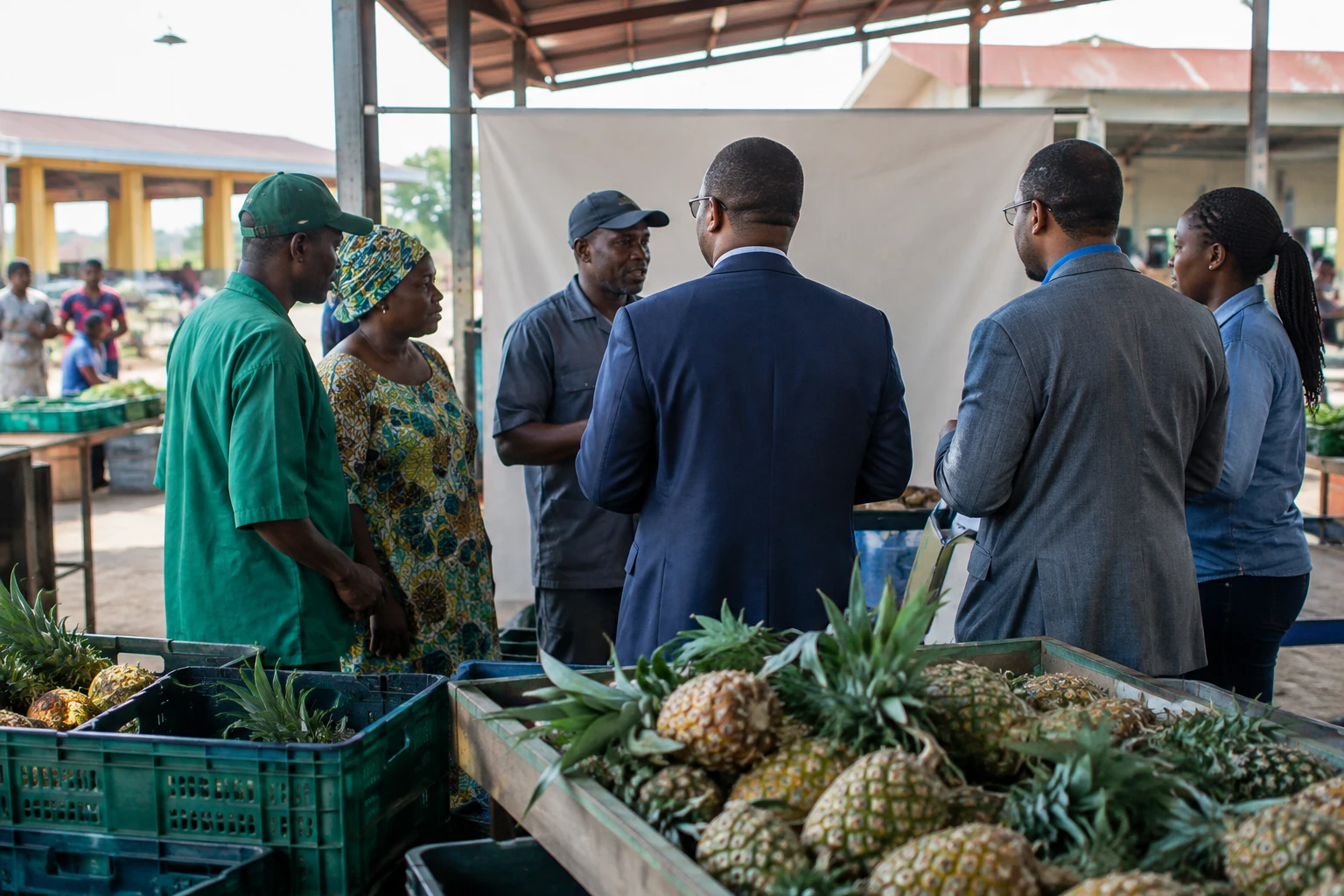
A pineapple rejected for export because it has been bruised is not necessarily lost. It still needs to be sorted, stored and matched with a buyer. This is one of the challenges facing the Akassato agro-food hub, in the commune of Abomey-Calavi, Benin: organising flows without cutting producers off from local markets.
A platform at the heart of a commercial reorganisation
The project is part of a broader transformation of Benin’s market infrastructure. Dantokpa market in Cotonou has long concentrated wholesale and retail activity extending beyond the country’s borders. Moving it or redistributing its functions therefore involves more than building new structures: the routes taken by goods and traders’ livelihoods must also be reorganised.
The Akassato hub, in Greater Nokoué, is to host wholesalers and storage activities, while retail markets are being developed in several cities. The Beninese government presents the wider initiative as a way to structure food supply chains and ease pressure on Dantokpa. This change is taking place in a country that is a member of ECOWAS, the West African regional community, where cross-border food trade plays an important role.
Successive announcements about the timetable nevertheless call for caution. In March 2025, the trade minister announced that the hub would enter service before the end of that year. In August 2025, the National Markets Management Agency instead referred to January 2026. Then, in March 2026, a post by APIEx, Benin’s agency responsible for promoting investment and exports, said that work was continuing and that the packaging centre was expected in the second half of 2027. These deadlines do not necessarily refer to the same stage: the market’s opening, its full operation and the export centre’s operation may come at different times.
Storing, sorting and better directing harvests
The site is designed as a logistics complex, not just a succession of stalls. Features outlined by the authorities include warehouses, logistics platforms, a sorting centre, water-treatment facilities and a truck maintenance area. According to the Beninese government, the project covers about 168 hectares. The buildings are intended to separate dry goods from fresh and refrigerated produce.
Packaging is a crucial link in the chain. For fruit and vegetables, sorting can separate produce that meets export requirements from goods that remain perfectly marketable locally or are destined for processing. A fruit that is blemished or too ripe to withstand a long journey need not automatically be ruled out for consumption. An efficient system could therefore limit losses and give producers more outlets.
The export facilities are intended in particular to make it easier to prepare consignments and keep them at the appropriate temperature. In March 2026, APIEx described a planned packaging centre with several chambers and an advertised capacity to handle large volumes of fruit and vegetables. These capacities remain planned features of the project: they do not yet show that the corresponding commercial flows are operational.
Benin is banking on sectors such as pineapple, mango, soya and cashew to increase the value of its exports. But infrastructure alone does not guarantee higher incomes. Results will also depend on small producers’ access to the site’s services, storage costs, the regularity of transport and the ability to find buyers.
Testing access and traders’ buy-in
The transition affects stakeholders with different interests. Exporters seek consistent volumes and a reliable cold chain. Wholesalers need a regular supply and an accessible location. Retailers depend on customer footfall, transport costs and the proximity of their suppliers.
Early feedback on Akassato’s new retail market illustrates this challenge. In May 2026, the Beninese daily Matin Libre reported that some traders appreciated the new site’s organisation, while others remained at the old location, which is more visible from the main road. This account concerns the local retail market, not the planned wholesale hub itself. It nevertheless underlines that modern facilities must also be well served and attract buyers.
Drawing on the expertise of Semmaris, the operator of the Rungis market in France, could help prepare operating rules and coordination between operators. But the model will need to adapt to Beninese realities: the weight of informal trade, the organisation of local markets and the significant role of women in selling food products. Governance and access costs will matter as much as the facilities.
A regional ambition, still to be tested
For Benin, Akassato could strengthen links between production areas, urban markets and overseas outlets. Its proximity to Cotonou and regional routes underpins the ambition to make it a distribution hub for West Africa. Its reach will nevertheless depend on smooth transport, health checks and trade cooperation with neighbouring countries.
The next benchmark will therefore not be just the inauguration date. It will be necessary to track the actual timetable for bringing the different components into service, the effective transfer of wholesalers, producers’ access to sorting and cold-storage facilities, and the development of outlets for products rejected for export. Only then can Akassato bring modern logistics closer to local incomes without making exports the sole measure of its success.
Information about the project’s scope and facilities is provided by the government of Benin. The announced dates have been checked against information published by Banouto, L’Économiste du Bénin and APIEx.



