Algeria
 Egypt
 Libya
 Morocco
 Sudan
 Tunisia
 Benin
 Burkina Faso
 Cabo Verde
 Ghana
 Guinea
 Guinea-Bissau
 Liberia
 Mali
 Mauritania
 Niger
 Nigeria
 Senegal
 Sierra Leone
 The Gambia
 Togo
 Cameroon
 Central African Republic
 Chad
 DR Congo
 Equatorial Guinea
 Gabon
 Republic of the Congo
 São Tomé and Príncipe
 Burundi
 Comoros
 Djibouti
 Eritrea
 Ethiopia
 Kenya
 Madagascar
 Malawi
 Mauritius
 Mozambique
 Rwanda
 Seychelles
 Somalia
 South Sudan
 Tanzania
 Uganda
 Angola
 Botswana
 Eswatini
 Lesotho
 Namibia
 South Africa
 Zambia
 Zimbabwe
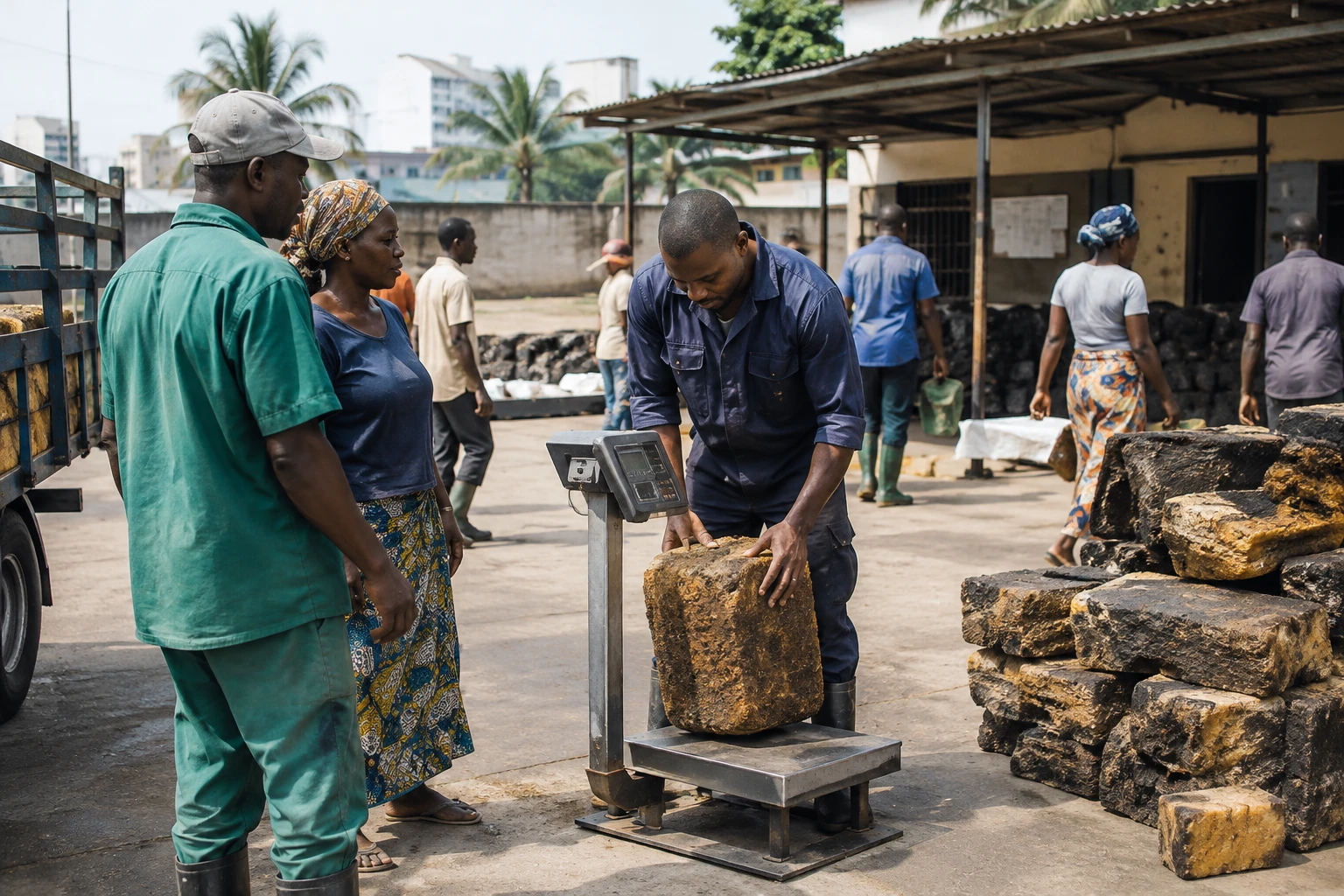
Producing more rubber does not guarantee that its value stays in Côte d’Ivoire. For the rubber sector, the next step lies in factories, village plantations and the capacity to meet new market requirements.
A major West African industry
Founded in 1975, the Association of Natural Rubber Professionals of Côte d’Ivoire (APROMAC) brought together industry players in Abidjan on 5 and 6 November 2026. The second edition of the Natural Rubber Days featured conferences, professional discussions and celebrations marking the organisation’s 50th anniversary.
Production has grown spectacularly. According to figures presented by APROMAC president Charles-Emmanuel Yacé, it rose from 164,138 tonnes in 2005 to two million tonnes in 2025. The Ivorian Press Agency (AIP) reported this figure. Other information published during the event, however, puts production at 2.5 million tonnes in 2025. The available material does not specify the respective scopes or calculation methods, so the two figures cannot be treated as equivalent.
The country’s global ranking also varies between publications. APROMAC and media outlets attending the event describe Côte d’Ivoire as the world’s second-largest producer, behind Thailand. Earlier government data placed it third. Rankings depend on the year and the data series used; production in 2025 nevertheless marks a significant rise.
More processing without undermining planters
Bruno Nabagné Koné, the Minister of Agriculture, Rural Development and Food Crops, put local processing at the heart of the priorities set out at the ceremony on 6 November. The aim is to move beyond the primary processing of latex and raw rubber to also manufacture semi-finished and finished products, including tyres, soles and technical components.
This shift could create industrial jobs and retain a larger share of value added in the country. But it requires investment, markets and a reliable supply for factories. Further upstream, village producers need to be able to sell on transparent terms. APROMAC says it represents about 180,000 producers. Their incomes depend in particular on the purchase price, recognised quality and reliable weighing.
The pricing mechanism for wet rubber, which came into force in February 2026 according to industry officials, is intended to regulate planters’ remuneration. Its practical impact will depend on how it is applied on the ground, particularly in rural areas where producers negotiate with buyers and factories. The dialogue between producer and processor groups, emphasised by APROMAC’s president, will therefore be crucial.
Plantations, skills and traceability
Higher volumes do not resolve the question of the plantations’ future. Scientific discussions on 5 November addressed the renewal of rubber plantations and the supply of processing plants. Ageing trees can reduce productivity; replacing them takes time, suitable seedlings and sufficient income for farmers during the replanting period.
The government’s roadmap also provides for stronger training, including a proposed Rubber Industry Academy in Taabo. Moving up the industrial value chain will require skills ranging from plantation management and quality control to maintenance and processing. The benefits will therefore be measured not only in export tonnage, but also in Ivorian workers’ access to these new occupations.
Another challenge is the traceability of plots. Organisers say that more than 99% of identified plantations have been georeferenced. This mapping can help document the origin of raw materials and prepare for anti-deforestation rules imposed by some markets, including the European Union. But it will need to be accompanied by support accessible to small producers, so that compliance costs do not become a barrier to trade for them.
A national issue with regional repercussions
Rubber directly links Côte d’Ivoire with its West African neighbours. Delegations from Ghana, Nigeria and Liberia took part in the meetings, alongside stakeholders from Asia, Europe and the Americas. Discussions with research organisations and producer countries highlight the sector’s dependence on markets, technologies and standards that extend beyond national borders.
For Côte d’Ivoire, which exports a large share of its production, processing more of its rubber could also change its role in these exchanges: the country would be not just a supplier of raw materials, but increasingly a producer of industrial inputs and goods. This ambition depends on the availability of energy, financing for equipment and the competitiveness of products against established suppliers.
The stated goal aligns with the priorities of the 2026-2030 National Development Plan. Progress will need to be tracked on the implementation of regulated pricing, financing for plantation renewal and the delivery of processing and training projects. APROMAC’s 50th anniversary thus showcases an industry that has grown in scale; its next challenge will be to distribute the benefits of that growth more widely among producers, workers and industrialists.