Algeria
 Egypt
 Libya
 Morocco
 Sudan
 Tunisia
 Benin
 Burkina Faso
 Cabo Verde
 Côte d'Ivoire
 Ghana
 Guinea
 Guinea-Bissau
 Liberia
 Mali
 Mauritania
 Niger
 Nigeria
 Senegal
 Sierra Leone
 The Gambia
 Togo
 Cameroon
 Central African Republic
 Chad
 DR Congo
 Equatorial Guinea
 Gabon
 Republic of the Congo
 São Tomé and Príncipe
 Burundi
 Comoros
 Djibouti
 Eritrea
 Ethiopia
 Kenya
 Madagascar
 Malawi
 Mauritius
 Mozambique
 Rwanda
 Seychelles
 Somalia
 South Sudan
 Tanzania
 Uganda
 Angola
 Botswana
 Eswatini
 Lesotho
 Namibia
 South Africa
 Zambia
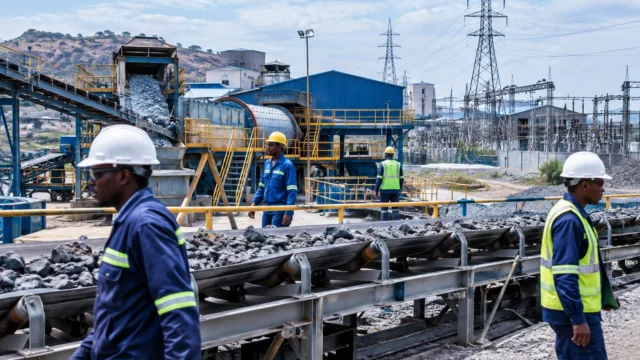
A major gold mine in Zimbabwe cannot be built on a single financing promise. For Bilboes, in the north of the country, Caledonia Mining is combining debt, bonds, revenue from an operating mine and hedging against fluctuations in the gold price. The balance between these resources will determine whether the announced timetable can be met.
A financing package still subject to several steps
On 5 November 2026, Caledonia Mining announced a financing agreement of up to $150 million to develop Bilboes. Under the terms outlined by the company, the package would include a credit facility capped at $50 million and a term loan of up to $100 million. The agreement would be concluded with a consortium of Zimbabwean financial institutions.
The announcement is part of a broader plan. In January 2026, the company raised $150 million through convertible bonds, debt securities that may be converted into shares under certain conditions. Caledonia has also hedged some of the future revenue from its Blanket mine against a fall in the gold price. These proceeds are intended to help fund the construction of Bilboes.
The new agreement does not, however, mean that all the funds are immediately available. The company says the first drawdown from the $50 million facility depends, among other things, on additional hedging against fluctuations in the metal price. It is also continuing talks with regional and international lenders to secure longer-term project financing.
In September, Caledonia said it was still in the due diligence and documentation phase for the facility, with a closing expected in October. Zimbabwean and South African media had reported this projected timetable. The 5 November announcement therefore marks progress on the steps previously described by the company, provided its conditions are met.
The importance of gold to Zimbabwe’s economy
Bilboes is located about 75 kilometres north of Bulawayo. Caledonia forecasts cumulative production of 1.55 million ounces over 10.8 years. The start of production is scheduled for the end of 2028, with the first full year of production expected in 2029. These projections come from the project’s feasibility study and remain dependent on construction, financing and operating conditions.
The development cost set out in the study is $484 million. This figure does not necessarily cover all financing needs related to interest, working capital and cost-overrun reserves. In September, a Caledonia presentation referred to an overall requirement of nearly $600 million when these items were taken into account. The estimates therefore do not cover the same scope.
Gold is one of Zimbabwe’s main sources of foreign currency. According to government figures cited by Reuters, national production reached a record 47 tonnes in 2025. This production does not come solely from large companies: Zimbabwe’s national development plan highlights the significant role of artisanal and small-scale mining, particularly in rural incomes.
A new industrial mine can boost exports and activity among suppliers, transporters and local service providers. But these benefits are not automatic. They depend on the share of purchases made in the country, the jobs created, the tax revenue actually collected and the management of impacts on land and water. The needs of a listed company and the priorities of communities near the site do not always coincide.
Local debt: both leverage and risk exposure
Turning to Zimbabwean banks gives the country’s lenders a role in financing a major project. The announced package could also serve as bridge financing, covering immediate expenditure before a longer-term loan is put in place. Caledonia had said the facility would be secured against cash flows from Blanket, its operating mine.
The structure therefore links two assets: revenue from Blanket would support work at Bilboes. This could help get construction under way, but it also concentrates some of the risk in the existing mine’s ability to generate sufficient revenue. Hedging against the gold price aims to reduce this uncertainty, but cannot eliminate it: production, costs, the timetable and credit conditions remain decisive.
For Zimbabwe, the stakes go beyond Caledonia’s accounts. The country is seeking to attract mining investment while deriving more value from its resources. Stable rules, access to foreign currency and predictable export conditions affect lenders’ decisions as well as public revenue. These issues also feature in discussions within the Southern African Development Community (SADC), a regional organisation of which Zimbabwe is a member.
The timetable faces the test of coming decisions
The next step will be to implement the agreement in practice: fulfil the drawdown conditions, disburse the first amounts and advance long-term project financing. The ordering of equipment and progress on preparatory work will also need to be monitored. At this stage, October 2028 remains a target announced by Caledonia, not a guarantee that production will begin.
Bilboes illustrates a question facing several African mining economies: who finances major projects, and under what conditions do mining revenues benefit the producing country? In Zimbabwe, the answer will be measured not only by future production but also by public revenue, jobs, local procurement and tangible effects around the site. The announced financing is an important part of the package, but it is not yet a completed mine.