Algeria
 Egypt
 Libya
 Morocco
 Sudan
 Tunisia
 Benin
 Burkina Faso
 Cabo Verde
 Côte d'Ivoire
 Ghana
 Guinea
 Guinea-Bissau
 Liberia
 Mali
 Mauritania
 Niger
 Nigeria
 Senegal
 Sierra Leone
 The Gambia
 Togo
 Cameroon
 Central African Republic
 Chad
 DR Congo
 Equatorial Guinea
 Gabon
 Republic of the Congo
 São Tomé and Príncipe
 Burundi
 Comoros
 Djibouti
 Eritrea
 Kenya
 Madagascar
 Malawi
 Mauritius
 Mozambique
 Rwanda
 Seychelles
 Somalia
 South Sudan
 Tanzania
 Uganda
 Angola
 Botswana
 Eswatini
 Lesotho
 Namibia
 South Africa
 Zambia
 Zimbabwe
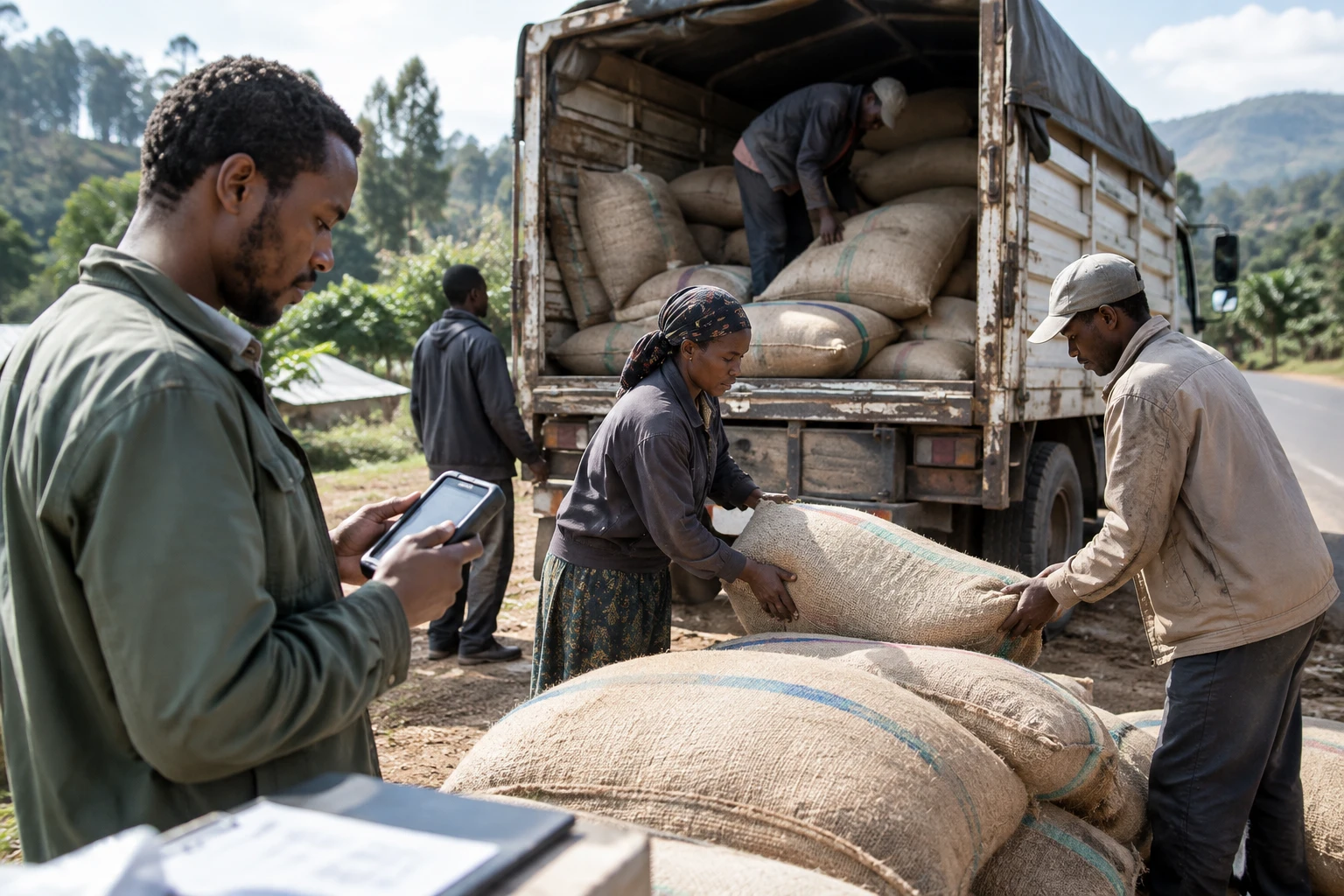
For Ethiopian coffee producers, the challenge is no longer just harvesting sought-after beans. They must also be able to document, plot by plot, their origin and journey to export. With new European rules approaching, this requirement could weigh on a major market.
A major market, a highly fragmented sector
Coffee is Ethiopia’s leading export commodity and an essential source of foreign currency. The European Union buys about 30% of the coffee exported by the country, according to estimates cited by ODI Global and the European Forest Institute. Overseas sales have risen sharply in recent years: Ethiopia’s public news agency ENA reports revenues of $2.65bn in 2025, followed by a record $3bn in the subsequent financial year. These national figures do not, however, show what share depends on the European market.
Production relies largely on small farms. ODI Global estimates that about four million farmers account for nearly 95% of the harvest. To assemble exportable volumes, coffee often passes through collectors, processing stations, warehouses and several intermediaries. This network allows scattered harvests to be pooled, but makes it harder to link an exported batch to the land where the beans were grown.
The same difficulty arises in other agricultural supply chains in the region: a trading chain that efficiently aggregates products can leave little digital or documentary trace at each stage. In Ethiopia, local intermediaries are therefore not simply an obstacle to be removed. They are an economic link whose practices need to be recorded and verified.
What the European Union will require
The EU Deforestation Regulation, or EUDR, covers several commodities, including coffee. It requires companies placing these products on the EU market to demonstrate that they do not come from land deforested after 31 December 2020 and that they comply with applicable laws in the country of production. European buyers may therefore ask their foreign suppliers for geolocation data and documents showing the origin of batches.
According to the timetable published by the European Commission, the main obligations will apply from 30 December 2026 to large and medium-sized operators, and from 30 June 2027 to most of the micro and small enterprises concerned. These dates give the sector time, but do not guarantee market access: buyers may request verifiable documentation ahead of the deadline to secure their supplies.
In its study published on 16 October 2026, ODI Global puts potential export revenue losses linked to compliance difficulties at between $160m and $453m. The upper end of this range corresponds to a scenario in which 57% of Ethiopian exports destined for the Union are excluded. This is a conditional estimate, not a loss already recorded or a certain forecast.
The cost of proof could shut out smaller producers
The problem is not limited to establishing that a plot has not been deforested. The contributing land must also be identified when several harvests are mixed. The EUDR does not prohibit mixing, but requires that all plots from which the product originates can be identified and that the required conditions are met.
ODI Global reports that 57.4% of marketed coffee is thought to pass through local collectors or channels outside officially designated market platforms. This figure highlights a traceability challenge, but does not mean that all the coffee concerned is non-compliant. The authors estimate that collecting the information could cost $4 to $7 per plot, with a further $5 to $12 for verification.
These costs may seem modest for an export consignment, but add up when a large number of small plots have to be documented. Exporters could favour suppliers that are already organised or certified, because their paperwork is easier to process. Farms that comply with environmental rules could then risk losing a buyer simply because their data are too expensive to produce.
The impact would not be the same for everyone. Producers integrated into a co-operative or a structured supply chain could benefit from collective support. Farmers who sell through scattered collectors would be more exposed. If European purchases fall, shifting sales to other markets could also mean different prices: retaining an outlet does not guarantee the same income.
A national system still to be strengthened
Ethiopia is not starting this work without tools. The Ethiopian Coffee and Tea Authority has developed a system to track coffee movements, with support from German development co-operation. A technical review published by the European Forest Institute in 2025 noted, however, that the system then tracked flows from district-level transaction points, without by itself providing full traceability back to individual plots.
Since then, the authorities have developed their system into the Ethiopian Coffee Traceability Management System. A guide published in May 2026 by the Ethiopian authority, with support from the European Forest Institute, describes the tracking of batches, volumes, processing, transport and shipments. The system also plans to link batches to contributing plots and incorporate land information. The platform provides a basis for further work; its existence does not yet prove that every exported batch has a complete file that is accessible and accepted by buyers.
The government has also set up a national committee and launched a three-year action plan. In June 2026, the Ethiopian Institute of Agricultural Transformation brought sector stakeholders together in Addis Ababa to discuss traceability and digital tools. The challenge will be to make databases, co-operatives, collectors and public services work together, while clarifying which evidence of land-use rights is acceptable.
A test for trade rules and regional co-operation
The European Commission has announced technical support for Ethiopia’s coffee supply chain, including the development of digital solutions and capacity-building for stakeholders. But compliance assistance must reach producers and intermediaries, not just government agencies and large exporters. Financing data collection and verification therefore remains a central issue.
For Ethiopia, a member of the Intergovernmental Authority on Development (IGAD), the experience also matters to its East African partners that export agricultural products to Europe. It also touches on the African Union’s continental role: how can the environmental objectives of importing markets be reconciled with supply chains built around millions of small farms? The answer is neither to abandon anti-deforestation requirements nor to treat commercial exclusion as inevitable.
The next steps will be practical: checking that plot data are complete, that the national system can exchange information with buyers, and that the costs are not passed on solely to producers. In Addis Ababa and across coffee-growing regions, success will be measured by the ability to make existing supply chains traceable without cutting off the farms they sustain from the market.