Algeria
 Egypt
 Libya
 Morocco
 Sudan
 Tunisia
 Benin
 Burkina Faso
 Cabo Verde
 Côte d'Ivoire
 Ghana
 Guinea
 Guinea-Bissau
 Liberia
 Mali
 Mauritania
 Niger
 Senegal
 Sierra Leone
 The Gambia
 Togo
 Cameroon
 Central African Republic
 Chad
 DR Congo
 Equatorial Guinea
 Gabon
 Republic of the Congo
 São Tomé and Príncipe
 Burundi
 Comoros
 Djibouti
 Eritrea
 Ethiopia
 Kenya
 Madagascar
 Malawi
 Mauritius
 Mozambique
 Rwanda
 Seychelles
 Somalia
 South Sudan
 Tanzania
 Uganda
 Angola
 Botswana
 Eswatini
 Lesotho
 Namibia
 South Africa
 Zambia
 Zimbabwe
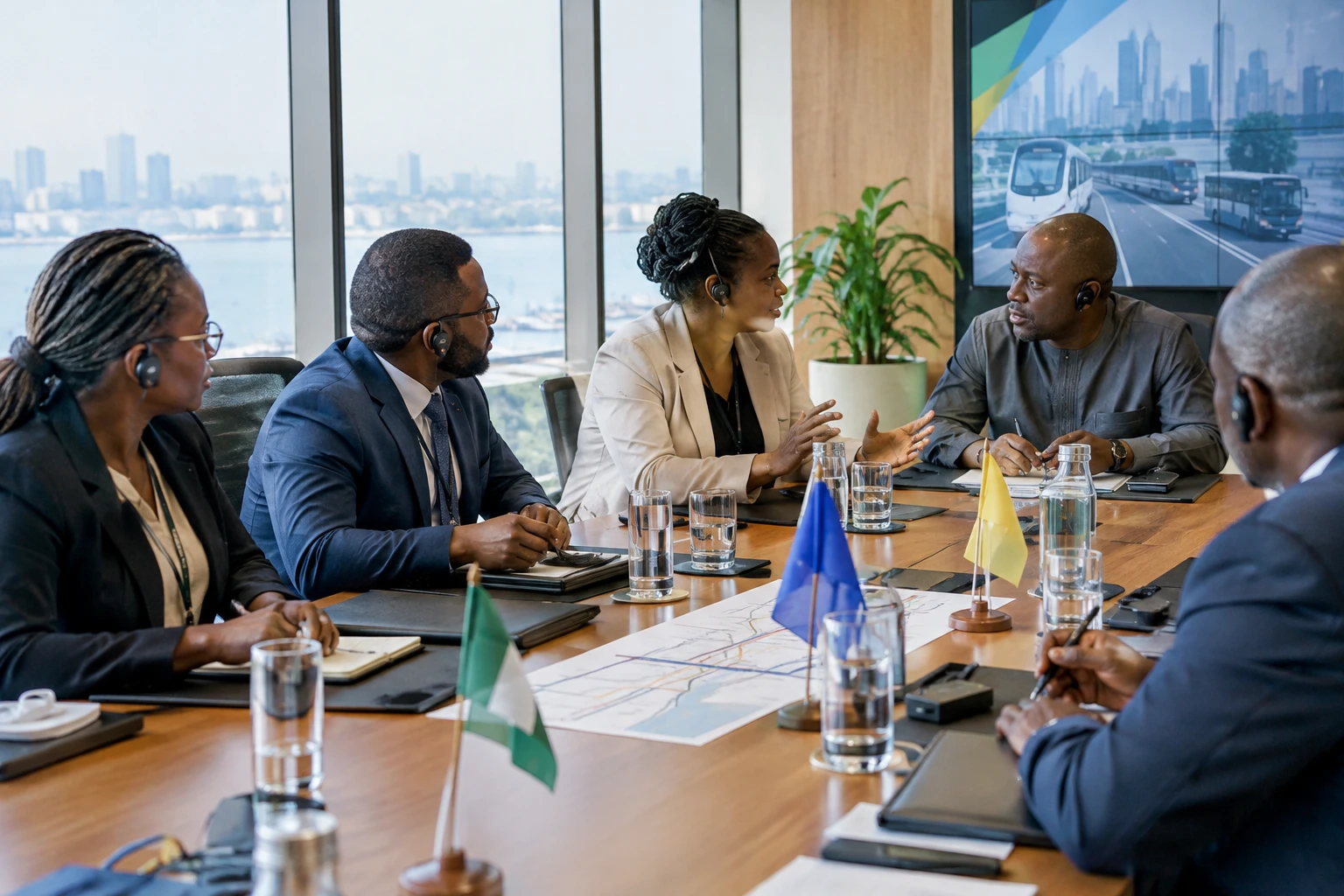
In Lagos, adding a few kilometres of rail can change the daily lives of thousands of commuters. But a line cannot ease congestion across a metropolis on its own: reliable connections, accessible stations and a regular enough service to meet everyday travel needs are also essential.
An extension towards western neighbourhoods
Lagos’s Blue Line, an electric railway, is due to welcome three new stations by the end of February 2027 at the latest. FESTAC, Alakija and Trade Fair will extend the service beyond its current terminus, Mile 2, towards the west of Lagos State. The announcement was made by Abimbola Akinajo, managing director of the Lagos Metropolitan Area Transport Authority (LAMATA), at a meeting organised by the state’s Ministry of Transportation. The date remains a stated target, not a confirmed start of service. LAMATA’s announced timetable.
If all three stations open as planned, the line will have eight stations in operation, up from five today: Marina, National Theatre, Iganmu, Alaba and Mile 2, followed by FESTAC, Alakija and Trade Fair. For residents of the neighbourhoods served, the expected change is tangible: being able to board the train closer to home and potentially cutting part of a journey previously made by road.
This step is part of the project’s second phase, which plans to link Mile 2 to Okokomaiko over about 14 kilometres. Three other stations are planned along this section: Volkswagen, Lagos State University (LASU) and Okokomaiko. The extension announced for February 2027 therefore does not, by itself, amount to completion of the whole line. The full project is intended to link Marina to Okokomaiko over about 27 kilometres. The development plan published by the Lagos authorities.
Rail in a road-oriented metropolis
Lagos is Nigeria’s main economic centre and one of West Africa’s major metropolises. Its economy depends on daily travel between Lagos Island, mainland neighbourhoods and expanding areas to the west. When roads are congested, however, the cost goes beyond time spent in traffic: working hours, deliveries and access to services are also affected.
The Blue Line began commercial operations on 4 September 2023, on an initial section of about 13 kilometres between Marina and Mile 2. Journeys that can take much longer by road are advertised as taking around 15 minutes by train on this section. This difference gives an indication of rail’s potential value, but does not mean all passengers will save the same amount of time: their experience will depend, among other things, on access to the station, waiting times and the onward journey after they get off.
The line is part of a wider transport network overseen by LAMATA. The state’s transport plan combines railways, bus rapid transit and interchanges. Regionally, Lagos is in Nigeria, a member of ECOWAS, the economic co-operation organisation for West African countries. The project is primarily a decision by Lagos State, but addresses an issue shared by the region’s major cities: connecting distant neighbourhoods without relying entirely on cars and buses caught in traffic.
Success will depend on connections
The extension’s impact will not be measured solely by the number of stations opened. LAMATA’s management also says that four bus corridors are nearing completion and that the Marina and Mile 2 interchanges are progressing. These facilities are intended to make connections between trains and buses easier. They are essential: an additional station remains of little use if passengers struggle to reach it from nearby streets or continue their journey after getting off.
The benefits will not be the same for everyone. Workers and traders near the Lagos-Badagry corridor could become less reliant on road journeys. Residents who live far from stations, however, will still need a bus, taxi or another form of transport to reach the train. The total cost of travel, service frequency and the safety of station surroundings will therefore matter as much as the duration of the rail journey.
The project also raises questions about the balance between investment and use. In a prequalification document published in 2022, the authorities described the Blue Line as a 27-kilometre infrastructure project and gave a projected capacity of 320,000 passengers a day at launch, with scope to increase it later. This is a planning projection, not a ridership count or a guarantee of demand. The capacity targets cited should not be confused with the actual number of passengers carried.
Data reported by LAMATA in September 2026 showed more than nine million passengers and over 70,000 trips since commercial operations began. This tally, attributed to the operator, points to use of the existing line. It does not, however, by itself show that the network is already meeting the needs of the whole metropolis. To assess the extension’s impact, it will be necessary to track ridership at each station, train punctuality and the quality of connections.
A step, not yet an integrated network
The Blue Line is advancing along a path that began several years ago. The first phase entered service in 2023; the extension to Okokomaiko is now intended to bring rail closer to new neighbourhoods. A study of the project nevertheless notes that construction of the first section took time and that the network’s effects will also depend on how residents can actually use it. An analysis of the Blue Line and the challenges of public transport in Lagos.
The next milestone to watch is therefore the actual opening of FESTAC, Alakija and Trade Fair by the end of February 2027. After that date, the pace of work towards Volkswagen, LASU and Okokomaiko will show whether the announcement becomes a continuous rail link. For Lagos, the challenge is to make rail, buses and local access work together. For other African cities facing rapid urban growth, the project is a reminder that useful infrastructure is judged as much by its connections and everyday use as by the kilometres built.