Algeria
 Egypt
 Libya
 Morocco
 Sudan
 Tunisia
 Benin
 Burkina Faso
 Cabo Verde
 Côte d'Ivoire
 Ghana
 Guinea
 Guinea-Bissau
 Liberia
 Mali
 Mauritania
 Niger
 Nigeria
 Senegal
 Sierra Leone
 The Gambia
 Togo
 Cameroon
 Central African Republic
 Chad
 DR Congo
 Equatorial Guinea
 Gabon
 Republic of the Congo
 São Tomé and Príncipe
 Burundi
 Comoros
 Djibouti
 Eritrea
 Kenya
 Madagascar
 Malawi
 Mauritius
 Mozambique
 Rwanda
 Seychelles
 Somalia
 South Sudan
 Tanzania
 Uganda
 Angola
 Botswana
 Eswatini
 Lesotho
 Namibia
 South Africa
 Zambia
 Zimbabwe
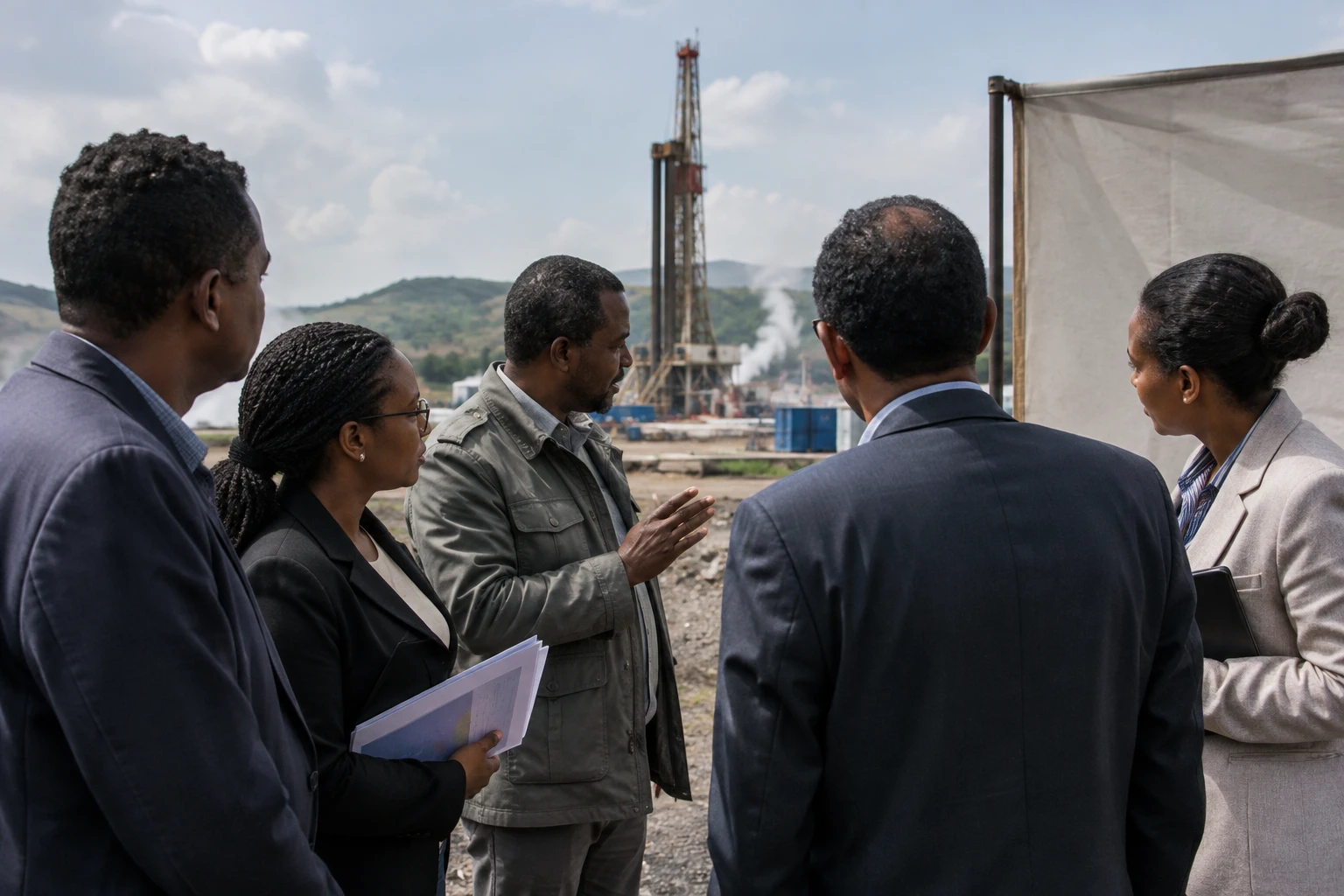
For Ethiopia, the stakes at Corbetti go beyond building a power plant: the project aims to generate electricity less dependent on rainfall and mobilise private capital before the potential of the underground resource has even been confirmed.
A stable resource in a volcanic region
Located in the Oromia Region, about 250 kilometres south of Addis Ababa, Corbetti lies in the Rift Valley, an area where underground heat can power geothermal plants. Unlike hydropower, this generation can operate continuously, provided drilling confirms a viable resource.
This diversification matters for Ethiopia, whose electricity system relies heavily on dams. The Grand Ethiopian Renaissance Dam (GERD), brought into service in stages, strengthens the country’s hydropower potential, but does not eliminate the risks associated with hydrological variations or the need to broaden energy sources.
The challenge also affects East Africa. Ethiopia is a member of the Intergovernmental Authority on Development (IGAD), a regional organisation bringing together countries facing growing needs for energy access and cooperation. Geothermal energy is already a major focus in neighbouring Kenya; Corbetti could help expand the sector across the region.
A new shareholder, but drilling comes first
On 19 October 2026, Taranis announced that it had completed, earlier in the month, the acquisition of a majority stake in the company behind the project. InfraCo Africa, a subsidiary of the Private Infrastructure Development Group, retains a significant minority stake. The transaction marks a new phase, but does not mean that the plant is financed or ready to be built.
Taranis plans to commit up to $27 million. The package comprises an equity subscription of about $17.1 million and a $9.5 million convertible loan facility for exploratory drilling. These amounts fund development and exploration; they do not represent the total construction cost, which has not been specified.
The proposed first phase is a 50-megawatt plant. A second 100-megawatt phase could take total capacity to 150 megawatts. But these targets remain conditional on the drilling results, which must establish the resource’s temperature, flow rate and quality. No commissioning timetable has been announced.
Kevin Ziemer, chief executive of the Taranis Energy for Africa fund, said the company wanted to advance exploratory drilling. This stage is critical: geothermal energy requires substantial upfront investment, while an unsuccessful well can undermine a project’s economics.
Power purchase agreement already extended
Corbetti has a power purchase agreement with Ethiopian Electric Power, the state-owned electricity utility. Signed in March 2020, the agreement sets the project’s commercial framework. In May 2024, it was extended by two years to allow the developer to continue preparations and its exploration programme.
The succession of deadlines highlights the gap between an institutional agreement and a plant actually generating power. For the state-owned utility, the contract prepares for the purchase of electricity; for investors, the extension keeps a development window open. For consumers and businesses, the tangible impact will depend on the completion of drilling, construction financing and connection to the grid.
Ethiopia’s energy compact, presented under Mission 300, sets a target of increasing the share of non-hydro renewable energy from 5.6% to at least 15% by 2030. Geothermal energy can contribute to this target, alongside solar and wind. However, a project still at the drilling stage cannot by itself guarantee that the target will be met.
Credibility will depend on delivery
For Addis Ababa, Corbetti is also a test of the country’s ability to attract private investors to long-term energy infrastructure. Development financing can support exploration, but it does not automatically resolve questions around plant financing, risk-sharing, contractual stability and grid connection.
The project’s significance extends beyond Ethiopia: Mission 300, an initiative of the World Bank and the African Development Bank, aims to accelerate access to electricity in sub-Saharan Africa. Projects such as Corbetti demonstrate the value of a diversified energy mix, but also the difficulty of turning financial commitments into actual generation. The drilling results and the next step in the power purchase agreement will therefore be key indicators to watch.
The financial details and new shareholding structure are reported in the announcement by law firm Eversheds Sutherland on the Corbetti transaction. The contract timetable and planned capacity are also set out by InfraCo Africa and PIDG. National diversification targets are included in the World Bank document on Ethiopia’s energy compact.