Algeria
 Egypt
 Libya
 Morocco
 Sudan
 Tunisia
 Benin
 Burkina Faso
 Cabo Verde
 Côte d'Ivoire
 Ghana
 Guinea
 Guinea-Bissau
 Liberia
 Mali
 Mauritania
 Niger
 Nigeria
 Senegal
 Sierra Leone
 The Gambia
 Togo
 Cameroon
 Central African Republic
 Chad
 DR Congo
 Gabon
 Republic of the Congo
 São Tomé and Príncipe
 Burundi
 Comoros
 Djibouti
 Eritrea
 Ethiopia
 Kenya
 Madagascar
 Malawi
 Mauritius
 Mozambique
 Rwanda
 Seychelles
 Somalia
 South Sudan
 Tanzania
 Uganda
 Angola
 Botswana
 Eswatini
 Lesotho
 Namibia
 South Africa
 Zambia
 Zimbabwe
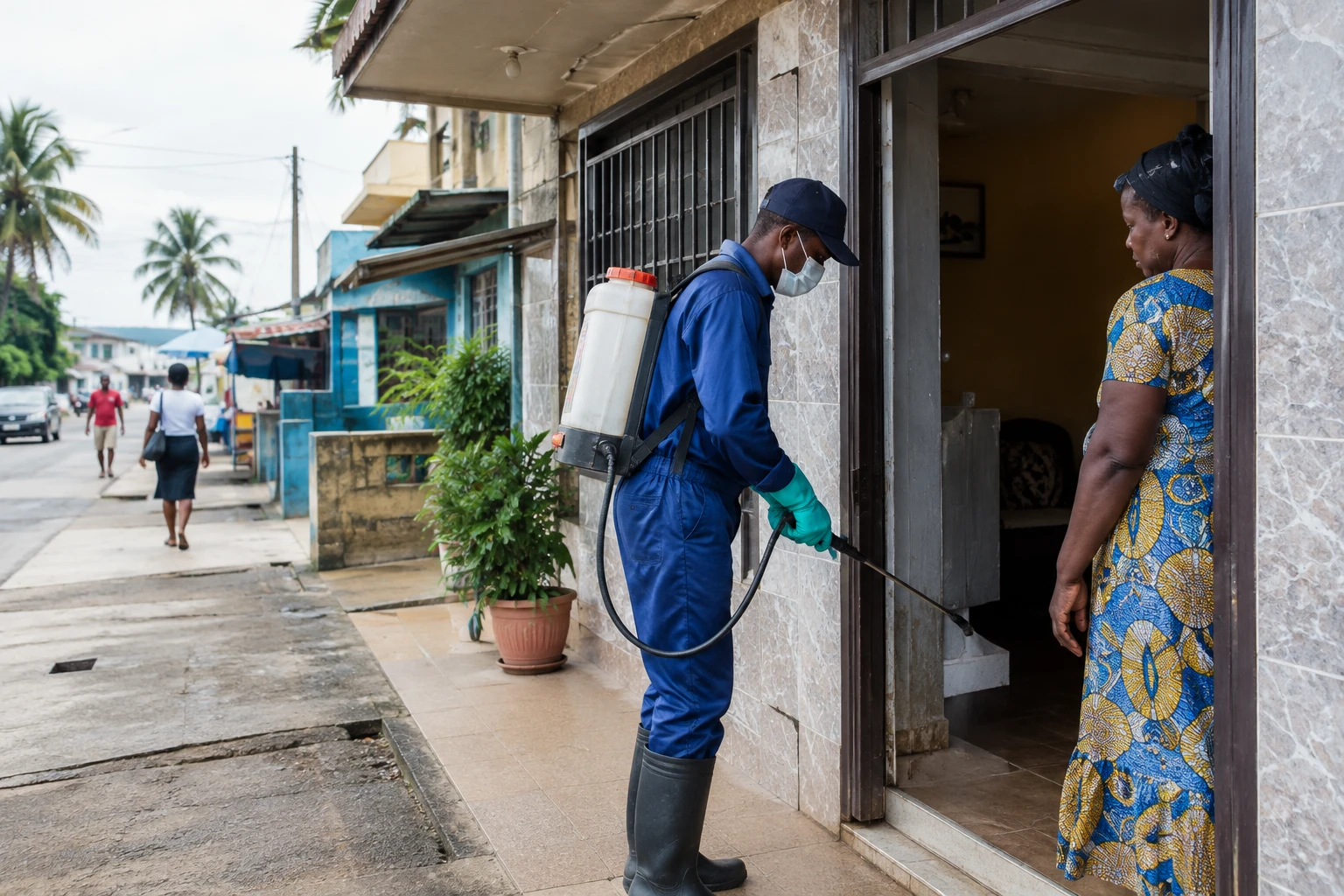
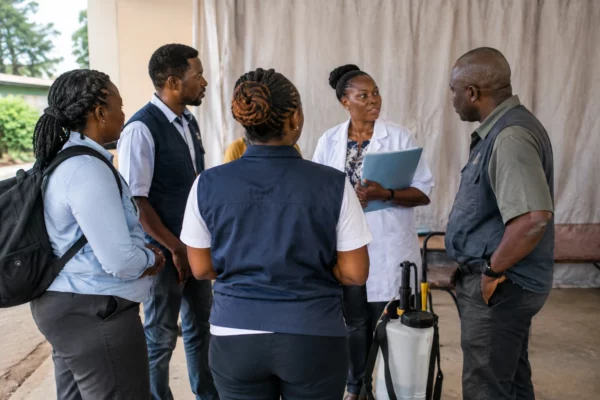
In Malabo, the fight against malaria is already visible on doorsteps: health teams are offering to treat homes against mosquitoes. The challenge now is to make this strategy work beyond Bioko, across a larger mainland territory connected to countries where the disease is circulating.
From Bioko to the whole country
Equatorial Guinea is aiming to eliminate malaria by 2030. The government wants to extend to the mainland and the island of Annobón the methods developed over more than 20 years on Bioko, the island where Malabo and a large share of the national population are located.
Bioko has recorded a significant decline in infections and deaths linked to the disease. According to figures presented by Equatorial Guinean authorities at the launch of the national strategy on 24 February 2026, prevalence among children aged 2 to 14 fell by 83% from its previous level, standing at 7.2% in 2025. The government also reports a 78% decline in mortality among children under five. These are official national figures; they do not mean malaria has disappeared from the island. The official account of the launch of the Vision 2030 strategy attributes them to the programme run on Bioko.
The campaign combines indoor insecticide spraying, bed nets, larval control and case monitoring. Its effectiveness also depends on community outreach: teams must explain the interventions and obtain residents’ consent. In a home, spraying can interrupt transmission; without trust or regular access to healthcare, coverage remains incomplete.
A change of scale, not a simple copy
Equatorial Guinea’s mainland faces different constraints. It is about 13 times larger than Bioko and shares borders with Cameroon to the north and Gabon to the east and south. The movement of people, as well as the circulation of the parasite, can reintroduce cases after a period of decline. Interventions will therefore need to adapt to the seasons, transmission settings and availability of health services.
The announced strategy also plans to roll out the R21 vaccine, recommended by the World Health Organisation for children. The stated goal is to vaccinate 300,000 children nationwide. Authorities are also considering drones to identify areas with high mosquito populations and are studying approaches involving genetically modified mosquitoes. These options do not replace the tools already in use: their implementation will depend on feasibility, health evaluation and acceptability.
The announcement of $116 million in funding from the government and businesses is intended to support the programme’s expansion to the mainland and Annobón. Bioko’s experience is a reminder, however, that a start-up budget does not guarantee continuity: mosquito control, vaccination and surveillance must be sustained over time. On the island, the programme has benefited in particular from public funding and oil companies operating in the country. The central question will therefore be the stability of resources and how they are distributed among the different provinces.
Public health at the heart of social issues
For families, malaria means medical consultations, expenses and missed days of work or school. Children and pregnant women are particularly vulnerable to severe forms of the disease. A national campaign cannot therefore be measured solely by the number of homes sprayed or doses distributed: it also depends on prompt diagnosis, access to treatment and health centres’ ability to monitor patients, including outside major cities.
The Minister of Health and Social Welfare, Mitoha Ondo’o Ayekaba, presents elimination as part of the development programme to 2035, particularly as a way to support economic diversification and tourism. But health gains will only be sustainable if households in rural areas and workers in the informal economy can access the same services as residents of Malabo and Bata.
Specialists also warn that a decline in transmission can weaken the protection acquired by the population if prevention is interrupted and the disease then returns. Surveillance must therefore identify outbreaks quickly and direct resources, while exchanges with neighbouring countries are important to limit reintroductions. Elimination is a public health goal; it cannot be declared solely on the basis of progress observed on an island.
A challenge for Central Africa
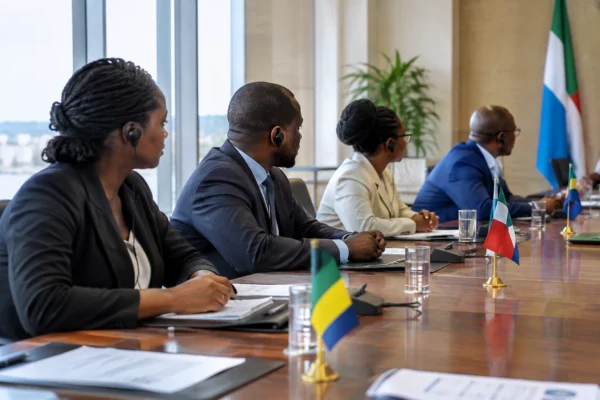
Equatorial Guinea belongs to CEMAC, the Central African Economic and Monetary Community, which also brings together Cameroon and Gabon. This institutional proximity does not guarantee health coordination, but it underlines the value of regional exchanges on surveillance, data and continuity of care at borders. The official overview of CEMAC’s six member states places Equatorial Guinea within this shared space.
Across the continent, the ambition remains demanding. The WHO certifies a country as malaria-free after at least three consecutive years without local transmission, then verifies its ability to prevent the disease’s return. In the WHO African Region, Algeria, Mauritius and Cabo Verde are among the countries certified; the official list distinguishes these certifications from cases where malaria has never existed or has disappeared without specific measures. The WHO register of countries certified malaria-free sets out these criteria.
The next step will therefore be less a slogan than an implementation test: turning the announced funding into regular services, extending vaccination and maintaining reliable data across the whole country. The decline observed on Bioko offers useful experience. Replicating it will nevertheless require sustained resources and cooperation suited to the realities of Central Africa’s borders.